Not enough data yet. Log a session to help build the accuracy score.
This guide was generated from conditions data. Know this spot? Submit your own tips below.
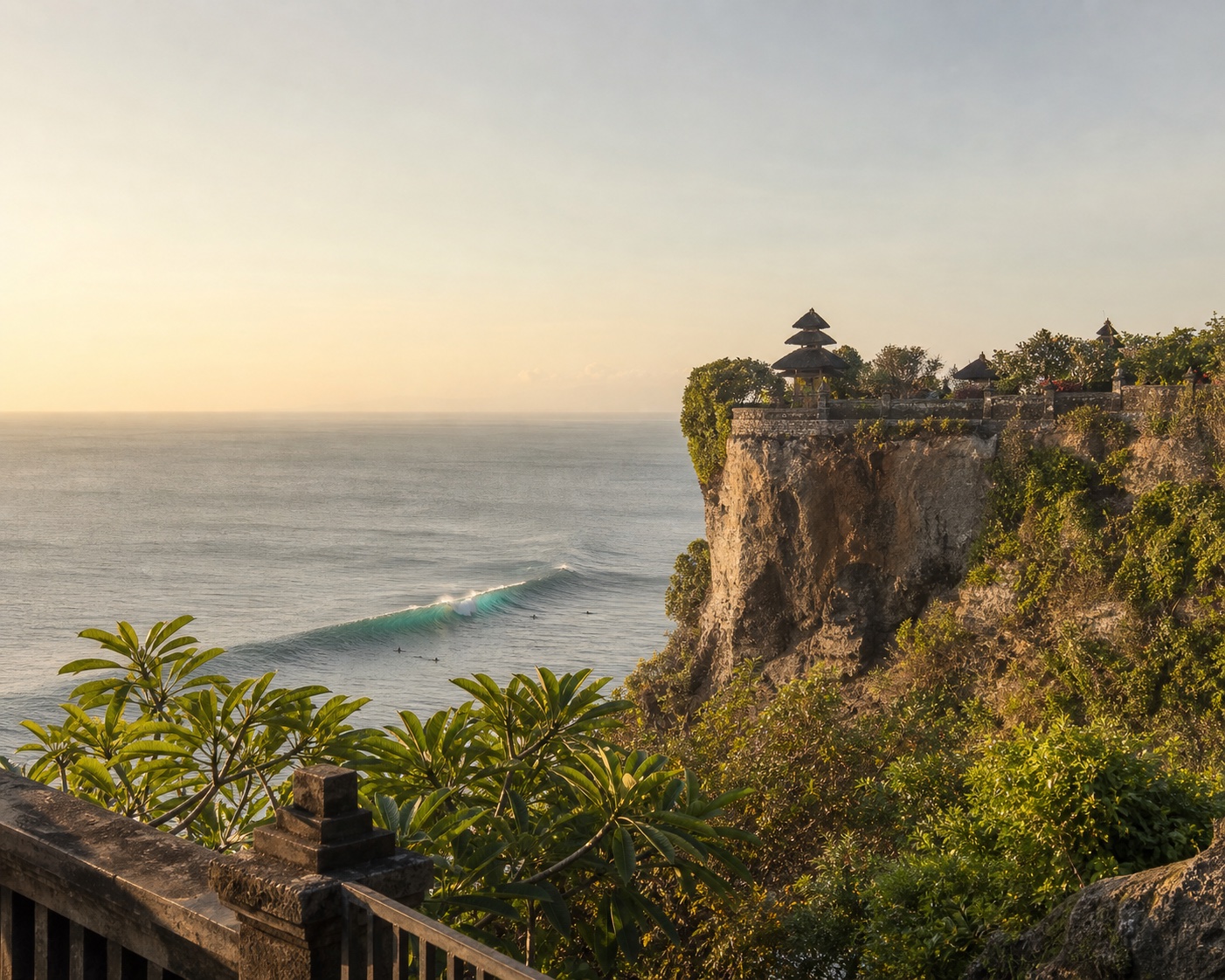
Uluwatu is Bali's most celebrated wave, a complex multi-peaked left-hand reef break at the base of limestone cliffs on the western Bukit Peninsula. The reef extends hundreds of metres offshore, comprising several distinct sections: Outside Corner, Racetracks, The Peak, and The Bombie. When the swell fills in and the trade winds blow offshore, Uluwatu produces long, tapering walls with multiple barrel sections that connect through the various peaks. Access through the cliff cave adds to the wave's legendary status.
The dry season from May through October delivers consistent south-westerly Indian Ocean groundswells with offshore south-easterly trade winds. The wave activates on 3ft swells and handles genuine 12ft-plus days. The trade winds are strongest from June through August, providing all-day offshore grooming. Dawn glass-offs offer the cleanest conditions before the wind kicks in. The wave works across most of the tide range but is shallowest and most hollow at lower tides.
The Peak is the most popular take-off zone, offering defined lefts that peel along the reef. Outside Corner handles the biggest swells and connects through to Racetracks on overhead days. Racetracks is the barrel section where the reef shallows. The take-off at The Peak is beside a distinctive rock formation visible at lower tides. Sit on the outside edge of the reef platform and wait for the sets that swing wide.
The reef is extremely shallow at lower tides with exposed coral throughout. Falls put you directly onto sharp limestone. The cave entry and exit is affected by tides and swell: at high tide the cave fills, and at low tide the reef inside is exposed and sharp. Strong currents sweep along the reef, particularly through the Racetracks section. The cliffs are unstable in sections. Large swells produce powerful hold-downs.
Motorbike parking is available at the cliff-top warungs. Access to the water is via a staircase cut into the limestone cliff, descending approximately 30 metres to the cave at the base. The cave opens onto the reef, where you step across rocks and paddle out through the channel. At certain tides, the cave entrance is partially submerged and requires careful timing. Board dings on the rocks during entry and exit are common.
Uluwatu is Bali's most popular wave and the crowd reflects this. On prime days, expect 50-100 surfers across the various sections. The Peak is the most congested. Outside Corner and Racetracks thin out but require more skill and commitment. The local Balinese crew is exceptional and commands respect in the line-up. Dawn patrol and late afternoon sessions offer the best wave-to-surfer ratios.
The tide dictates which section works best. Lower tides make Racetracks barrel but also expose dangerous reef. Higher tides fatten The Peak but make it safer. Mid-tide on the incoming is the sweet spot for most surfers: enough water depth for safety with sufficient reef interaction for shape. Bring two boards: a standard shortboard for smaller days and a step-up for anything overhead. The cliff-top warungs serve cold Bintang and provide a magnificent vantage point for watching the sets. Respect the Hindu offerings placed at the cave entrance.
No recent check-ins. Be the first to report.
Record your session, conditions and gear.
Based on historical weekly averages
Combining historical conditions with school holiday crowd pressure to find the sweet spot.
How busy each week is based on school holiday overlap from feeder markets.
The timing score combines two signals: historical conditions quality (how good the skiing or surfing typically is in a given week, based on 5 years of weather data) and crowd pressure (how many of this destination's feeder markets have school holidays that week).
Crowd pressure is weighted by each feeder country's share of visitors. If 40% of a resort's visitors come from France and France is on holiday, that contributes 0.40 to the crowd pressure score. Crowds can reduce the timing score by up to 35%, ensuring conditions still matter most.
Scores: 5 = great conditions with low crowds (the sweet spot). 4 = great conditions with moderate crowds, or good conditions with low crowds. 3 = average. 2 = below average conditions or very crowded. 1 = poor conditions or peak holiday chaos.
Last 29 days of logged conditions.
Sign up to save favourite spots and get surf alerts
Create free accountCreate a free profile and let employers in Uluwatu find you.
Create Profile βCurrent conditions refresh every 3 hours when the cron runs. Hourly data updates every 30 minutes. The 7-day forecast, luck factor, and packing notes are all pre-computed at the same time.
We compare the 7-day forecast to the last 5 years of marine data for the same week at Uluwatu. The delta tells you whether conditions are shaping up better, worse, or about the same as a typical mid-June.
We score each day of the 7-day forecast using the same algorithm as the leaderboard, and highlight the highest scorer.
Open-Meteo's Marine API (swell height, period, water temperature) and Weather API (wind and conditions).
Honestly, no. Every break has tide windows, swell directions and reef contours that a global model cannot see. Treat the score as a starting point, then check a local cam.
The best week for surf at Uluwatu is the week of 30 November (score 3/5) with low crowds.
Slim pickings. Only worth it if you are gagging for a wave. Reasonable period putting some grunt behind each wave. Strong offshore, clean but tough to paddle into.
Heads up: thunderstorms forecast, and jellyfish: peak season.
Indicators derived from forecast data, not official warnings. Always check local lifeguard or official advice.
Reduced water clarity: ~3m visibility
Elevated phytoplankton detected, possible algal bloom
Daily scores over the last 12 months at Uluwatu