New Zealand · Australasia
Not enough data yet. Log a session to help build the accuracy score.
This guide was generated from conditions data. Know this spot? Submit your own tips below.
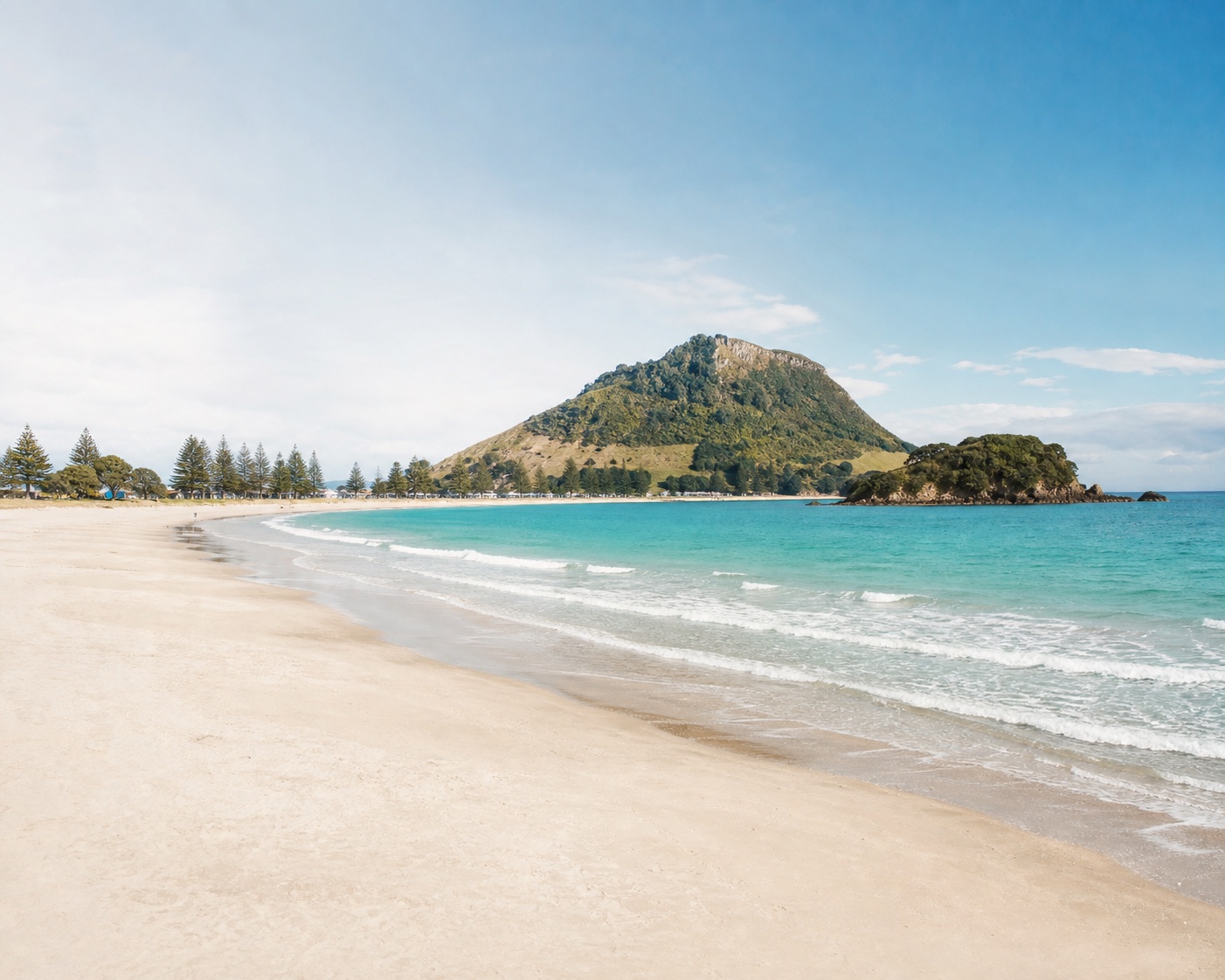
Mount Maunganui, known locally as The Mount, is a gentle beach break at the base of Mauao (a volcanic cone) in New Zealand's Bay of Plenty. The wide, gently sloping sandy beach produces soft, crumbling waves that roll rather than pitch, making it one of New Zealand's premier learning environments. The extinct volcano rising from the beach creates a dramatic backdrop, and the town's cafe culture and relaxed lifestyle have made it a favourite destination for surfers of all levels.
North-easterly wind swells arrive year-round, with occasional Pacific cyclone groundswells from January through April delivering larger, more organised surf. The wave works on 2-5ft of north-east to east swell. South-westerly offshore winds provide clean conditions, most reliable in the early mornings and during approaching cold fronts. The beach's gentle gradient means it handles a wide range of conditions.
The main beach offers multiple peaks along a wide stretch of sand. The area closest to the mount (Moturiki Island end) sometimes produces slightly more defined peaks due to the sand accumulation patterns. Beginners should stay in the whitewater close to shore. More experienced surfers can sit on the outer bars. The surf club provides a useful reference point.
Minimal hazards. The sandy bottom is flat and forgiving. Mild rip currents can develop during bigger swells, particularly near the mount end. The water is cold in winter (13-16C). Bluebottle jellyfish appear occasionally during onshore north-east wind events. The main hazard is other surfers and swimmers in the busy waterway.
Multiple car parks serve the beach along Marine Parade. The beach is flat and fully accessible with multiple entry points. Surf rental and schools operate from the waterfront. Full facilities including cafes, showers, and changing rooms are available. The town is a 3-hour drive from Auckland.
The Mount is popular with both surfers and swimmers. Summer weekends are busy. The wide beach and multiple peaks distribute people effectively. Weekday mornings are quiet. The local community is friendly and welcoming. The standard ranges from beginners to experienced shortboarders.
A longboard or foam board maximises wave count on the gentle faces. The best surf usually arrives with approaching cold fronts from the south-west, when the offshore wind cleans up whatever swell is running. Check the eastern end of the beach first; it often has slightly more shape due to sand dynamics around the base of the mount. A 3/2mm wetsuit covers summer and autumn; a 4/3mm with boots for winter. The walk up Mauao at sunrise provides a stunning perspective on the coastline and incoming swell patterns.
No recent check-ins. Be the first to report.
Record your session, conditions and gear.
Based on historical weekly averages
Combining historical conditions with school holiday crowd pressure to find the sweet spot.
How busy each week is based on school holiday overlap from feeder markets.
The timing score combines two signals: historical conditions quality (how good the skiing or surfing typically is in a given week, based on 5 years of weather data) and crowd pressure (how many of this destination's feeder markets have school holidays that week).
Crowd pressure is weighted by each feeder country's share of visitors. If 40% of a resort's visitors come from France and France is on holiday, that contributes 0.40 to the crowd pressure score. Crowds can reduce the timing score by up to 35%, ensuring conditions still matter most.
Scores: 5 = great conditions with low crowds (the sweet spot). 4 = great conditions with moderate crowds, or good conditions with low crowds. 3 = average. 2 = below average conditions or very crowded. 1 = poor conditions or peak holiday chaos.
Last 29 days of logged conditions.
Sign up to save favourite spots and get surf alerts
Create free accountCreate a free profile and let employers in Mount Maunganui find you.
Create Profile →Current conditions refresh every 3 hours when the cron runs. Hourly data updates every 30 minutes. The 7-day forecast, luck factor, and packing notes are all pre-computed at the same time.
We compare the 7-day forecast to the last 5 years of marine data for the same week at Mount Maunganui. The delta tells you whether conditions are shaping up better, worse, or about the same as a typical mid-June.
We score each day of the 7-day forecast using the same algorithm as the leaderboard, and highlight the highest scorer.
Open-Meteo's Marine API (swell height, period, water temperature) and Weather API (wind and conditions).
Honestly, no. Every break has tide windows, swell directions and reef contours that a global model cannot see. Treat the score as a starting point, then check a local cam.
The best week for surf at Mount Maunganui is the week of 30 November (score 3/5) with low crowds.
Next to nothing in the water. Check back tomorrow. Reasonable period putting some grunt behind each wave. Light offshore grooming the faces nicely.
Heads up: rocks exposed at low tide, and cold-shock risk.
Indicators derived from forecast data, not official warnings. Always check local lifeguard or official advice.
Moderate water clarity: ~7m visibility
Daily scores over the last 12 months at Mount Maunganui