Not enough data yet. Log a session to help build the accuracy score.
This guide was generated from conditions data. Know this spot? Submit your own tips below.
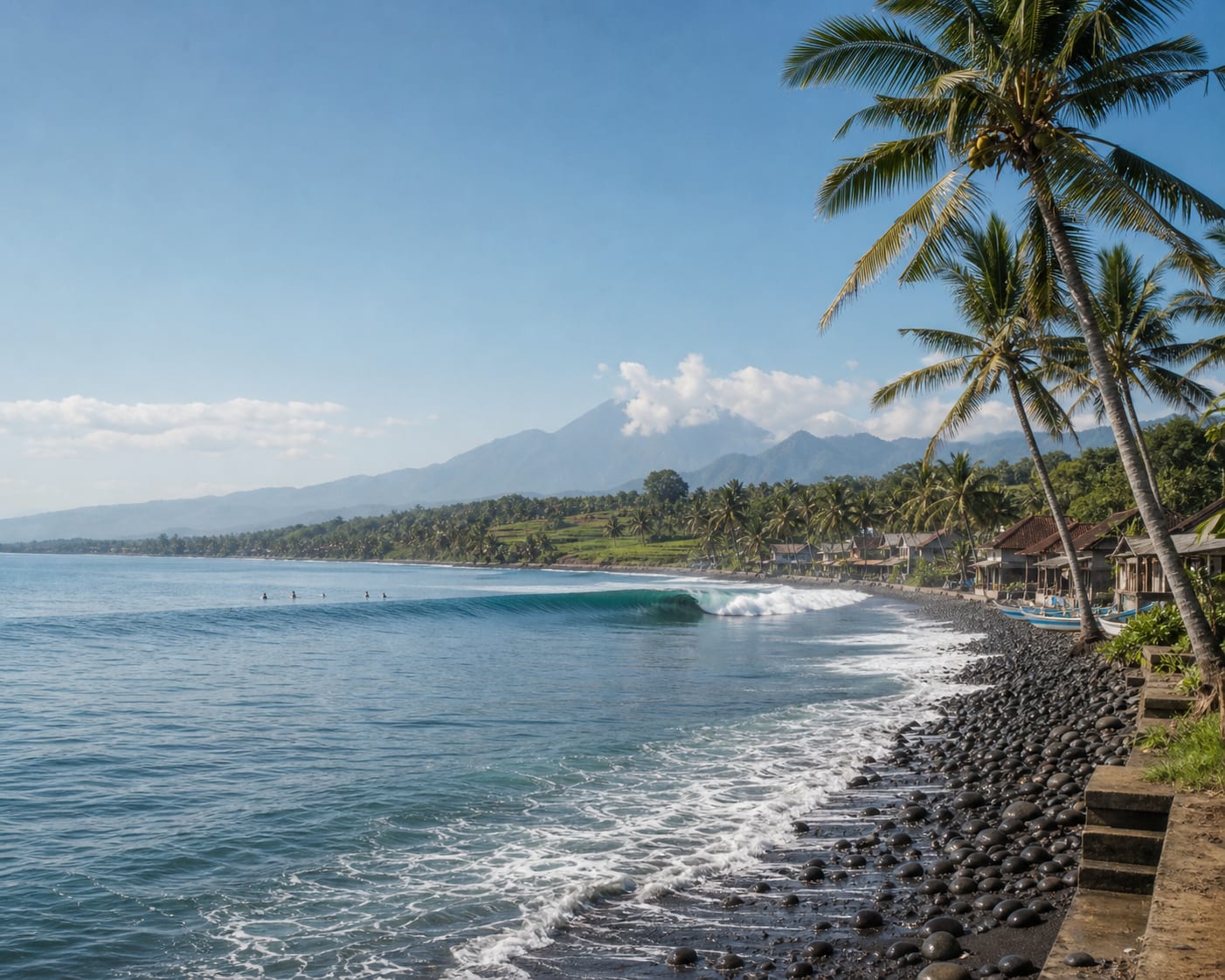
Medewi is Bali's longest wave, a mellow left-hand point break on the island's western coast that rolls endlessly over smooth river cobblestones. Unlike the hollow, consequence-laden breaks of the Bukit Peninsula, Medewi offers a thick, sloping face that peels at a comfortable pace, making it ideal for longboarders and intermediates looking to build confidence on longer rides. The setting is rural Bali at its most authentic: rice paddies, Hindu temples, and a fishing community that predates the surf tourism.
The dry season from May through October delivers the most consistent south-westerly Indian Ocean groundswells. The wave activates on surprisingly small swells (2-3ft) and handles size up to 6-8ft before the sections start closing out. North-easterly offshore winds are standard during the dry season mornings, providing clean conditions until the thermal sea breeze develops around midday. The monsoon season (November-March) brings onshore winds and inconsistent swell.
The take-off zone is at the top of the point where the cobblestones create a defined peak. From here, the wave peels left for 200-300 metres on a good day. The outside section has more push and speed, while the inside gradually fattens. Position yourself at the top of the point and commit to riding as far down the line as the wave allows. The cobblestones create a visible boil in the water that marks the take-off spot.
The cobblestone bottom is the primary concern. Falls in shallow water can result in bruising or twisted ankles on the rounded rocks. The rocks are slippery and the entry requires careful footing. On bigger swells, the current running down the point strengthens and can sweep you further south than intended. The paddle back up the point against the current is tiring after long rides.
Several warungs and small hotels line the road above the break. Motorbike parking is available at the beachfront establishments. The walk from the road to the water crosses a short section of cobblestones. No formal facilities exist at the beach beyond the adjacent warungs offering food and drink. The entry point to the water is well-known and marked by the congregation of surfers.
Medewi is quieter than the Bukit breaks, attracting a mellower crowd of longboarders, mid-length riders, and intermediates. Expect 10-20 surfers on a good day. The length of the wave distributes people naturally. The atmosphere is relaxed and non-competitive. Local Balinese surfers are skilled and friendly. Weekday mornings are the quietest.
Bring a longboard or a wide mid-length. Medewi does not reward aggressive shortboarding; the wave is too slow and fat for it. What it does reward is smooth, flowing trim and drawn-out carving. A single fin or a 2+1 setup generates beautiful speed down the predictable face. The wave is best on a mid to high incoming tide when the water depth softens the cobblestone bottom. Pack booties if you have sensitive feet for the rocky entry. The sunset sessions here are among Bali's most beautiful, with the wave catching golden light as it peels into the evening.
No recent check-ins. Be the first to report.
Record your session, conditions and gear.
Based on historical weekly averages
Combining historical conditions with school holiday crowd pressure to find the sweet spot.
How busy each week is based on school holiday overlap from feeder markets.
The timing score combines two signals: historical conditions quality (how good the skiing or surfing typically is in a given week, based on 5 years of weather data) and crowd pressure (how many of this destination's feeder markets have school holidays that week).
Crowd pressure is weighted by each feeder country's share of visitors. If 40% of a resort's visitors come from France and France is on holiday, that contributes 0.40 to the crowd pressure score. Crowds can reduce the timing score by up to 35%, ensuring conditions still matter most.
Scores: 5 = great conditions with low crowds (the sweet spot). 4 = great conditions with moderate crowds, or good conditions with low crowds. 3 = average. 2 = below average conditions or very crowded. 1 = poor conditions or peak holiday chaos.
Last 29 days of logged conditions.
Sign up to save favourite spots and get surf alerts
Create free accountCreate a free profile and let employers in Medewi find you.
Create Profile βCurrent conditions refresh every 3 hours when the cron runs. Hourly data updates every 30 minutes. The 7-day forecast, luck factor, and packing notes are all pre-computed at the same time.
We compare the 7-day forecast to the last 5 years of marine data for the same week at Medewi. The delta tells you whether conditions are shaping up better, worse, or about the same as a typical mid-June.
We score each day of the 7-day forecast using the same algorithm as the leaderboard, and highlight the highest scorer.
Open-Meteo's Marine API (swell height, period, water temperature) and Weather API (wind and conditions).
Honestly, no. Every break has tide windows, swell directions and reef contours that a global model cannot see. Treat the score as a starting point, then check a local cam.
The best week for surf at Medewi is the week of 30 November (score 3/5) with low crowds.
Slim pickings. Only worth it if you are gagging for a wave. Reasonable period putting some grunt behind each wave. Breezy. Some surface chop to deal with. Best conditions early morning before the sea breeze arrives. Not enough swell to get this spot firing properly.
Heads up: thunderstorms forecast, and jellyfish: peak season.
Indicators derived from forecast data, not official warnings. Always check local lifeguard or official advice.
Good water clarity: ~9m visibility
Daily scores over the last 12 months at Medewi