Not enough data yet. Log a session to help build the accuracy score.
This guide was generated from conditions data. Know this spot? Submit your own tips below.
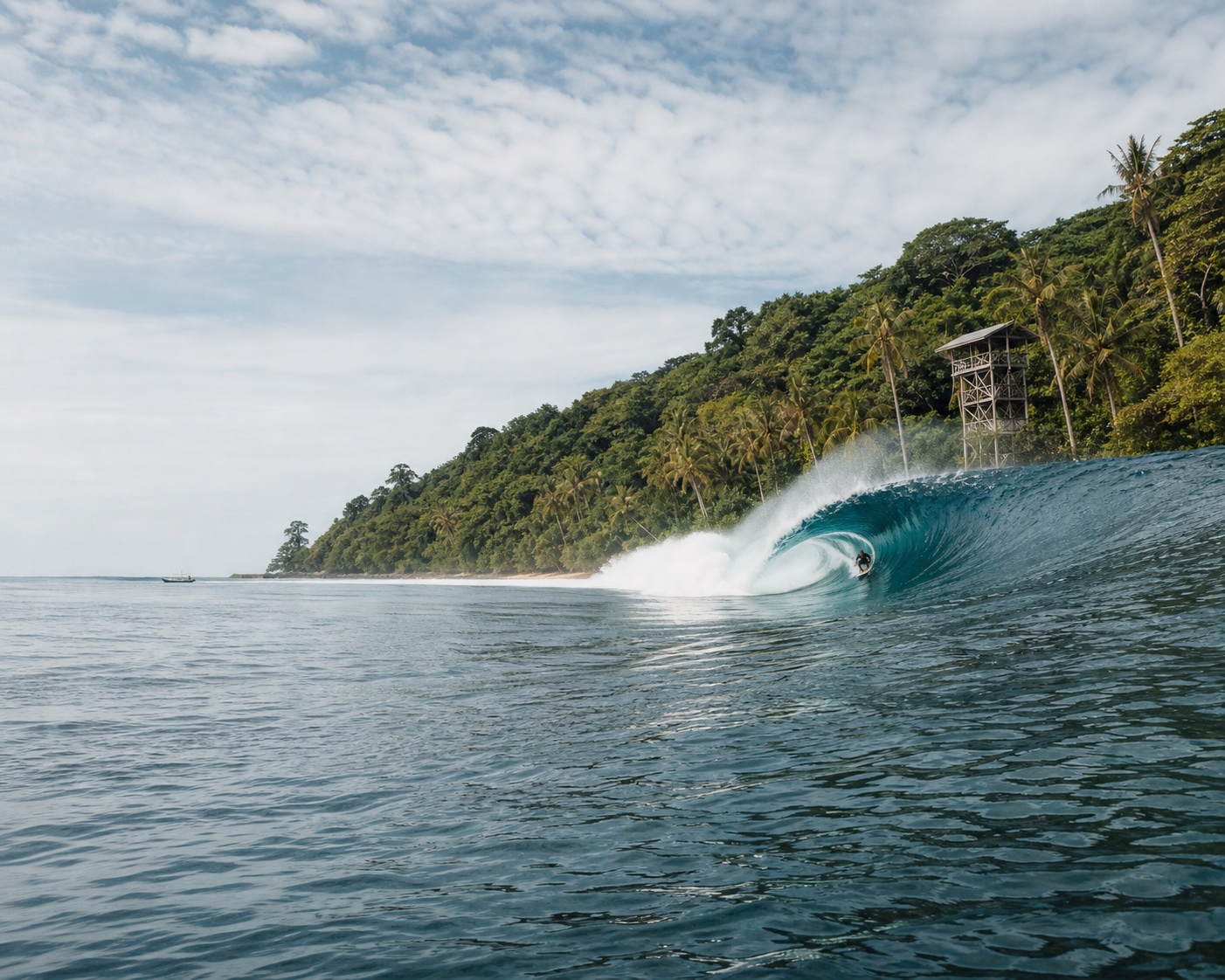
G-Land, Grajagan, is one of surfing's most iconic left-hand reef breaks, situated on the edge of Alas Purwo National Park in East Java. The wave reels along a perfectly aligned volcanic coral reef for hundreds of metres, connecting through three distinct sections: Kongs on the outside, Money Trees in the middle, and Speedies on the inside. Backed by impenetrable jungle teeming with wildlife, G-Land offers a surfing experience that feels genuinely wild and remote despite the established surf camps.
The dry season from April through October delivers consistent south-westerly Indian Ocean groundswells. June through August typically sees the largest and most powerful swells. The wave needs at least 4-6ft to properly activate all sections, and it handles size up to genuine 12ft before becoming too fast to ride. The south-easterly trade wind blows directly offshore, and these are most reliable and consistent during the dry season, providing all-day grooming.
Kongs is the outside section, handling the biggest swells with a steep drop into a long, winding wall. Money Trees is the middle section where the barrel becomes more defined and the reef shallows. Speedies is the inside section and the most intense: a fast, shallow, mechanical barrel that spits violently. On a connecting day, you take off at Kongs and ride through all three sections. The channel between the reef and shore provides entry. Sit on the outside edge of the reef where the water colour shifts from deep blue to turquoise.
The coral reef is extremely shallow and razor-sharp throughout. Wipeouts at Speedies are particularly dangerous due to the minimal water depth and intense wave velocity. The jungle behind the beach harbours venomous snakes, leopards, and wild boar. Strong currents sweep along the reef and can push you into shallower zones. The nearest hospital is hours away by boat and road. Infections from coral cuts develop rapidly in the tropical climate.
Access is by boat from Grajagan village, a journey of approximately one hour through the mangroves and along the coast. Several established surf camps operate on the jungle fringe, providing accommodation and boat transfers. Independent access is theoretically possible through the national park but impractical. Booking a surf camp is the standard approach.
The camps control numbers to some extent, but on prime swells G-Land can see 30-40 surfers spread across the sections. Kongs and Money Trees absorb more bodies due to wider take-off zones. Speedies is naturally limited by the concentrated peak and the consequence of the wave. The camp system creates a social atmosphere on shore, with surfers sharing the lineup camaraderie.
Speedies is significantly heavier than it looks from shore. Watch for a full set cycle from the channel before paddling into the inside section. A step-up board (6'4" to 6'8" for most surfers) handles the speed and power better than a standard shortboard. Reef boots are essential. Bring a comprehensive first aid kit with antiseptic, waterproof dressings, and antibiotics; any coral cut will become infected without immediate treatment. The afternoon trades are relentless and perfect, so don't waste energy fighting the morning crowd when the wind is still variable.
No recent check-ins. Be the first to report.
Record your session, conditions and gear.
Based on historical weekly averages
Combining historical conditions with school holiday crowd pressure to find the sweet spot.
How busy each week is based on school holiday overlap from feeder markets.
The timing score combines two signals: historical conditions quality (how good the skiing or surfing typically is in a given week, based on 5 years of weather data) and crowd pressure (how many of this destination's feeder markets have school holidays that week).
Crowd pressure is weighted by each feeder country's share of visitors. If 40% of a resort's visitors come from France and France is on holiday, that contributes 0.40 to the crowd pressure score. Crowds can reduce the timing score by up to 35%, ensuring conditions still matter most.
Scores: 5 = great conditions with low crowds (the sweet spot). 4 = great conditions with moderate crowds, or good conditions with low crowds. 3 = average. 2 = below average conditions or very crowded. 1 = poor conditions or peak holiday chaos.
Last 29 days of logged conditions.
Sign up to save favourite spots and get surf alerts
Create free accountCreate a free profile and let employers in G-Land find you.
Create Profile βCurrent conditions refresh every 3 hours when the cron runs. Hourly data updates every 30 minutes. The 7-day forecast, luck factor, and packing notes are all pre-computed at the same time.
We compare the 7-day forecast to the last 5 years of marine data for the same week at G-Land. The delta tells you whether conditions are shaping up better, worse, or about the same as a typical mid-June.
We score each day of the 7-day forecast using the same algorithm as the leaderboard, and highlight the highest scorer.
Open-Meteo's Marine API (swell height, period, water temperature) and Weather API (wind and conditions).
Honestly, no. Every break has tide windows, swell directions and reef contours that a global model cannot see. Treat the score as a starting point, then check a local cam.
The best week for surf at G-Land is the week of 30 November (score 3/5) with low crowds.
Rideable waves with moderate energy. Reasonable period putting some grunt behind each wave. Breezy. Some surface chop to deal with. Best conditions early morning before the sea breeze arrives.
Heads up: thunderstorms forecast, and rip risk elevated.
Indicators derived from forecast data, not official warnings. Always check local lifeguard or official advice.
Crystal clear water: ~17m visibility
Daily scores over the last 12 months at G-Land