Mexico Β· Central America
Not enough data yet. Log a session to help build the accuracy score.
This guide was generated from conditions data. Know this spot? Submit your own tips below.
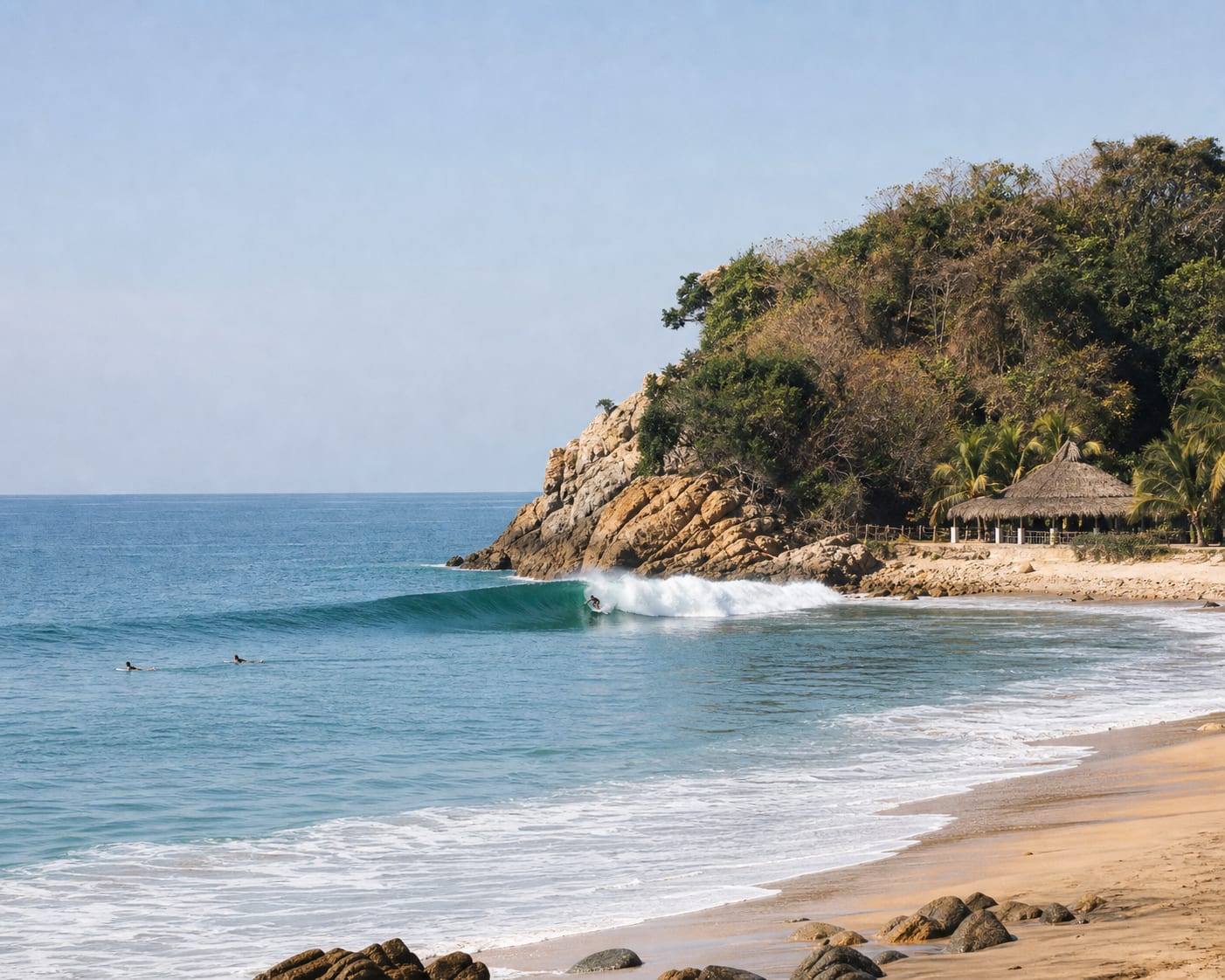
Barra de la Cruz is a legendary right-hand point break in Oaxaca, southern Mexico, where river-deposited sand fills the gaps in a rocky reef to create an impeccably smooth, mechanical wave. The point produces flawless, peeling rights that combine deep barrel sections with steep carving walls, running for hundreds of metres when conditions align. The wave quality is so exceptional it has appeared on the professional tour schedule. The indigenous Zapotec community manages access to the break.
South-westerly Pacific groundswells from May through October deliver the goods, with the largest and cleanest swells typically arriving in July and August. The wave needs at least 4-6ft of swell to properly activate the full length of the point. Northerly offshore winds groom the faces, most reliable in the early mornings before the thermal sea breeze develops. The river must have deposited sand recently for the reef to produce its perfectly smooth bottom contour.
The take-off zone sits at the top of the point close to the exposed rock headland. The wave peels right for 200-300 metres along the sand-filled reef, with barrel sections forming where the bottom shallows. Position yourself tight to the rocks at the top of the point for the longest potential ride. The deep-water channel adjacent to the headland provides the paddle-out.
The exposed rock at the top of the point is sharp and the take-off is critical. The wave breaks rapidly down the line and getting caught behind a section drives you onto shallow reef. Strong currents develop on bigger swells. The remote location means medical facilities are distant. The entrance fee system is managed by the local community and must be respected.
Access is via a dirt road from the highway, controlled by the local Zapotec community who charge an entrance fee (currently around $5-10 USD per person). Parking is available near the beach. The community provides basic facilities and food. Accommodation in the village is limited to a few simple cabanas. Puerto Escondido is the nearest town with full services (1.5 hours' drive).
The entrance fee and remote location limit numbers somewhat. On good swells, expect 15-25 surfers, a mix of Mexican locals and travelling surfers. The concentrated take-off zone makes the crowd feel significant. The local community is welcoming but expects their management system to be respected. Dawn sessions before other visitors arrive offer the best ratios.
The wave changes character significantly depending on recent river activity. After heavy rains, the river deposits fresh sand that fills the reef perfectly, creating the smoothest barrel sections. During dry periods, rocks become exposed and the wave is less consistent. A step-up board handles the speed and power of the bigger days. Respect the community's access system absolutely; they have the right to close the spot. Bring cash for the entrance fee and food purchases.
No recent check-ins. Be the first to report.
Record your session, conditions and gear.
Based on historical weekly averages
Combining historical conditions with school holiday crowd pressure to find the sweet spot.
How busy each week is based on school holiday overlap from feeder markets.
The timing score combines two signals: historical conditions quality (how good the skiing or surfing typically is in a given week, based on 5 years of weather data) and crowd pressure (how many of this destination's feeder markets have school holidays that week).
Crowd pressure is weighted by each feeder country's share of visitors. If 40% of a resort's visitors come from France and France is on holiday, that contributes 0.40 to the crowd pressure score. Crowds can reduce the timing score by up to 35%, ensuring conditions still matter most.
Scores: 5 = great conditions with low crowds (the sweet spot). 4 = great conditions with moderate crowds, or good conditions with low crowds. 3 = average. 2 = below average conditions or very crowded. 1 = poor conditions or peak holiday chaos.
Last 29 days of logged conditions.
Sign up to save favourite spots and get surf alerts
Create free accountCreate a free profile and let employers in Barra de la Cruz find you.
Create Profile βCurrent conditions refresh every 3 hours when the cron runs. Hourly data updates every 30 minutes. The 7-day forecast, luck factor, and packing notes are all pre-computed at the same time.
We compare the 7-day forecast to the last 5 years of marine data for the same week at Barra de la Cruz. The delta tells you whether conditions are shaping up better, worse, or about the same as a typical mid-June.
We score each day of the 7-day forecast using the same algorithm as the leaderboard, and highlight the highest scorer.
Open-Meteo's Marine API (swell height, period, water temperature) and Weather API (wind and conditions).
Honestly, no. Every break has tide windows, swell directions and reef contours that a global model cannot see. Treat the score as a starting point, then check a local cam.
The best week for surf at Barra de la Cruz is the week of 30 November (score 3/5) with low crowds.
Quality groundswell hitting the coast. Reasonable period putting some grunt behind each wave. Light cross-shore texture but very manageable. Best conditions early morning before the sea breeze arrives.
Heads up: jellyfish: peak season, and rip risk elevated.
Indicators derived from forecast data, not official warnings. Always check local lifeguard or official advice.
Crystal clear water: ~20m visibility
Daily scores over the last 12 months at Barra de la Cruz