Open ledger · AOD.SKI.V00 · ORIGINALClose ledger · AOD.SKI.V00
Ledger AOD.SKI.V00
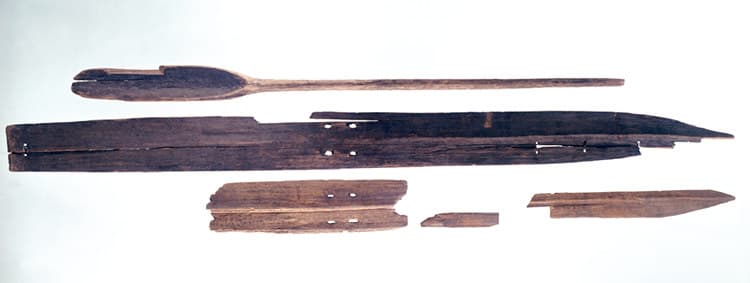
Kalvträskskidan
A pine ski found with a second ski and pole near Kalvträsk in 1924.
- Visual description
- Long prehistoric pine ski displayed beside associated ski fragments and a wooden pole.
- Nature
- original
- Made
- Object found in 1924; photograph date and creator not recorded on the object page
- Medium
- Museum object photograph
- Source
- Västerbottens Museum · CC BY 4.0 displayed by the object record; applicability to the photograph pending reviewLive retrieval timed out, so the reviewed local derivative used the exact 6 February 2026 Internet Archive capture of the same museum file. Awaiting confirmation that the displayed licence covers the exact photograph and confirmation of the required creator credit.
BEFORE THE SURVIVING RECORD
Skiing
The oldest way through winter became a way to fly.
Scroll to follow the tracks through time
Before it was a sport, snow was a problem of distance.
The surviving evidence is scattered. Wooden objects and written traces endure in Norway; the pine skis found near Kalvträsk are dated by the museum to about 5,400 years ago; rock art in the Chinese Altai has been interpreted as showing skiers. These are different kinds of evidence, separated by place, time and certainty.
No one trace can carry the whole beginning. The honest starting point is a human need repeated across deep winter: spread weight over snow, keep moving and leave a line where there was none.
Open ledger · AOD.SKI.V01 · ORIGINALClose ledger · AOD.SKI.V01
Ledger AOD.SKI.V01
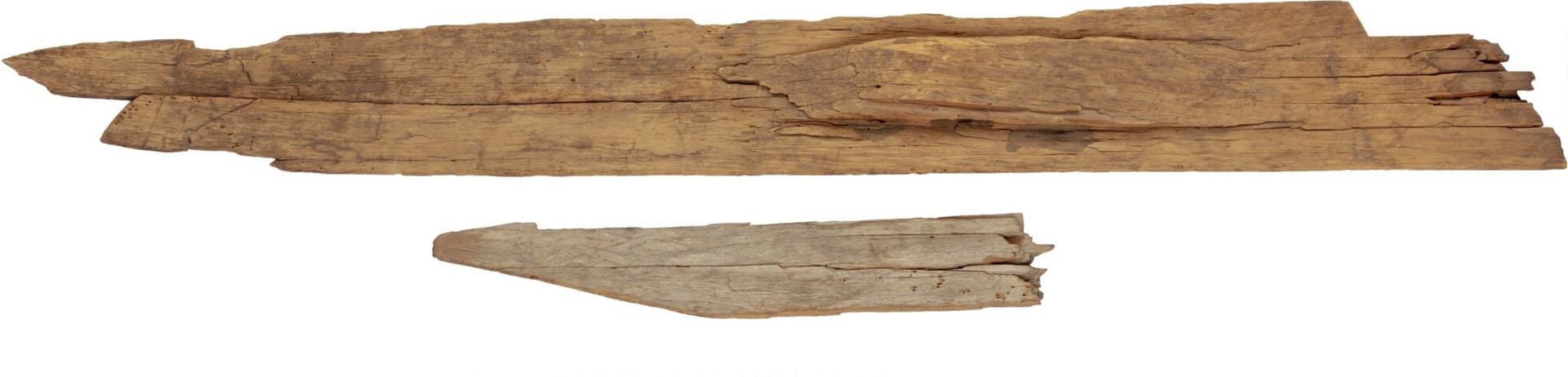
Ski
A decorated wooden ski found in a bog at Bastusund in northern Sweden.
- Visual description
- Fragmented wooden ski with a raised footboard, pointed nose and incised decoration.
- Nature
- original
- Medium
- Museum object photograph
- Source
- Swedish History Museum · CC BY 4.0 candidate; final attribution review pendingPhotograph credited on the candidate record to Jens Mohr, Historiska museet/SHM. Awaiting a saved licence record and final attribution review.
ANCIENT WINTERS
The technology of survival
A ski meant access to food, work and a road across winter.
Archaeological context, wear and comparison connect early skis with travel and hunting. Local timber spread a traveller's weight. Some regional systems used unequal lengths: a long gliding ski and a shorter ski faced with animal skin for grip and propulsion.
There was no universal kit. Some traditions kept the use of one long pole while two-pole use also appears in the historical record. Materials and forms answered local snow, terrain and work rather than following one neat sequence.
Open ledger · AOD.SKI.V02 · ILLUSTRATIONClose ledger · AOD.SKI.V02
Ledger AOD.SKI.V02
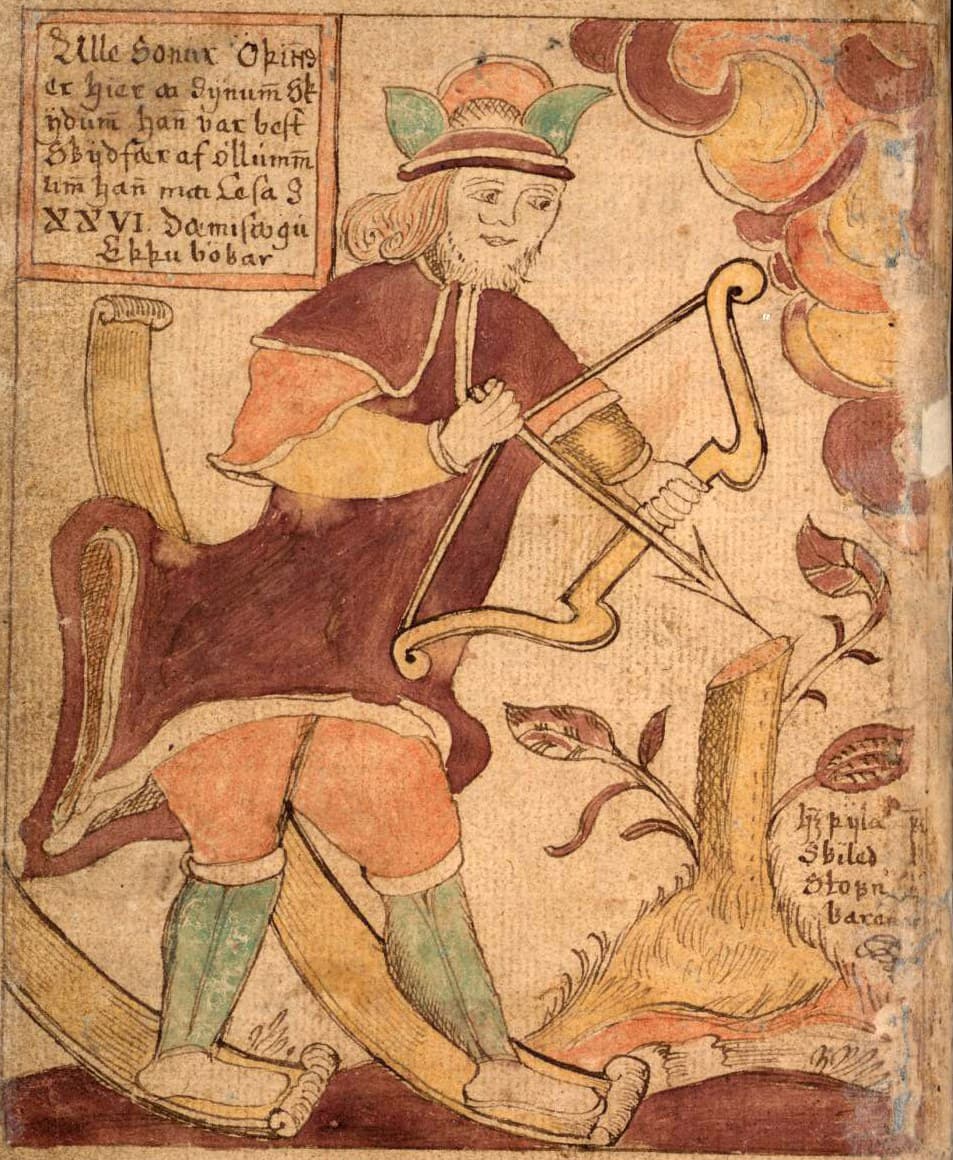
Ullr
Ull on skis with a bow in an Icelandic manuscript of 1765 to 1766.
- Visual description
- Eighteenth-century manuscript illustration of Ull travelling on skis and carrying a bow.
- Nature
- illustration
- Made
- Illustrated in 1765 or 1766
- Medium
- Manuscript illustration
- Source
- Árni Magnússon Institute, Iceland · Public-domain marking on the exact SNL image record; final jurisdiction review pendingJakob Sigurðsson created the manuscript illustration. Skadinaujo is separately credited for image processing: crop, rotation and colour levels. This image postdates the medieval texts by centuries and is not evidence of prehistoric belief.
CULTURAL MEMORY
Gods, hunters and winter stories
Winter travel entered imagination as well as tracks.
Norse sources associate Skaði with mountains, hunting and skiing, and Ull with skis and the bow. Their stories place movement through snow inside cultural memory, where skill could belong to gods as well as hunters.
Sources for this chapter
Open ledger · AOD.SKI.V03 · ORIGINALClose ledger · AOD.SKI.V03
Ledger AOD.SKI.V03
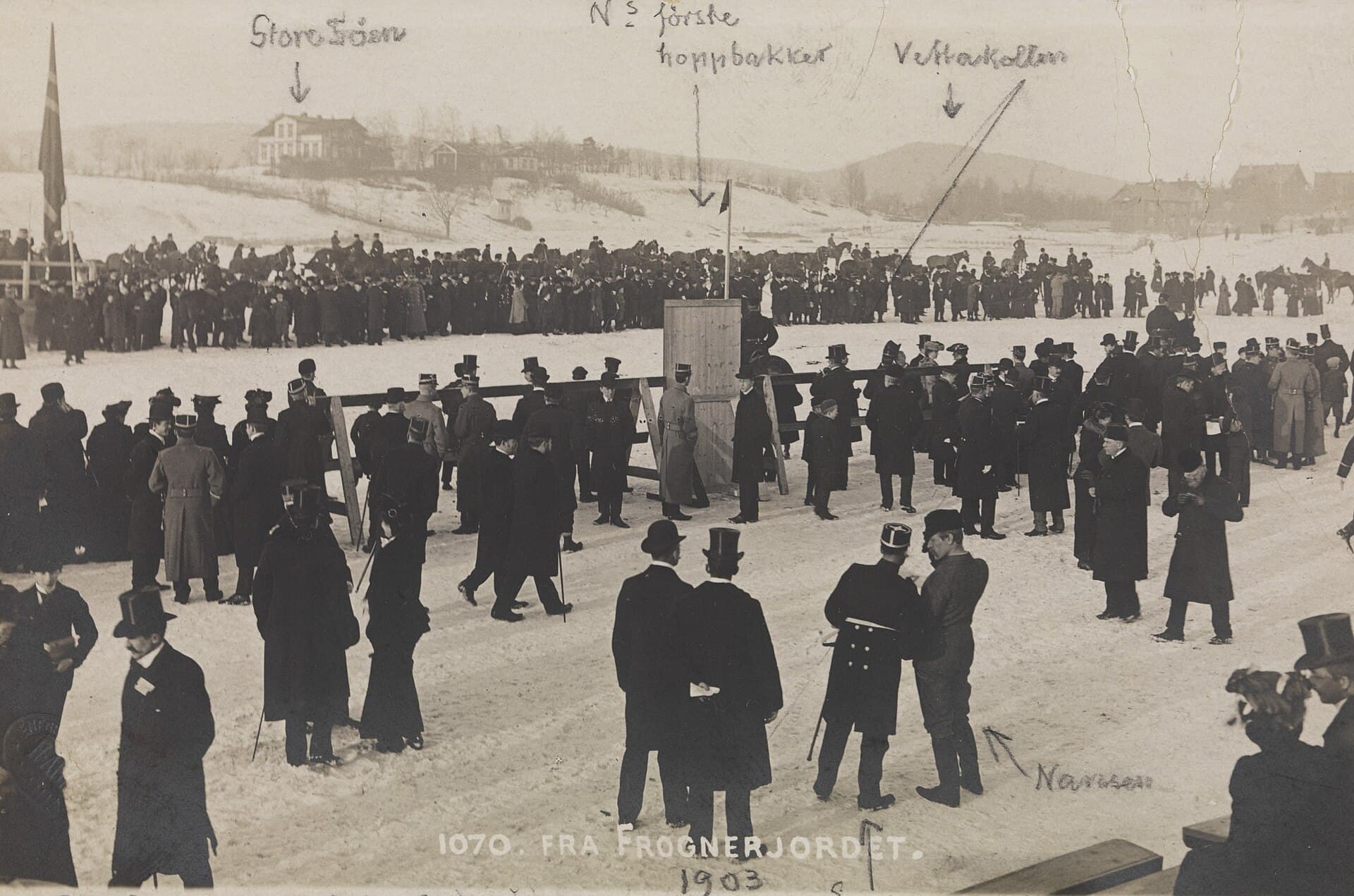
Skiing competition at Frogner Field during Wintersports Week
A ski competition at Frogner Field before 1903, with organiser Fridtjof Nansen in the foreground.
- Visual description
- Crowd and competitors gathered on a snowy field while two men speak in the foreground.
- Nature
- original
- Made
- Photographed before 1903 by Hans Holtermann Abel
- Medium
- Historic photograph
- Source
- National Library of Norway · Public domain in Norway; United States status is conditional on the image having been public domain in Norway on 1 January 1996 with no US registration, pending jurisdiction reviewThe date follows the formal file record. This documents one organised event and is not a claim for the first ski competition.
1700s
From survival to measured skill
A useful skill became something people could compare.
Later military exercises in the eighteenth century put skiing inside measured tests. Local contests and civilian clubs followed without erasing the older work of travel and hunting.
The first known civilian race in the surviving Norwegian record was held at Tromsø in 1843. 'Known' matters: the archive records institutionalisation, not the first time skiers challenged one another.
Sources for this chapter
Open ledger · AOD.SKI.V04 · ILLUSTRATIONClose ledger · AOD.SKI.V04
Ledger AOD.SKI.V04
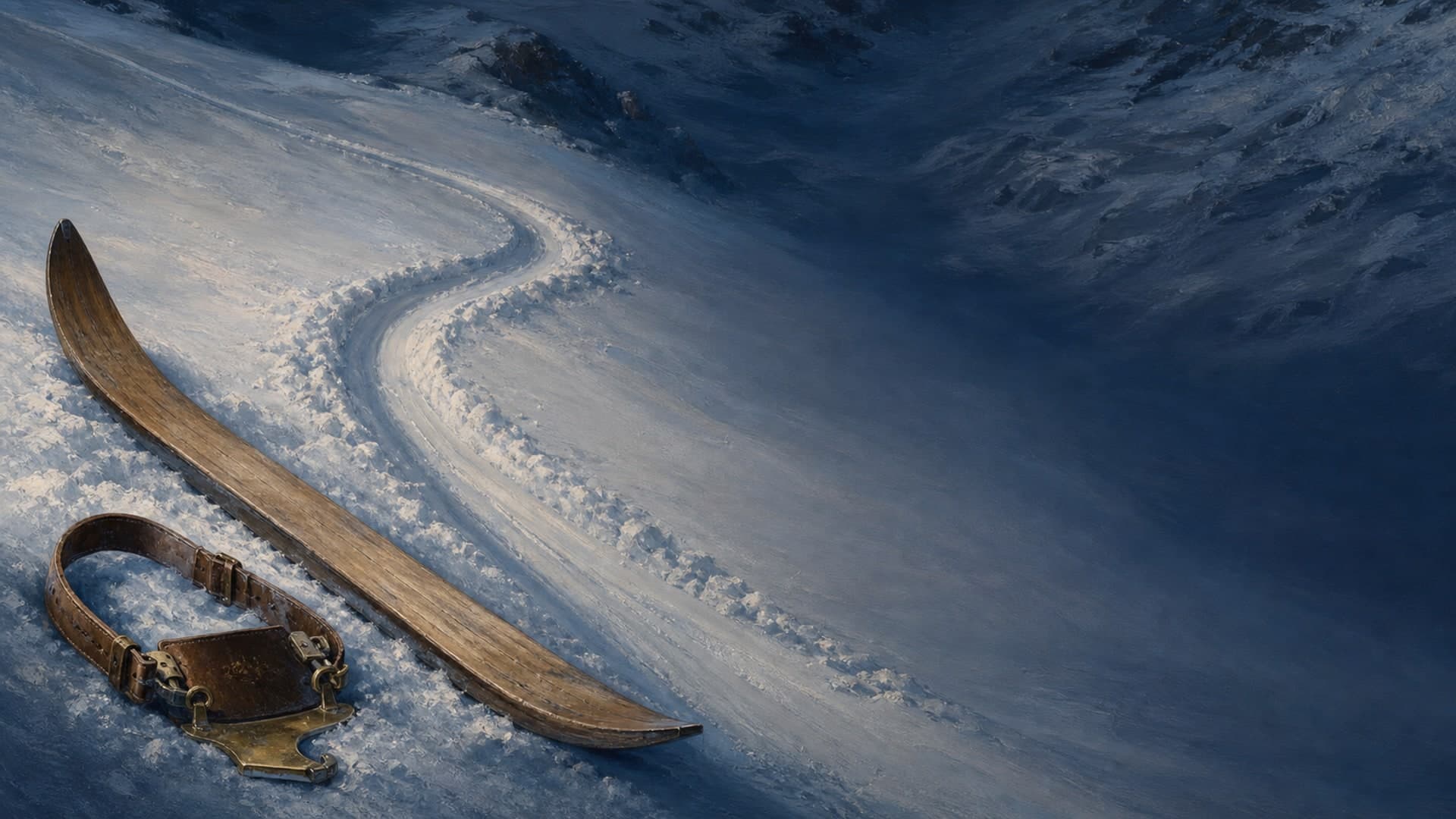
The controlled turn
Bindings, shaped skis and practised technique improved control in descent.
- Visual description
- Paired carved ski tracks beside details of a heel strap and waisted ski profile.
- Nature
- illustration
- Made
- Created for The Archive of Days in 2026
- Medium
- AI-assisted digital illustration, art-directed by PeakWave
- Source
- PeakWave original illustration · No licence clearance recordedOriginal interpretive illustration, not historical evidence. Awaiting final visual and rights review.
1800s
The turn changes everything
The descent became a line a skier could choose.
In nineteenth-century Telemark, more secure heel attachment, shaped skis and practised linked turns made control on descent more capable. Sondre Norheim's 1868 competition success helped carry those techniques to a wider audience.
The turn did not begin with one man. Sidecut existed before Norheim, and other skiers developed the bindings, shapes and techniques around him. His documented influence is substantial without the later 'father' and 'cradle' mythology.
Open ledger · AOD.SKI.V05 · ILLUSTRATIONClose ledger · AOD.SKI.V05
Ledger AOD.SKI.V05
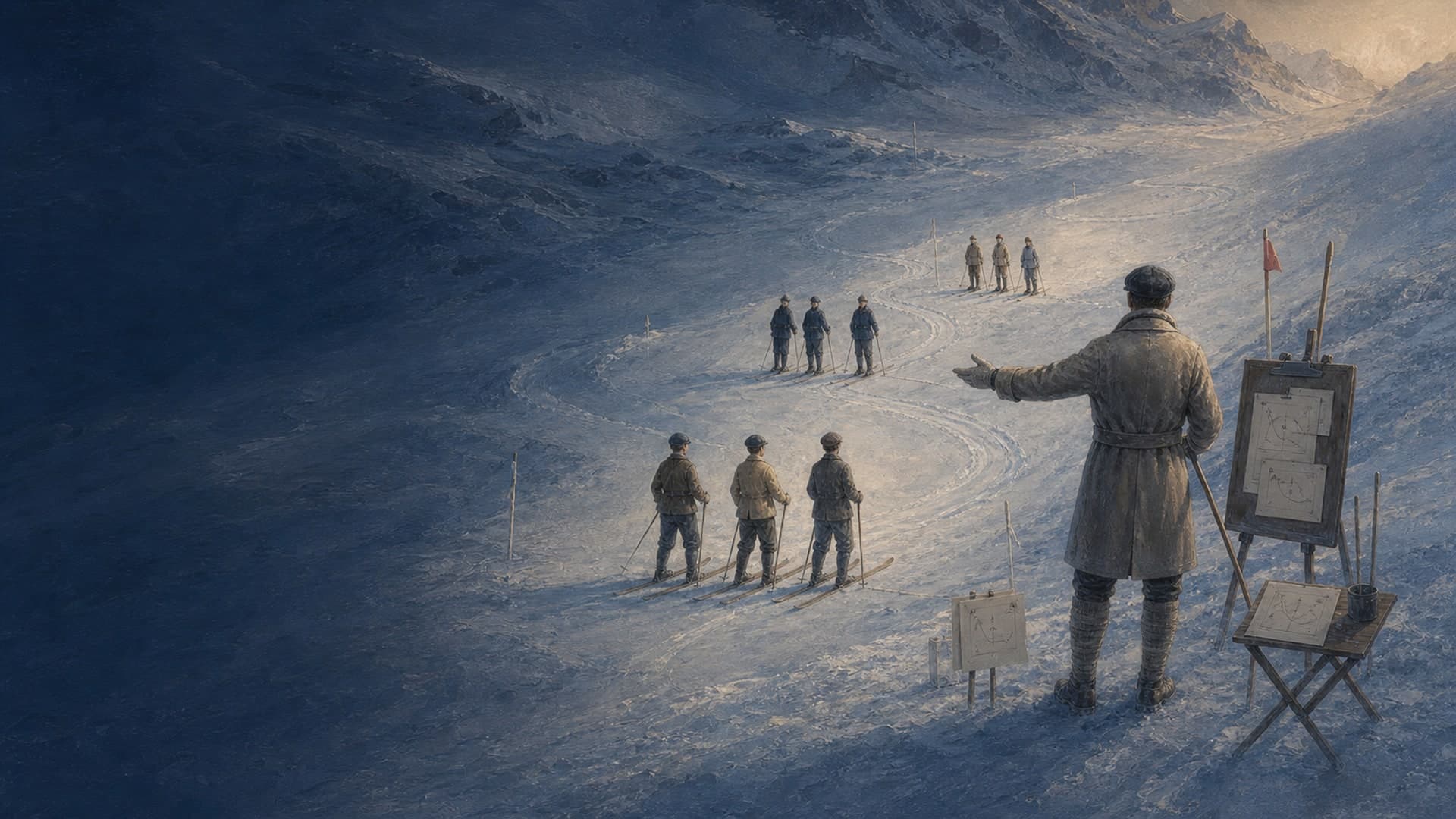
A lesson becomes a system
Ability groups, teacher guidance and collaboration helped organise Alpine instruction.
- Visual description
- Instructor arranging three pupil groups beside shared lesson cards and technique notes.
- Nature
- illustration
- Made
- Created for The Archive of Days in 2026
- Medium
- AI-assisted digital illustration, art-directed by PeakWave
- Source
- PeakWave original illustration · No licence clearance recordedOriginal interpretive illustration, not historical evidence. Awaiting final visual and rights review.
1880s TO 1930s
The Alps learn to ski
A travelling technology met steeper ground and had to change.
Alpine skiing grew through clubs, guides, teachers and visitors, with competing systems shaped by terrain and equipment. No school acted alone. Hannes Schneider became a leading systematiser of instruction at Arlberg, grouping pupils by ability and training teachers within work developed with collaborators including Rudolf Gomperz.
British organisers including Arnold Lunn helped formalise downhill and slalom rules. Their role belongs to international competition, not to a claim that visitors created Alpine skiing.
Open ledger · AOD.SKI.V06 · ILLUSTRATIONClose ledger · AOD.SKI.V06
Ledger AOD.SKI.V06
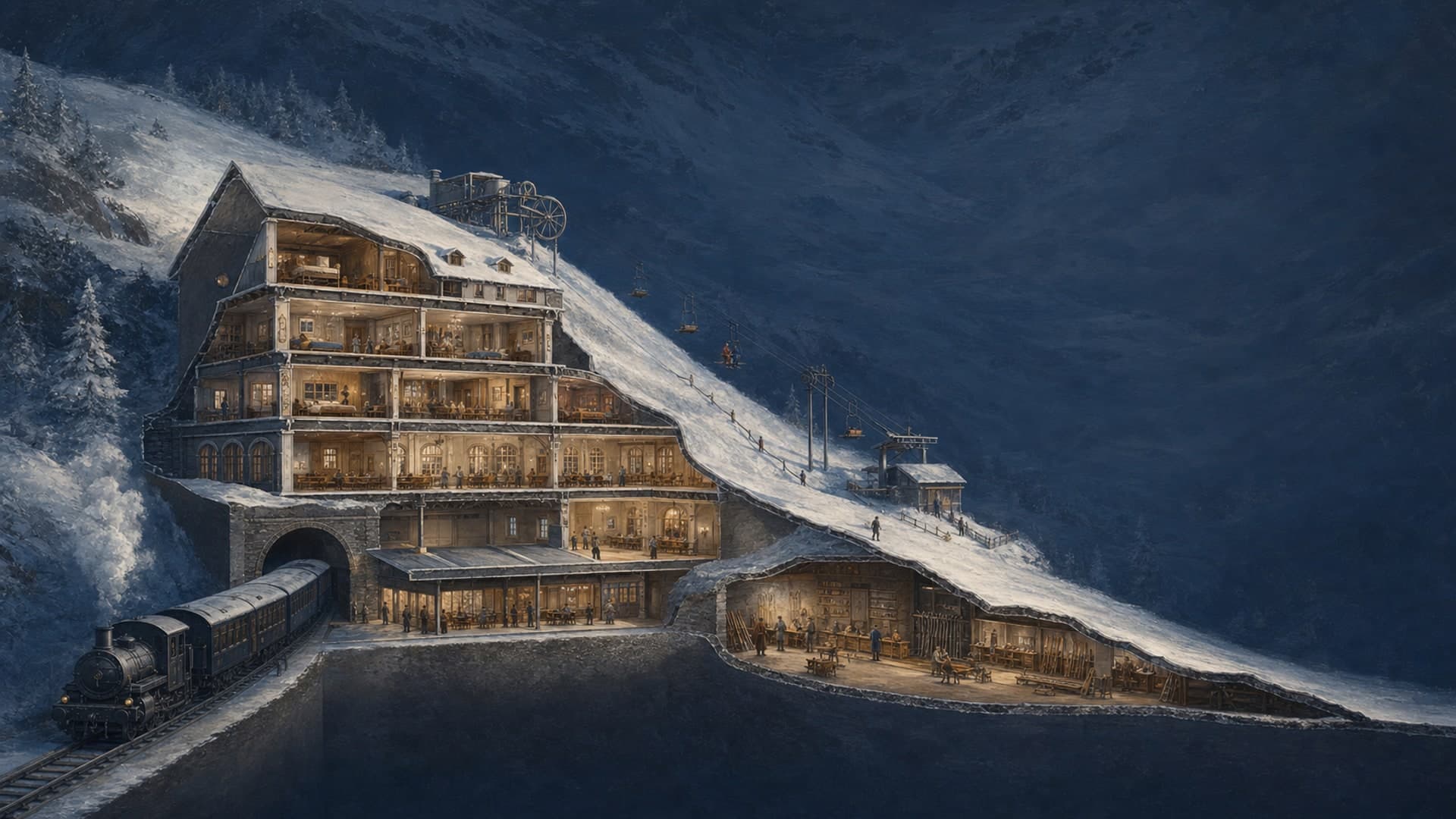
The mountain holiday
A mountain resort cross-section links rail access, hotel interiors, ski teaching, equipment and uplift.
- Visual description
- Architectural cross-section cutaway showing a train beneath a hotel, public interiors and a ski teaching and equipment space linked to a chairlift.
- Nature
- illustration
- Made
- Created for The Archive of Days in 2026
- Medium
- AI-assisted digital illustration, art-directed by PeakWave
- Source
- PeakWave original illustration · No licence clearance recordedOriginal interpretive illustration, not historical evidence. Awaiting final visual and rights review.
1900s TO 1970s
A mountain becomes a playground
The mountain holiday was built, connection by connection.
In some Alpine settlements, railways, hotels, ski schools, marked runs and mechanical uplift made repeated downhill recreation easier to reach. Post-war prosperity widened participation in places such as Switzerland, though neither the timetable nor the experience was universal.
Elsewhere, access grew through different institutions. Clubs, huts and volunteer labour supported organised skiing around New Zealand's Mount Ruapehu, where Glacier Hut became part of an early ski network.
Infrastructure brought pleasure, livelihoods and shared mountain culture. It also concentrated skiing around constructed corridors and changed the economies and landscapes that held them.
Open ledger · AOD.SKI.V07 · ILLUSTRATIONClose ledger · AOD.SKI.V07
Ledger AOD.SKI.V07
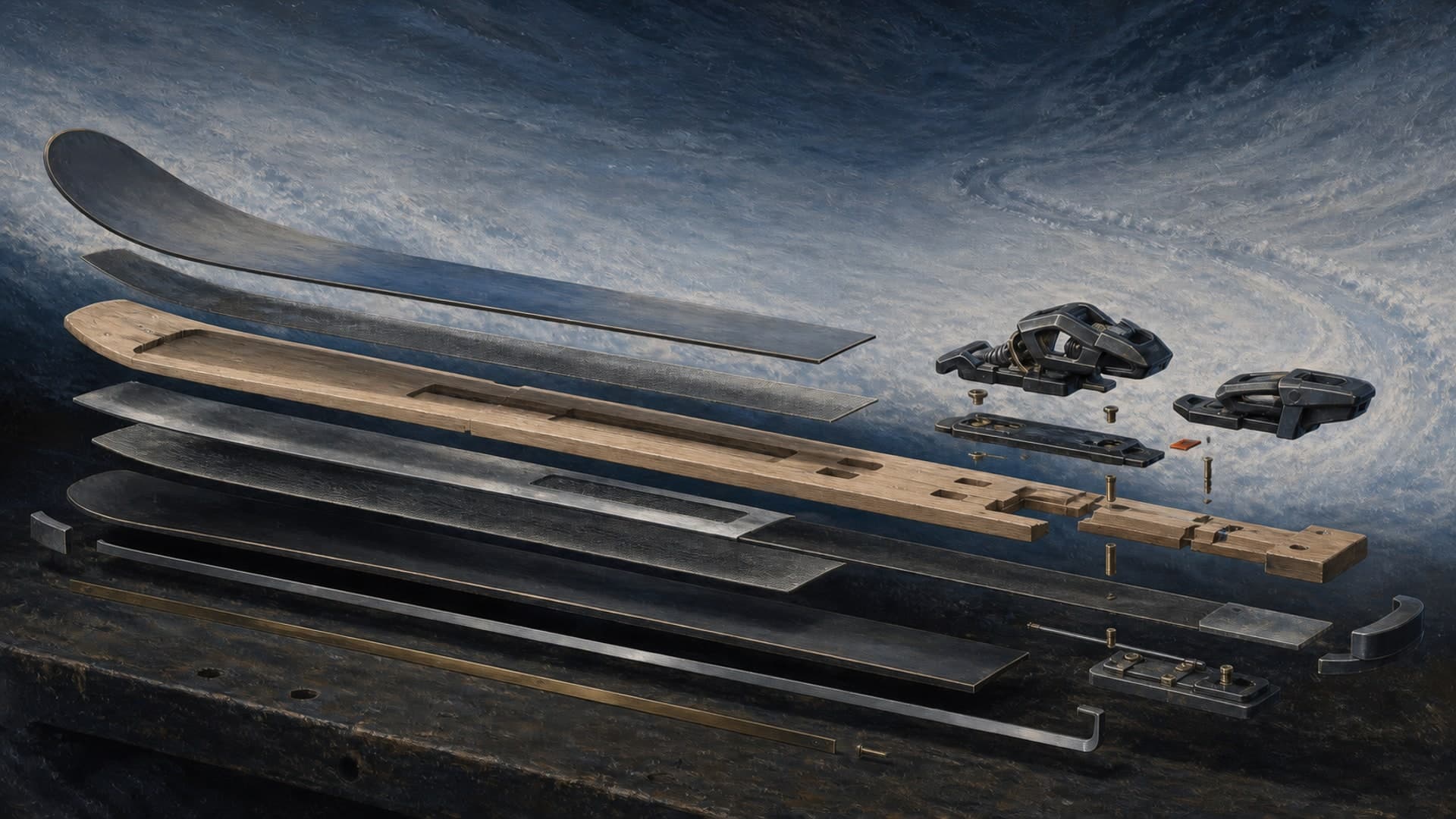
Anatomy of a ski
Modern skis combine specialised cores, laminates, bases, edges, bindings and geometry.
- Visual description
- Exploded ski cutaway showing wood core, laminates, edge, base and binding.
- Nature
- illustration
- Made
- Created for The Archive of Days in 2026
- Medium
- AI-assisted digital illustration, art-directed by PeakWave
- Source
- PeakWave original illustration · No licence clearance recordedOriginal interpretive illustration, not historical evidence. Awaiting final visual and rights review.
MATERIAL EVOLUTION
The ski bench
Every layer answers snow, force and the skier's intention.
Equipment history is not a queue in which each new ski makes the last one vanish. Constructions overlap, move between workshops and specialise for different kinds of movement.
Workshop sequence
The ski bench
Early travel
Solid wood
- Construction change
- Local timber was shaped into a broad running surface.
- Problem solved
- Weight needed to spread across soft snow.
- Skiing consequence
- Winter travel, hunting and work could cover greater distances.
Laminated construction
Combined wood strips
- Construction change
- Several pieces of wood supplemented one solid plank.
- Problem solved
- Builders could balance strength and flexibility.
- Skiing consequence
- Construction became more adaptable without one universal replacement date.
Interwar transition
Metal edges
- Construction change
- Durable edges supplemented exposed wooden running edges.
- Problem solved
- Grip and wear on hard snow demanded a tougher contact surface.
- Skiing consequence
- Skiers gained more dependable control on firm pistes.
Composite experiments
Wood-metal and fibreglass laminates
- Construction change
- Layered materials joined and sometimes supplemented all-wood construction.
- Problem solved
- Strength, torsion and mass could be tuned separately.
- Skiing consequence
- Skis could be built towards more specialised uses.
Mature safety systems
Release bindings
- Construction change
- Binding, boot and ski became a testable retention and release system.
- Problem solved
- A binding had to hold during skiing yet release under defined loads.
- Skiing consequence
- Recreational Alpine equipment gained repeatable safety criteria.
Discipline-specific design
Cores, bases, edges and sidecut
- Construction change
- Geometry and layered assemblies became increasingly purpose-specific.
- Problem solved
- Turning style, terrain and snow place different demands on one ski.
- Skiing consequence
- Shape became part of how a ski initiates turns, floats or tracks.
Open ledger · AOD.SKI.V08 · ILLUSTRATIONClose ledger · AOD.SKI.V08
Ledger AOD.SKI.V08
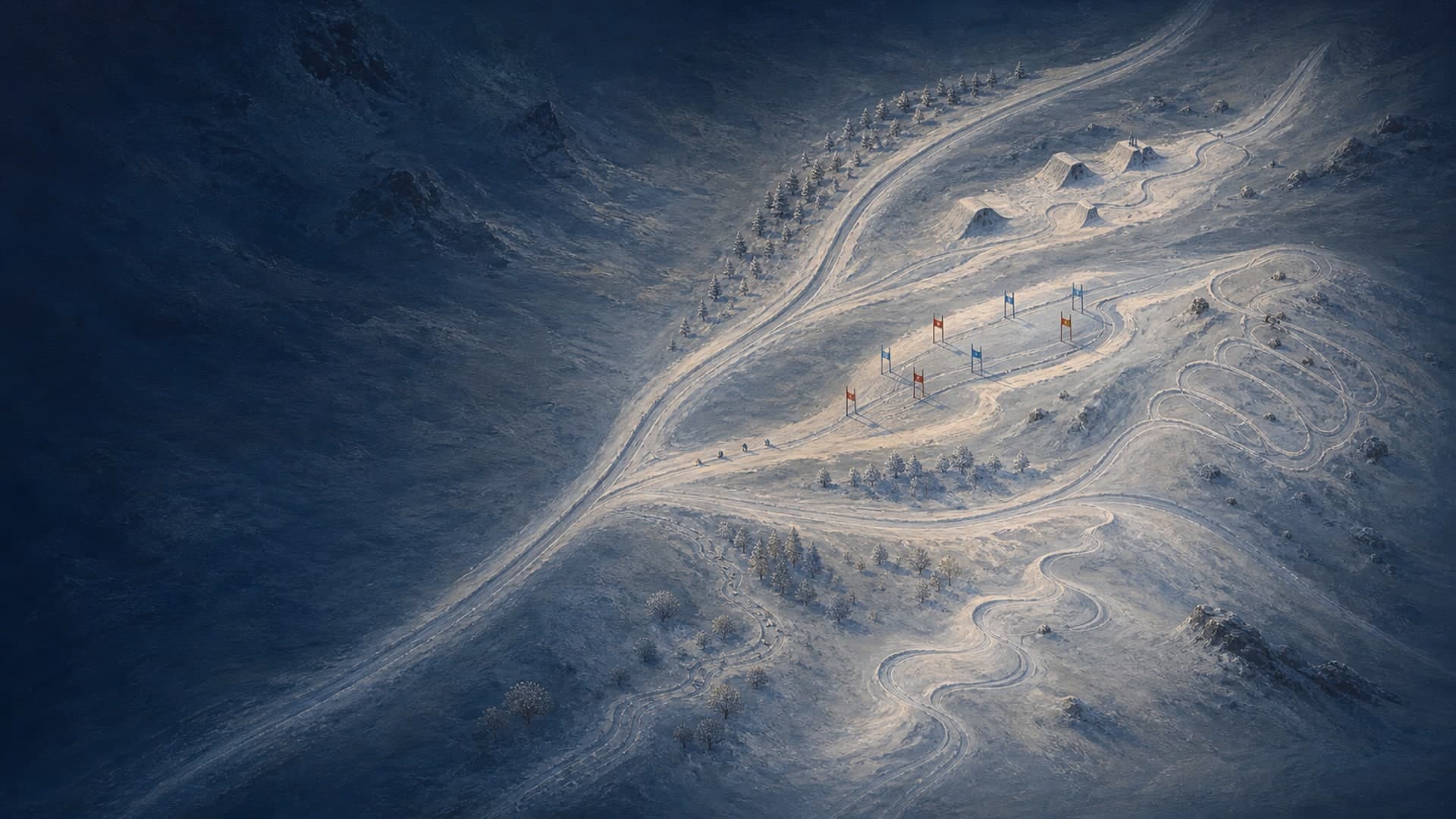
Ways through snow
Skiing branches into distinct disciplines, journeys and competition formats.
- Visual description
- Branching snow tracks representing Nordic, Alpine, biathlon, touring and freestyle disciplines.
- Nature
- illustration
- Made
- Created for The Archive of Days in 2026
- Medium
- AI-assisted digital illustration, art-directed by PeakWave
- Source
- PeakWave original illustration · No licence clearance recordedOriginal interpretive illustration, not historical evidence. Awaiting final visual and rights review.
THE DISCIPLINES
One practice becomes many sports
The tracks divide, cross and sometimes meet again.
Skiing became a family of journeys and contests rather than one uniform sport. Formation periods overlap, and institutional recognition often arrived long after the practice itself.
Shared roots, diverging tracks
The field of disciplines
Shared root
Winter travel
Organised through nineteenth-century ski sport
Cross-country
Cover distance over varied snow terrain.
SourceFIS: how Nordic combined works
Shared root
Nordic ski competition
Formalised through organised Nordic sport
Ski jumping
Convert approach speed and take-off into a measured jump.
SourceFIS: how Nordic combined works
Shared root
Ski jumping and cross-country
Established through organised Nordic competition
Nordic combined
Join a scored jump with a cross-country race.
SourceFIS: how Nordic combined works
Shared root
Cross-country skiing and marksmanship
Modern championship milestone: first Biathlon World Championships, 1958
Biathlon
Race over snow while shooting accuracy carries time or distance penalties.
SourceIBU: modern biathlon history
Shared root
Controlled descent in Alpine terrain
Formalised internationally in the early twentieth century
Alpine racing
Descend a gated course against time.
SourceFIS organisation and disciplines
Shared root
Free-heel controlled descent
Nineteenth-century technique with later competition structures
Telemark
Turn and descend with the heel free.
SourceFIS organisation and disciplines
Shared root
Creative and competitive skiing
Event families developed across the later twentieth century and after
Freestyle and freeski
Use moguls, jumps, pipes, parks and race formats for distinct judged or timed events.
SourceFIS freestyle event statistics
Shared root
Straight-line descent
International milestone: FIS introduced special speed competitions in 1965
Speed skiing
Reach a measured maximum on a dedicated prepared course.
SourceFIS: 1965 Congress speed-competition milestone
Shared root
Mountain travel
Mountain practice established before modern competition and Olympic recognition
Ski touring
Ascend with climbing skins and equipment transitions, then descend.
SourceStore norske leksikon: randoné
Shared root
Touring and mountain movement
Older practice; Olympic debut in 2026
Ski mountaineering
Combine ski ascent, descent and sections travelled on foot.
SourceIOC: ski mountaineering at Milano Cortina 2026
Sources for this chapter
Open ledger · AOD.SKI.V09 · ILLUSTRATIONClose ledger · AOD.SKI.V09
Ledger AOD.SKI.V09
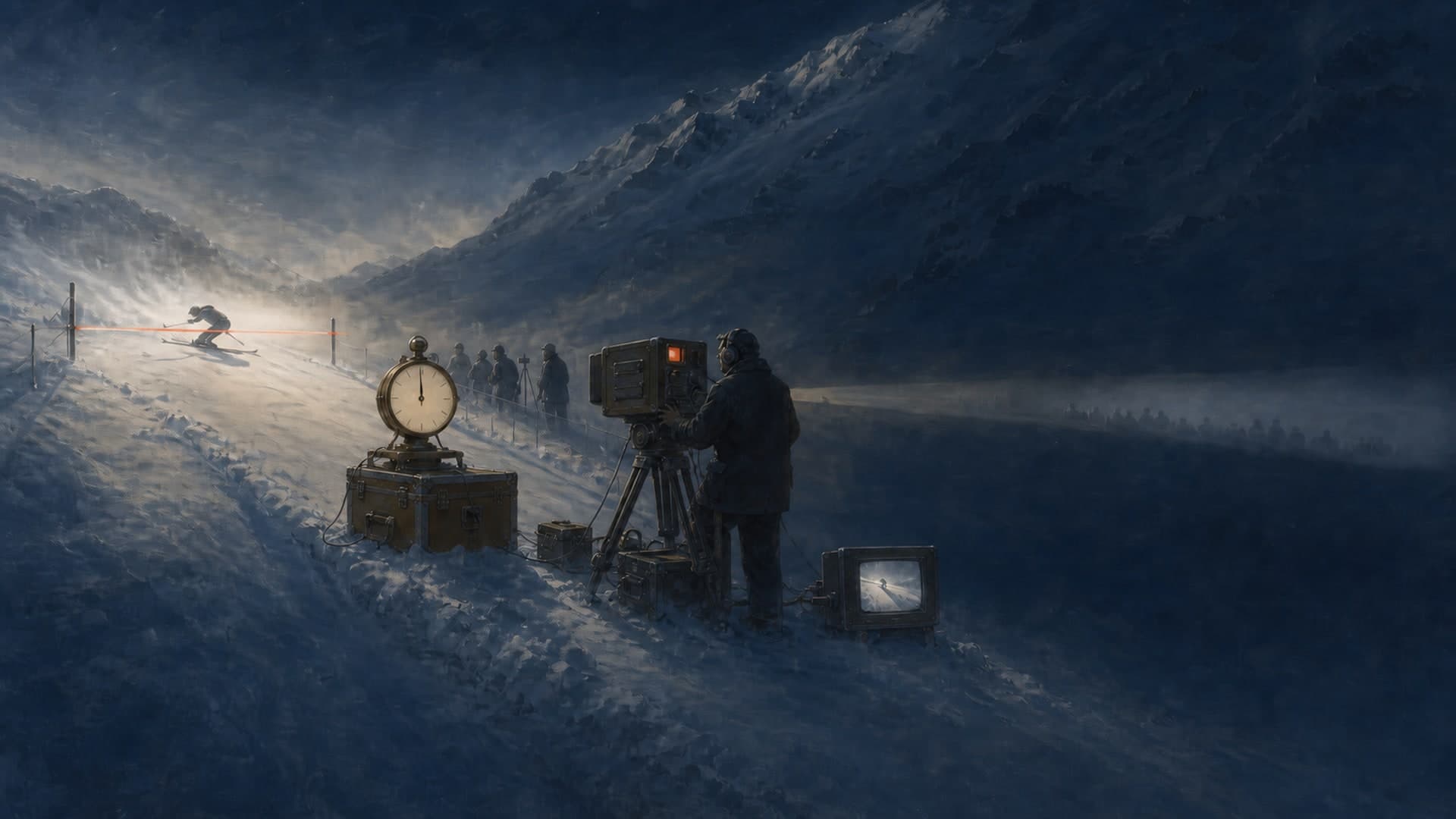
The watched race
Rules, timing and broadcasting helped turn elite skiing into an international spectacle.
- Visual description
- Generic finish scene with timing beam, clock, broadcast camera and distant spectators.
- Nature
- illustration
- Made
- Created for The Archive of Days in 2026
- Medium
- AI-assisted digital illustration, art-directed by PeakWave
- Source
- PeakWave original illustration · No licence clearance recordedOriginal interpretive illustration, not historical evidence. Awaiting final visual and rights review.
1924 ONWARDS
The world starts watching
A run could now finish far beyond the finish area.
FIS was founded in Chamonix on 2 February 1924. The winter sports week held there was retrospectively recognised as the first Olympic Winter Games, but skiing's Olympic programme arrived in stages: Alpine skiing joined the programme in 1936, while freestyle demonstration appearances preceded moguls medals in 1992 and later event additions.
Timing made results portable. As television and live coverage grew, elite performances became repeatable public theatre, though reach remained uneven between places and disciplines; broadcast rights, sponsorship and marketing became part of the Olympic system, not a single explanation for skiing's growth.
Open ledger · AOD.SKI.V10 · ORIGINALClose ledger · AOD.SKI.V10
Ledger AOD.SKI.V10
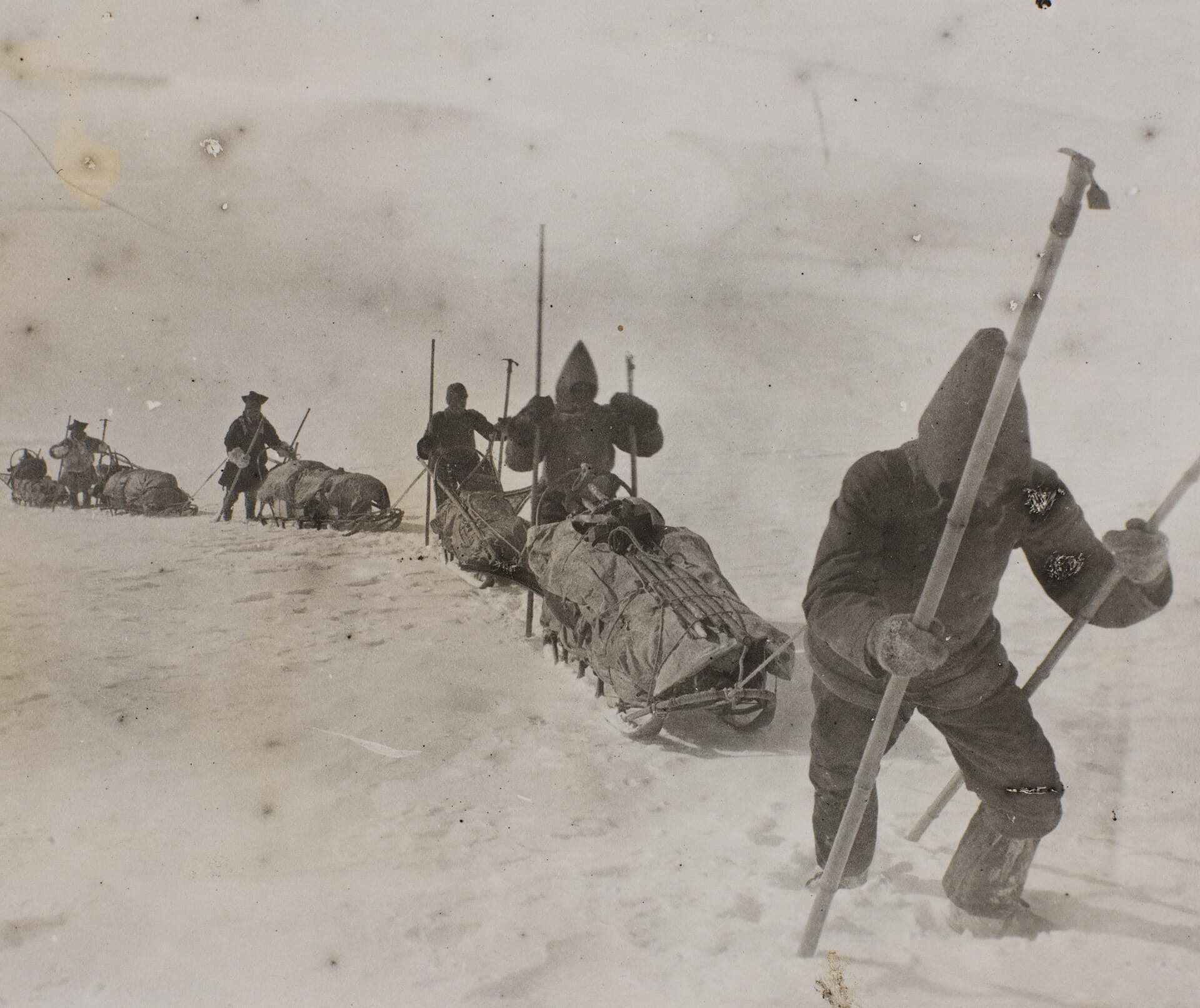
The march across the inland ice
Nansen's six-person party on the Greenland inland ice, associated with the 1888 to 1889 expedition.
- Visual description
- Six expedition members travelling with skis and loaded sledges across the Greenland ice.
- Nature
- original
- Made
- The formal file date says before 1888, while its description associates the photograph with the 1888 to 1889 expedition; exact exposure date unresolved
- Medium
- Historic expedition photograph
- Source
- National Library of Norway · Public domain in Norway; United States status is conditional on the image having been public domain in Norway on 1 January 1996 with no US registration, pending jurisdiction reviewThe formal file date and expedition description conflict, so the exact exposure date remains unresolved. The local derivative retains the complete six-person framing and the expedition sledges. Awaiting final visual and rights review.
1888 TO 1998
Runs that became legend
A track becomes legend when later generations keep returning to it.
In 1888 Fridtjof Nansen's six-person party crossed Greenland from east to west with skis central to a journey that also used sledges. Preserved equipment and museum interpretation keep the crossing alive as a story of experimentation, endurance and the reach of ski travel.
At Innsbruck in 1976, Franz Klammer won the Olympic downhill under home expectation. The official film made that fall-line performance central to its account of the Games. The run endures through result, risk and replay, not because one superlative can settle its value.
At Calgary in 1988, Eddie Edwards finished last in both ski-jumping events for Great Britain and became famous far beyond the results sheet. The story endures through museum preservation, later film and themes of persistence and good humour. His limited equipment belongs to that account, not a celebration of inadequate safety; fame was not a medal.
At Nagano in 1998, Hermann Maier crashed in the downhill, then returned three days later to win super-G before taking giant slalom gold. The story endures as a compressed crash-to-double-gold comeback in Olympic museum accounts, without making the fall harmless.
Sources for this chapter
- Fram Museum: across the Greenland ice
- Holmenkollen Ski Museum: The White Track
- Official report of the Innsbruck 1976 Winter Games
- Olympic World Library: White Rock film analysis
- Austrian Olympic Committee: Hermann Maier
- Norwegian Olympic Museum: Nagano 1998
- Olympedia: Eddie Edwards
- Olympic Museum: Eddie Edwards jacket

Open ledger · AOD.SKI.V11 · ILLUSTRATIONClose ledger · AOD.SKI.V11
Ledger AOD.SKI.V11
Nine records, nine contexts
Athlete achievements belong to different disciplines, eras and measures.
- Visual description
- Archive cabinet with nine blank object plates, each paired with a different record symbol.
- Nature
- illustration
- Made
- Created for The Archive of Days in 2026
- Medium
- AI-assisted digital illustration, art-directed by PeakWave
- Source
- PeakWave original illustration · No licence clearance recordedOriginal interpretive illustration, not historical evidence. Awaiting final visual and rights review.
THE RECORD BOOK
People who changed what was possible
Nine names, different measures, eras and disciplines.
Sondre Norheim refined and spread influential shapes, bindings and Telemark technique without acting alone. Hannes Schneider systematised Alpine teaching with collaborators and trained instructors.
Ingemar Stenmark's 86 Alpine World Cup wins defined a long-standing technical-racing mark. Franz Klammer's 1976 Olympic downhill fixed one performance in the public imagination. Marit Bjørgen reached 15 Olympic medals in cross-country at PyeongChang 2018.
Lindsey Vonn's downhill and super-G career continued with an 84th World Cup victory at Zauchensee on 10 January 2026. Marcel Hirscher's eight consecutive overall titles mark sustained multi-discipline Alpine dominance.
Mikaela Shiffrin finished the 2025 to 2026 World Cup season on 110 victories, continuing to revise Alpine records. Sarah Burke became the first FIS women's halfpipe world champion in 2005 and a leading advocate within the wider movement for women's freeskiing and Olympic inclusion.
These figures use the research cut-off of 13 July 2026. They require a fresh check before publication; no single ledger can turn incomparable achievements into a ranking.
Sources for this chapter
- Store norske leksikon: Sondre Norheim
- Ski School Arlberg: Hannes Schneider
- FIS: Stenmark and Shiffrin
- Official report of the Innsbruck 1976 Winter Games
- Olympic World Library: Marit Bjørgen
- FIS: Lindsey Vonn's Zauchensee victory
- FIS: Marcel Hirscher's career and return
- FIS: Mikaela Shiffrin's 2025 to 2026 season
- Canadian Ski Hall of Fame and Museum: Sarah Burke
Open ledger · AOD.SKI.V12 · ILLUSTRATIONClose ledger · AOD.SKI.V12
Ledger AOD.SKI.V12
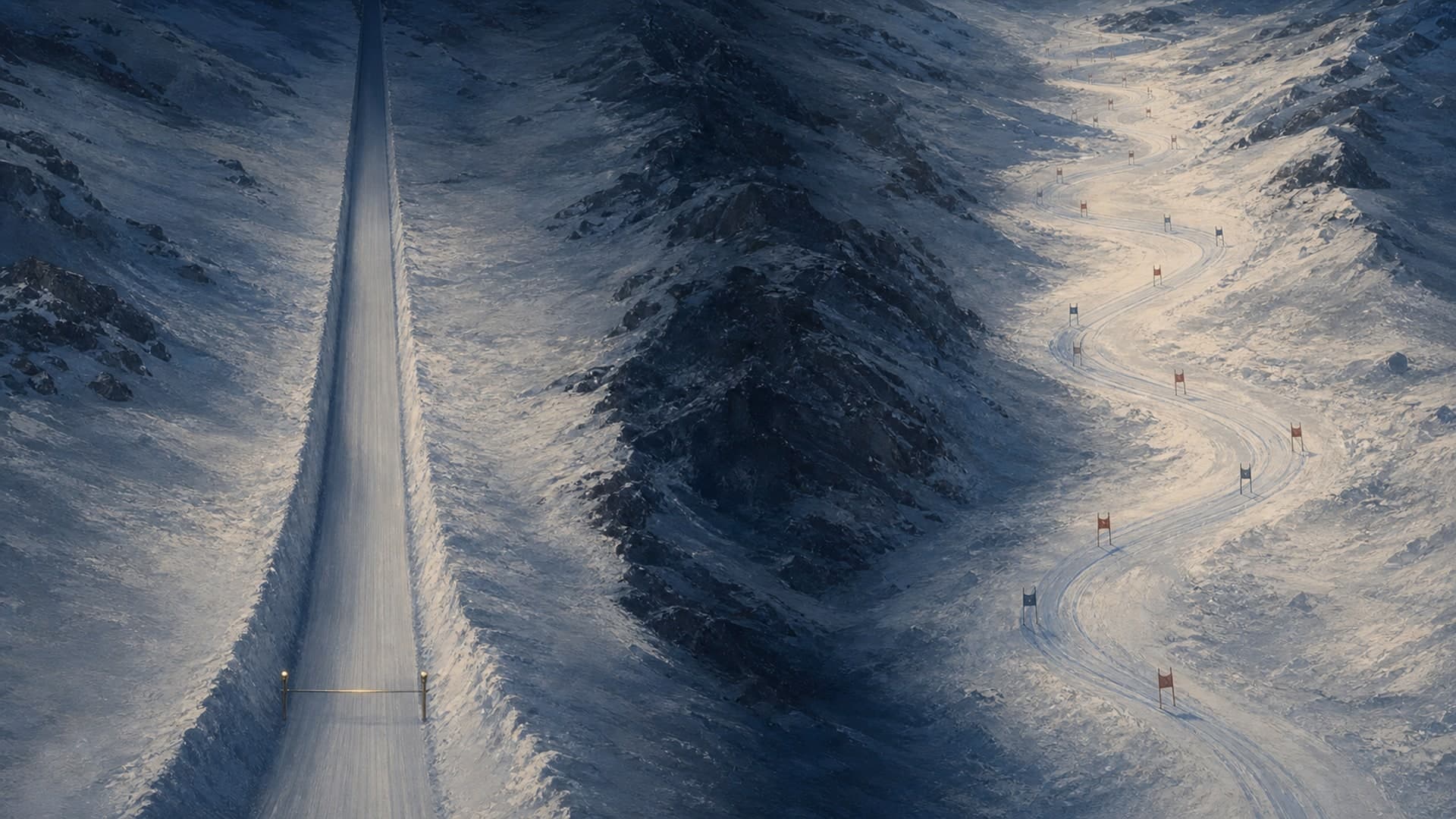
Record and race are different
A speed-skiing record and a downhill-race maximum measure different performances.
- Visual description
- Two abstract parallel snow lanes comparing a speed-skiing record with a downhill-race measurement.
- Nature
- illustration
- Made
- Created for The Archive of Days in 2026
- Medium
- AI-assisted digital illustration, art-directed by PeakWave
- Source
- PeakWave original illustration · No licence clearance recordedOriginal interpretive illustration, not historical evidence. Awaiting final visual and rights review.
MEASURED SPEED
How fast can a human travel on snow?
A straight course asks a different question from a downhill race.
Speed skiing uses specialised skis, suit, helmet, aerodynamic fairings and a prepared straight course. Alpine downhill still demands speed, but its gates, line choices and race-course maximum measure a technically different performance.
The compact posture is an engineering choice: skiers try to minimise aerodynamic drag while remaining stable. Wind-tunnel research shows that different Alpine tuck positions produce measurably different drag, but that Alpine study is not a study of speed-skiing record attempts.
Under the current FIS speed-skiing rules, speed is calculated across a precisely surveyed 100-metre timing zone using distance divided by time, and two independent photoelectric timing systems must record the passage. That is the present competition standard. The surviving sources for the record runs below do not identify the timing operator or apparatus used for Billy's 2023 run or Greggio's 2026 run.
- 255.500 km/h
- Simon Billy, FIS speed-skiing world record, Vars, France, 22 March 2023. The cited FIS report does not identify the timing operator.
- 248.270 km/h
- Valentina Greggio, FIS-recognised women's speed-skiing world record at the cut-off, Chabrières piste at Vars, 3 April 2026. FIS confirms the record; the athlete biography supplies date and place; neither source identifies the timing operator.
- 161.9 km/h
- Johan Clarey, Guinness-recorded peak during the FIS World Cup downhill at Wengen, Switzerland, 19 January 2013. This is a race-course maximum, not an average or a speed-skiing record.
These entries are deliberately not a leaderboard. Discipline, authority and measurement context travel with every number.
Open ledger · AOD.SKI.V13 · ILLUSTRATIONClose ledger · AOD.SKI.V13
Ledger AOD.SKI.V13
Beyond the piste
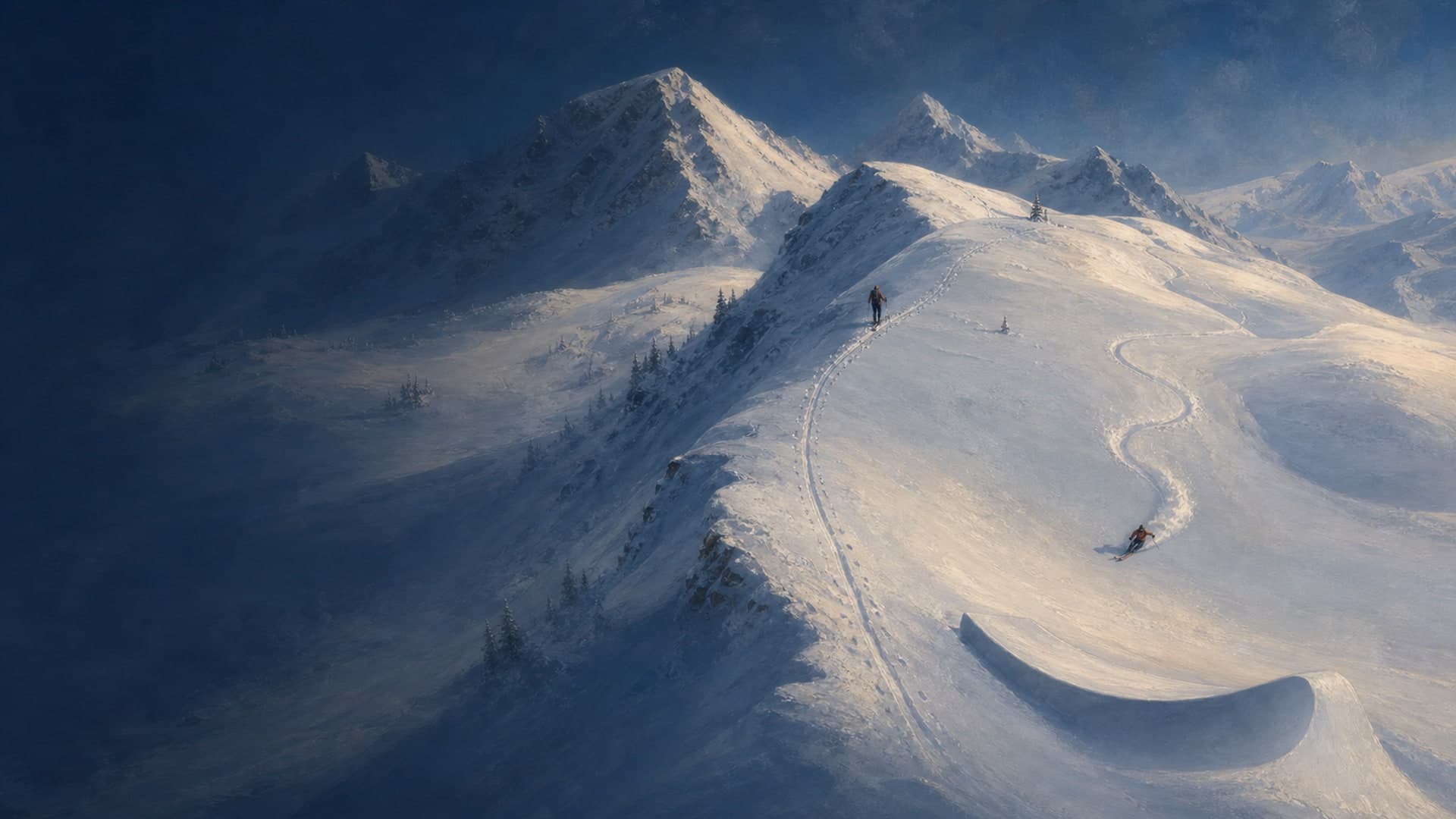
Touring, powder, steep skiing and freeski culture opened different routes beyond race courses.
- Visual description
- A touring track climbs before a distinct twin-tip track descends a soft-snow face.
- Nature
- illustration
- Made
- Created for The Archive of Days in 2026
- Medium
- AI-assisted digital illustration, art-directed by PeakWave
- Source
- PeakWave original illustration · No licence clearance recordedOriginal interpretive illustration, not historical evidence. Awaiting final visual and rights review.
1960s ONWARDS
Skiing escapes the piste
The boundary moved whenever a skier found another line.
What became known as hot-dog freestyle grew around moguls, aerials and ballet before later standardisation. Recurring feature-length ski films circulated steep, powder and big-mountain skiing far beyond race courses, while influential pioneers such as Scot Schmidt helped establish professional freeskiing identities.
Parks, halfpipe, slopestyle and big air became formal competitive expressions of a wider creative skiing culture. Olympic inclusion was one institutional pathway, not the boundary of freestyle or freeskiing.
Beyond the contest calendar, feature-length films, professional careers and equipment collaborations carried freestyle and freeskiing into a wider commercial world. The Salomon 1080, developed with Mike Douglas and Stephen Fearing in 1998, became an important modern high-performance twin-tip for the emerging scene. Earlier skis had upturned tails, so its significance is not a claim of absolute invention.
Off-piste became a useful category only after resorts marked, groomed and patrolled selected runs. The snow beyond those boundaries was not newly discovered. What changed was the division between managed terrain and places where route choice, snow stability and rescue planning remained with the skier.
Public avalanche bulletins turned local observation into shared regional guidance. They made snowpack history, weather and likely avalanche problems easier to discuss, without making an individual slope safe. The growth of forecasting therefore changed skiing beyond the piste as much as wider skis or mechanical access did.
Touring is not freestyle. For touring, climbing skins and equipment transitions enable ascent before descent; freeride, powder skiing, steep skiing, parks and judged events answer different objectives. Freestyle's commercial current cannot stand in for touring's whole history.
Touring also preserves skiing's oldest practical logic: travel across winter ground under one's own power. Modern bindings, skins and lightweight boots refined the ascent, while ski mountaineering races measured transitions and climbing speed. Recreational touring continued to judge the whole journey, including the decision to turn around.
Sources for this chapter
- Canadian Ski Hall of Fame and Museum: Michel Daigle
- U.S. Ski and Snowboard Hall of Fame: Warren Miller
- U.S. Ski and Snowboard Hall of Fame: Scot Schmidt
- Canadian Ski Hall of Fame and Museum: Mike Douglas
- Canadian Olympic Committee: freestyle skiing
- Store norske leksikon: randoné
- Norwegian Ski Federation: Telemark
- WSL Institute for Snow and Avalanche Research: origins of the avalanche bulletin
- International Ski Mountaineering Federation: history of ski mountaineering

Open ledger · AOD.SKI.V14 · ILLUSTRATIONClose ledger · AOD.SKI.V14
Ledger AOD.SKI.V14
Many centres, one snow world
Local traditions, migration, institutions and indoor snow make skiing a world history.
- Visual description
- Balanced world map with ski-track markers across northern Eurasia, Japan, the Americas, New Zealand and indoor cities.
- Nature
- illustration
- Made
- Created for The Archive of Days in 2026
- Medium
- AI-assisted digital illustration, art-directed by PeakWave
- Source
- PeakWave original illustration · No licence clearance recordedOriginal interpretive illustration, not historical evidence. Awaiting final visual and rights review.
A GLOBAL PRACTICE
One sport, many worlds
A world history has no centre line.
Northern European, Arctic and Central Asian evidence centres preserve different traces, with uneven survival and study. The Alps, Scandinavia and North America became powerful centres of sport, industry and tourism, but none contains the whole history.
Japan's organised modern record includes Theodor von Lerch's 1911 teaching mission at Takada, without implying that no earlier snow travel existed there. In New Zealand, imported knowledge, local clubs and mountain huts shaped documented skiing from the nineteenth and early twentieth centuries.
Purpose-built indoor snow in cities now separates skiing from outdoor mountain climate. That is evidence of technological and geographical reach, not a permanent record claim or a reason to turn older local traditions into side notes.
Open ledger · AOD.SKI.V15 · ILLUSTRATIONClose ledger · AOD.SKI.V15
Ledger AOD.SKI.V15
The track ahead
One continuous pair of ski tracks enters a winter whose snow, access and livelihoods are changing.
- Visual description
- One continuous pair of ski tracks runs from the snowy foreground to a distant mountain horizon.
- Nature
- illustration
- Made
- Created for The Archive of Days in 2026
- Medium
- AI-assisted digital illustration, art-directed by PeakWave
- Source
- PeakWave original illustration · No licence clearance recordedOriginal interpretive illustration, not historical evidence. Original fallback selected because written IPCC permission to reproduce Figure 14.9 is not available. The IPCC figure was not copied, cropped or redistributed. Awaiting final visual and rights review.
NOW
The track ahead
The next line depends on the winter that remains, and who can reach it.
Mountain regions are warming, with changes in snow cover extent and duration especially evident at lower elevations. Outcomes vary by region, height and emissions pathway. There is no honest single date for skiing's end.
Snowmaking can reduce some near-term exposure where cold, regulation, water and energy allow it. It is neither a complete answer nor one uniform harm. Climate pressure also reaches safety, infrastructure, tourism income and mountain livelihoods.
FIS describes how elite Alpine competition safety continues to evolve through equipment rules, course management and protection systems. That institutional account does not mean risk has been eliminated and is not a guide to recreational safety.
At end of life, multi-material ski boots create difficult choices. The EU LIFE Re-SkiBoot project demonstrates the problem and tests one circular response; it does not prove sector-wide success.
In one United States programme, U.S. Ski and Snowboard names economic and geographical barriers while working with the National Brotherhood of Skiers on access and representation. It is a specific programme example, not proof of a global pattern or evidence that those barriers have been removed.
People still seek a line through winter. The conditions of making it, materially, socially and climatically, are changing beneath the track.
THE LEDGER
Sources and credits
Every track through history rests on traces that survived.
Each chapter's sources are disclosed within that chapter. Disputed origins remain qualified, myth remains labelled, records carry their date and authority, and every time-sensitive total must be checked again before publication.
This exhibition remains a draft while named historical review, visual rights review and a dated correction history are still open.
Sources for this chapter
Artefacts in order of appearance
Kalvträskskidan
AOD.SKI.V00 · original · Västerbottens Museum · CC BY 4.0 displayed by the object record; applicability to the photograph pending review
Ski
AOD.SKI.V01 · original · Swedish History Museum · CC BY 4.0 candidate; final attribution review pending
Ullr
AOD.SKI.V02 · illustration · Árni Magnússon Institute, Iceland · Public-domain marking on the exact SNL image record; final jurisdiction review pending
Skiing competition at Frogner Field during Wintersports Week
AOD.SKI.V03 · original · National Library of Norway · Public domain in Norway; United States status is conditional on the image having been public domain in Norway on 1 January 1996 with no US registration, pending jurisdiction review
The controlled turn
AOD.SKI.V04 · illustration · PeakWave original illustration · No licence clearance recorded
A lesson becomes a system
AOD.SKI.V05 · illustration · PeakWave original illustration · No licence clearance recorded
The mountain holiday
AOD.SKI.V06 · illustration · PeakWave original illustration · No licence clearance recorded
Anatomy of a ski
AOD.SKI.V07 · illustration · PeakWave original illustration · No licence clearance recorded
Ways through snow
AOD.SKI.V08 · illustration · PeakWave original illustration · No licence clearance recorded
The watched race
AOD.SKI.V09 · illustration · PeakWave original illustration · No licence clearance recorded
The march across the inland ice
AOD.SKI.V10 · original · National Library of Norway · Public domain in Norway; United States status is conditional on the image having been public domain in Norway on 1 January 1996 with no US registration, pending jurisdiction review
Nine records, nine contexts
AOD.SKI.V11 · illustration · PeakWave original illustration · No licence clearance recorded
Record and race are different
AOD.SKI.V12 · illustration · PeakWave original illustration · No licence clearance recorded
Beyond the piste
AOD.SKI.V13 · illustration · PeakWave original illustration · No licence clearance recorded
Many centres, one snow world
AOD.SKI.V14 · illustration · PeakWave original illustration · No licence clearance recorded
The track ahead
AOD.SKI.V15 · illustration · PeakWave original illustration · No licence clearance recorded
Editorial record
Beta exhibition. Historical and sporting claims are linked to museum, archaeology, Olympic and governing-body sources.