United States Β· Pacific Islands
Not enough data yet. Log a session to help build the accuracy score.
This guide was generated from conditions data. Know this spot? Submit your own tips below.
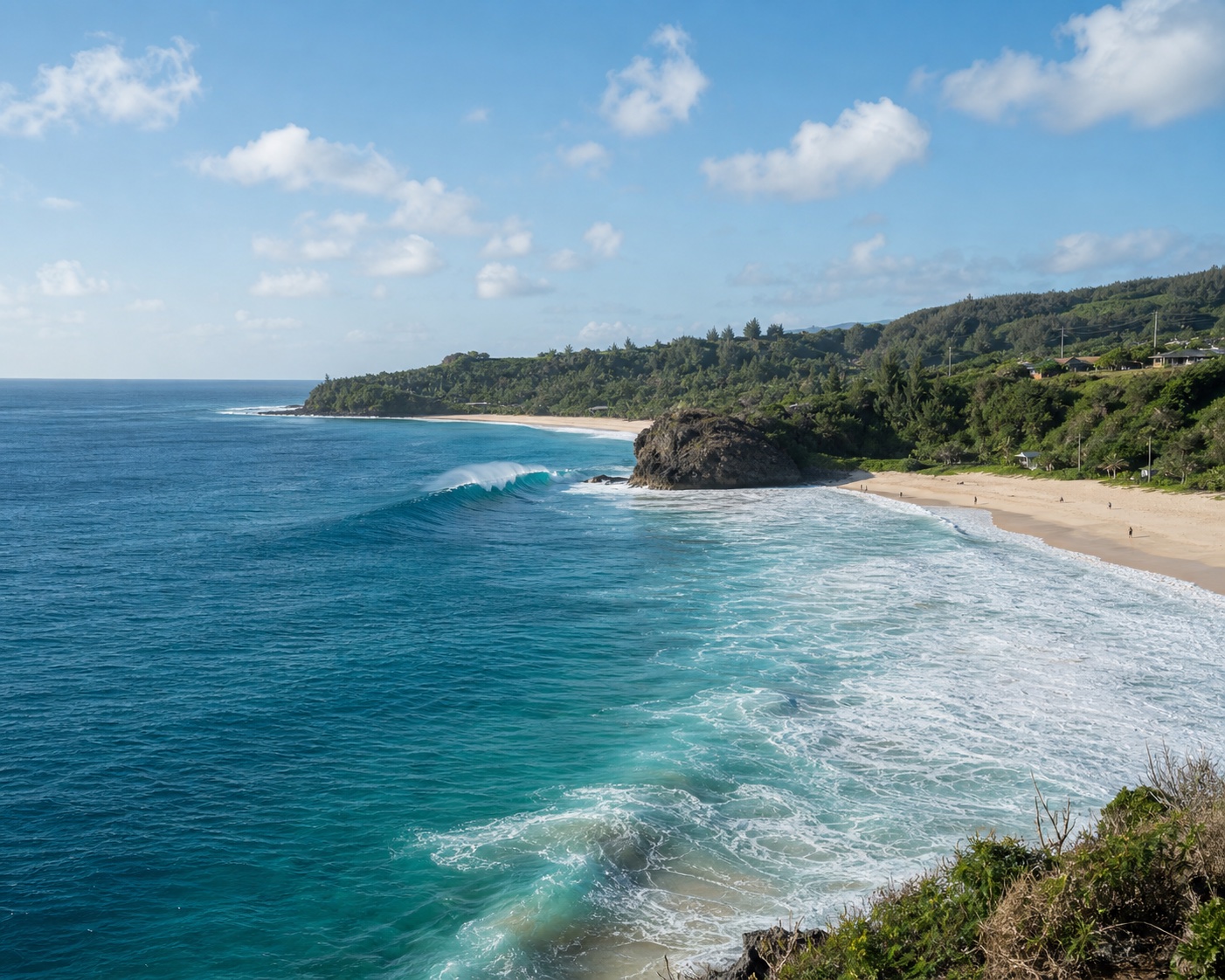
Waimea Bay is the birthplace of big-wave surfing, a legendary arena on Oahu's North Shore where massive winter swells detonate on a volcanic rock and sand shelf. When the bay is breaking, the sheer volume and power of the water is awe-inspiring. The wave produces a towering, steep-faced A-frame that demands absolute commitment on the drop. During summer, the bay transforms into a calm, placid swimming hole, betraying nothing of the winter violence. This is hallowed ground in surfing history.
Waimea only activates when North Pacific winter swells exceed 15ft on the face, typically between November and February. The bay needs genuine size to properly break; anything under 12ft passes through without detonating on the shelf. The biggest days produce waves of 25-40ft. Easterly trade winds provide offshore conditions. The wave breaks best on a mid-tide with moderate water depth over the rock shelf.
The take-off zone shifts depending on swell size. On moderate days (15-20ft), the peak sits over the inside rock shelf. On bigger days, it shifts further out into deeper water. Position yourself just beyond where the biggest sets are breaking and wait. The drop is steep and fast, requiring immediate acceleration to outrun the lip. The deep-water channel on the west side of the bay provides the paddle-out route and safety zone.
Everything about Waimea is dangerous at size. The hydraulic force of the breaking wave produces violent, extended hold-downs. The shorebreak at the back of the bay is brutal and has caused spinal injuries. The rock shelf is unforgiving on wipeouts. Strong currents sweep across the bay during big swells. Jet-ski safety teams operate during major swells. Do not paddle out unless you have specific big-wave experience, fitness, and equipment.
A beach park with car parking sits directly at the bay. Parking fills rapidly on big swell days, often by dawn. Street parking along Kamehameha Highway fills next. The beach is directly accessible from the park. During major swells, thousands of spectators line the beach and road.
On big days, the line-up is reserved for experienced big-wave surfers, typically 15-30 in the water. The hierarchy is well-established and enforced. Do not paddle out if you are not genuinely prepared for the consequences. On smaller days (12-18ft), the crowd expands but remains composed of highly competent surfers. The spectator crowd on shore can number in the thousands.
Waimea is not a wave you work up to during a holiday. It requires specific preparation: big-wave gun (9'0"+), inflation vest, leash rated for the size, and extensive breath-hold training. The drop is steeper and faster than it appears from shore. Study the wave extensively from the beach before committing. The rock called 'The Rock' in the centre of the bay serves as a reference point for positioning. Jumping off The Rock into the bay is a local tradition on calm summer days.
No recent check-ins. Be the first to report.
Record your session, conditions and gear.
Based on historical weekly averages
Combining historical conditions with school holiday crowd pressure to find the sweet spot.
How busy each week is based on school holiday overlap from feeder markets.
The timing score combines two signals: historical conditions quality (how good the skiing or surfing typically is in a given week, based on 5 years of weather data) and crowd pressure (how many of this destination's feeder markets have school holidays that week).
Crowd pressure is weighted by each feeder country's share of visitors. If 40% of a resort's visitors come from France and France is on holiday, that contributes 0.40 to the crowd pressure score. Crowds can reduce the timing score by up to 35%, ensuring conditions still matter most.
Scores: 5 = great conditions with low crowds (the sweet spot). 4 = great conditions with moderate crowds, or good conditions with low crowds. 3 = average. 2 = below average conditions or very crowded. 1 = poor conditions or peak holiday chaos.
Last 28 days of logged conditions.
Sign up to save favourite spots and get surf alerts
Create free accountCreate a free profile and let employers in Waimea Bay find you.
Create Profile βCurrent conditions refresh every 3 hours when the cron runs. Hourly data updates every 30 minutes. The 7-day forecast, luck factor, and packing notes are all pre-computed at the same time.
We compare the 7-day forecast to the last 5 years of marine data for the same week at Waimea Bay. The delta tells you whether conditions are shaping up better, worse, or about the same as a typical mid-June.
We score each day of the 7-day forecast using the same algorithm as the leaderboard, and highlight the highest scorer.
Open-Meteo's Marine API (swell height, period, water temperature) and Weather API (wind and conditions).
Honestly, no. Every break has tide windows, swell directions and reef contours that a global model cannot see. Treat the score as a starting point, then check a local cam.
The best week for surf at Waimea Bay is the week of 30 November (score 3/5) with low crowds.
Barely any swell. Not much to work with today. Reasonable period putting some grunt behind each wave. Breezy. Some surface chop to deal with. Not enough swell to get this spot firing properly.
Heads up: jellyfish: peak season, and rocks exposed at low tide.
Indicators derived from forecast data, not official warnings. Always check local lifeguard or official advice.
Crystal clear water: ~27m visibility
High sediment levels, possible runoff or storm disturbance
Daily scores over the last 12 months at Waimea Bay