United States ยท Pacific Islands
Each location is refreshed once every three hours. The hourly view, 7-day forecast, luck factor and packing notes come from the same stored update.
We compare the 7-day forecast with the version-matched historical observations available for the same time of year at Sunset Beach. The delta shows whether conditions look better, worse or about the same as a typical late July.
We score each day of the 7-day forecast using the same algorithm as the leaderboard, and highlight the highest scorer.
Open-Meteo's Marine API (swell height, period, water temperature) and Weather API (wind and conditions).
Barely any swell. Not much to work with today. Long-period energy means powerful, well-spaced sets. Moderate wind adding texture to the faces. Conditions improving through the afternoon. Not enough swell to get this spot firing properly.
PeakWave scores are planning signals, not safety clearance. Check local authorities, official bulletins and on-site conditions before you go. Read our editorial policy.
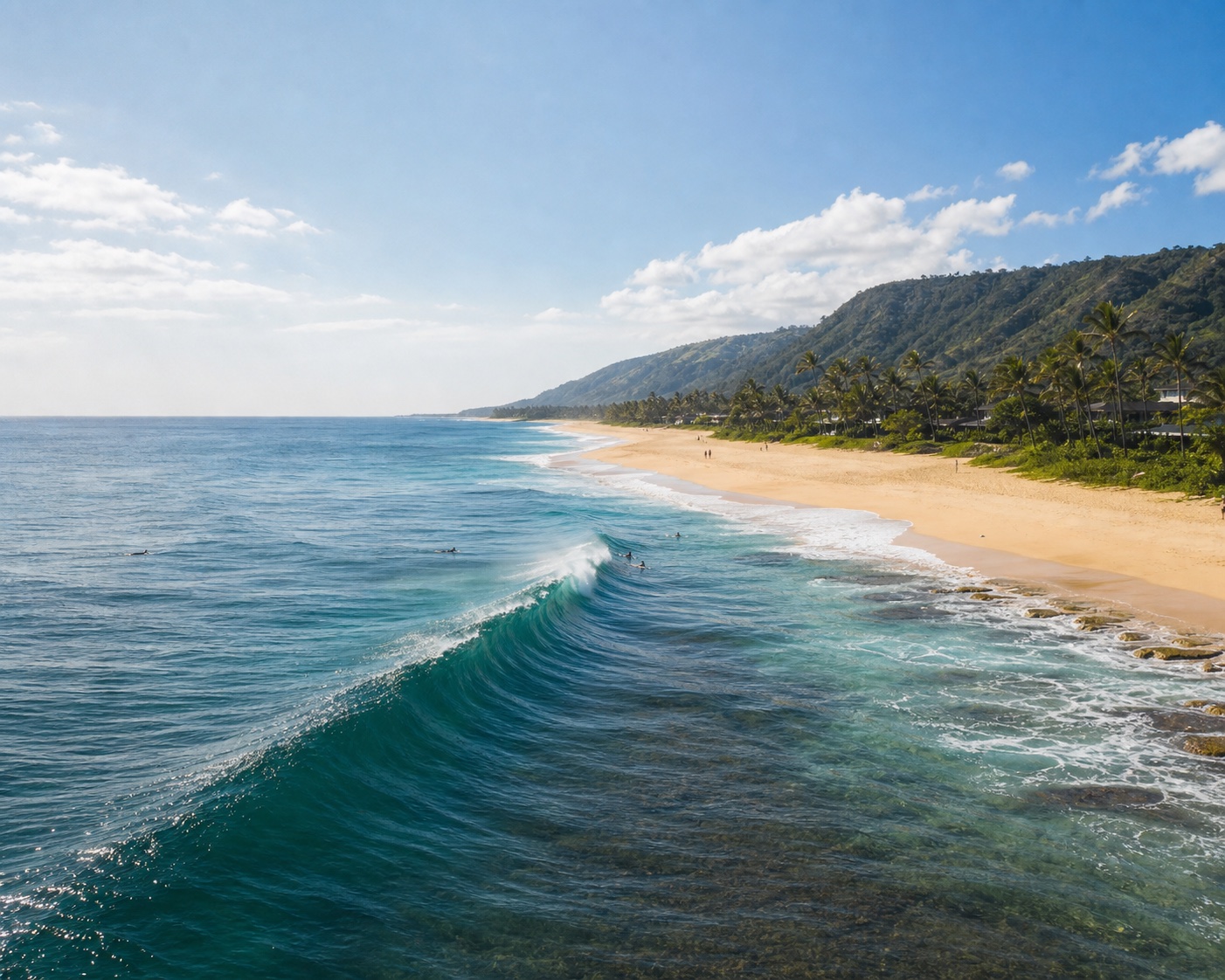
Sunset Beach is a massive, highly complex right-hand reef break situated on the North Shore of Oahu, Hawaii. The bathymetric topography comprises an expansive, uneven matrix of deep coral and limestone ridges that span a massive playing field. As colossal north-westerly winter groundswells travel unimpeded across the deep Pacific Ocean, they collide with this sprawling underwater structure, forcing the wave to jack significantly in height and thickness. An easterly trade wind provides the ideal offshore flow, grooming the massive, shifting peaks. The wave mechanics feature a highly critical, thick-lipped take-off that transitions into a fast, bowling inside section. Due to the extreme hydraulic force, the volume of moving water, and the vast, shifting nature of the line-up, it leaves virtually no margin for error. Surviving Sunset requires an oversized surfboard, elite paddling strength, and precise ocean awareness to avoid being caught inside by rogue sets. Consequently, it is universally classified as an advanced-only arena, demanding supreme physical endurance and big-wave experience.
Heads up: jellyfish: peak season, and rocks exposed at low tide.
Indicators derived from forecast data, not official warnings. Always check local lifeguard or official advice.
The air here is 61% cleaner than the average comparison city right now.
Noticeably cleaner air than a typical city. Good conditions for prolonged outdoor activity.
Not a pollutant. Ozone is naturally higher at altitude and near the coast, and lower in cities where traffic exhaust breaks it down. High readings here typically indicate clean air. Can cause short-term airway irritation during intense exercise but is not linked to the long-term health risks of particulate pollution.
Additive health score: each pollutant contributes points relative to its WHO 2021 guideline and long-term health impact (PM2.5 9, NOโ 5, Oโ 3, PM10 2, SOโ 1 at WHO limits). Data via Open-Meteo. City markers show live readings. Red line marks the WHO guideline. Updated 09:24
Crystal clear water: ~34m visibility
Daily scores over the last 12 months at Sunset Beach
Historical quality only. Safety is not reconstructed for this view.
Create a free profile and let employers in Sunset Beach find you.
Create Profile โPartly. The model uses stored spot geometry, swell ranges and tide preferences where configured. It cannot see changing banks, crowds, access, closures or everything visible on a local cam, so treat it as a starting point.
The best week for surf at Sunset Beach is the week of 30 November (score 3/5) with low crowds.
This guide was generated from conditions data. Know this spot? Submit your own tips below.
Sunset Beach is a massive, complex right-hand reef break on Oahu's North Shore, featuring one of the biggest and most challenging playing fields in surfing. The wave breaks over an expansive, uneven reef matrix that creates a shifting, unpredictable line-up spanning hundreds of metres. Unlike Pipeline's concentrated peak, Sunset's challenge lies in reading the massive, moving peaks across a vast ocean surface. The wave demands boards longer and wider than standard shortboards and paddle strength beyond what most surfers possess.
North-westerly winter groundswells from November through February deliver the goods. Sunset needs 6ft-plus to activate properly and handles genuine 20ft-plus faces on the biggest days. Easterly trade winds provide offshore grooming. The wave breaks at various sizes but only truly comes alive above 8ft when the outside sections start connecting.
The take-off zone is vast and shifting. The outside peak (Val's Reef) handles the biggest swells. The inside section (The Bowl) produces shorter but hollower waves. The challenge is maintaining position across the enormous playing field as currents and sets shift the peaks. Use the beach landmarks (the houses on the hillside) to maintain reference points. Sit further outside than you think necessary.
The volume of moving water is extraordinary. Getting caught inside by a set means a long, brutal hold-down with multiple waves landing on you. The currents are powerful and constantly shift. The reef is deep enough to avoid direct contact in most cases, but the turbulence and duration of wipeouts is the primary danger. The paddle-out during big swells is an extreme fitness test.
Beach park parking directly at the break. Fills early on swell days. The beach is immediately accessible. The paddle-out is straightforward on moderate days but can take 20+ minutes during large swells as you navigate the impact zone.
Sunset draws experienced North Shore regulars and visiting professionals. Expect 20-40 surfers on good days. The hierarchy is based on ability, commitment, and time in the water. Paddle strength is the limiting factor; many surfers physically cannot maintain position in the line-up.
Bring a board 6'6" to 8'0" with extra volume and paddle power. Standard shortboards are inadequate for the paddle speed needed to catch waves and the length needed for control on the big faces. Study the peaks from the beach before paddling out; the sets reveal the primary peak locations over 15-20 minutes. Position further outside and further north (upwind/upcurrent) than seems necessary. Hawaiian etiquette and hierarchy must be respected absolutely.
Surf at Sunset Beach
Your score
Forecast feel
Score this window against what you actually found.
No scored surf reviews in the last 24 hours.
No recent check-ins. Be the first to report.
Log a day
Add Sunset Beach to your private Companion record without GPS.
Combining historical conditions with school holiday crowd pressure to find the sweet spot.
The timing score combines two signals: historical conditions quality (how good the skiing or surfing typically is in a given week, based on 5 years of weather data) and crowd pressure (how many of this destination's feeder markets have school holidays that week).
Crowd pressure is weighted by each feeder country's share of visitors. If 40% of a resort's visitors come from France and France is on holiday, that contributes 0.40 to the crowd pressure score. Crowds can reduce the timing score by up to 35%, ensuring conditions still matter most.
Scores: 5 = great conditions with low crowds (the sweet spot). 4 = great conditions with moderate crowds, or good conditions with low crowds. 3 = average. 2 = below average conditions or very crowded. 1 = poor conditions or peak holiday chaos.
Last 30 days of logged conditions.
Based on historical weekly averages
Conditions at Sunset Beach tend to be best between 07:00 to 10:00 in July.
Average score during this window: 10/100
See timing scores, school holiday busyness, and lift pass pricing to find the best time to book.
View Best Time to Go โ