South Africa · Southern Africa
Create a free profile and let employers in Muizenberg find you.
Create Profile →Current conditions refresh every 3 hours when the cron runs. Hourly data updates every 30 minutes. The 7-day forecast, luck factor, and packing notes are all pre-computed at the same time.
We compare the 7-day forecast to the last 5 years of marine data for the same week at Muizenberg. The delta tells you whether conditions are shaping up better, worse, or about the same as a typical early July.
We score each day of the 7-day forecast using the same algorithm as the leaderboard, and highlight the highest scorer.
Open-Meteo's Marine API (swell height, period, water temperature) and Weather API (wind and conditions).
Honestly, no. Every break has tide windows, swell directions and reef contours that a global model cannot see. Treat the score as a starting point, then check a local cam.
The best week for surf at Muizenberg is the week of 30 November (score 3/5) with low crowds.
Moderate swell providing fun waves for a session. Heavy offshore making for difficult paddle-outs but textbook faces.
Heads up: rocks exposed at low tide, and cold-shock risk.
Indicators derived from forecast data, not official warnings. Always check local lifeguard or official advice.
The air here is 34% cleaner than the average comparison city right now.
Somewhat cleaner than a typical city. Air quality is unlikely to affect most people.
Not a pollutant. Ozone is naturally higher at altitude and near the coast, and lower in cities where traffic exhaust breaks it down. High readings here typically indicate clean air. Can cause short-term airway irritation during intense exercise but is not linked to the long-term health risks of particulate pollution.
Additive health score: each pollutant contributes points relative to its WHO 2021 guideline and long-term health impact (PM2.5 9, NO₂ 5, O₃ 3, PM10 2, SO₂ 1 at WHO limits). Data via Open-Meteo. City markers show live readings. Red line marks the WHO guideline. Updated 21:00
Moderate water clarity: ~4m visibility
This guide was generated from conditions data. Know this spot? Submit your own tips below.
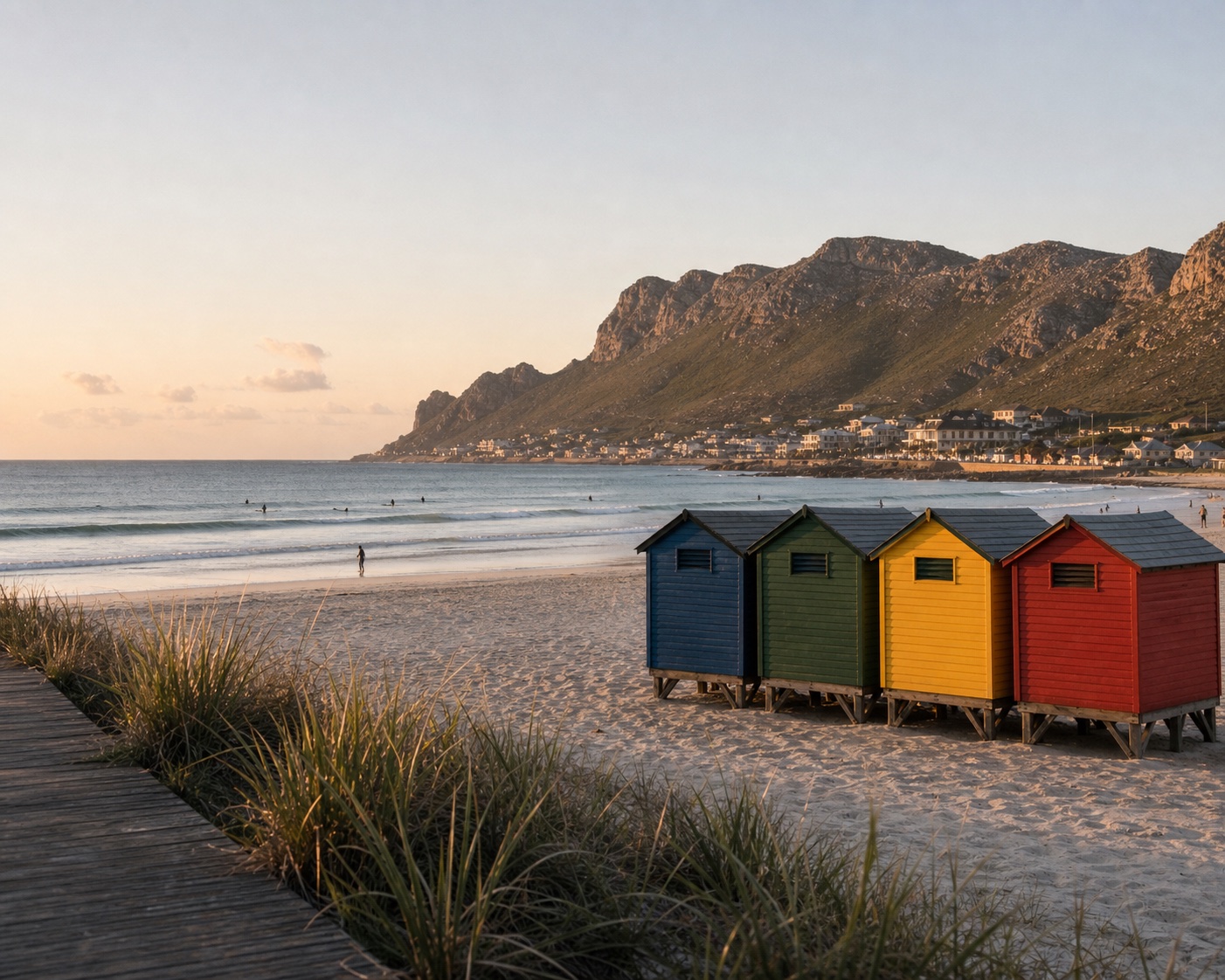
Muizenberg is South Africa's most famous learning wave, a gentle beach break in the corner of False Bay near Cape Town where an incredibly flat gradient of white sand produces soft, rolling waves that crumble rather than crash. The colourful beach huts lining the waterfront have become an icon of Cape Town surf culture. This is where generations of South African surfers have caught their first wave, and the community built around this break is warm, inclusive, and deeply connected to the ocean.
Muizenberg works best from March through October when south-westerly winter swells generated in the Southern Ocean diffract around the Cape Peninsula into False Bay. Because the bay is so sheltered, the raw swell energy is heavily filtered, arriving as gentle, manageable waves. The wave works on anything from 2-6ft of open ocean swell. North-westerly winds blow offshore here, and winter cold fronts often provide perfect conditions for a day or two as they pass.
The main surf zone extends along the beach in front of the colourful huts. The gentle gradient means waves break far from shore and reform multiple times as they roll in. Beginners should start in the whitewater close to the beach. More experienced riders can sit further out where the unbroken green faces offer longer, cleaner rides. The south end near the tidal pool tends to have slightly more shape.
Great white sharks are present in False Bay, and Muizenberg has had incidents. The Shark Spotters programme operates from the mountain above the beach, flying a flag system to indicate shark presence. A white flag means conditions are too poor to spot; a red flag means a shark has been seen. Respect the flag system absolutely. Beyond sharks, rip currents are minimal due to the flat gradient, and the sandy bottom presents no reef or rock hazards.
A large car park sits directly behind the beach near the pavilion. Street parking extends along Beach Road. The beach is completely flat and accessible with no stairs or difficult entry. Surf schools operate along the waterfront offering lessons and board rental. Changing rooms, showers, and cafes line the beachfront. The Metrorail station is a short walk away.
Muizenberg is extremely popular, particularly on weekends and during school holidays. The wide beach and long stretch of rideable waves absorb significant numbers of people. Surf schools dominate the central zone. Experienced surfers tend to move to the ends of the beach or further along to Surfers Corner. The vibe is overwhelmingly friendly and supportive.
The water in False Bay is cold year-round (12-18C), so a full wetsuit is essential even in summer. A 4/3mm with boots covers winter; a 3/2mm handles the warmer months. Respect the shark flag system without question. The best conditions often coincide with approaching cold fronts when the offshore wind is strongest, but these windows are brief (a few hours before the front arrives and conditions deteriorate). A longboard or foam board maximises wave count on these gentle, low-powered waves.
Surf at Muizenberg
Your score
Forecast feel
Score this window against what you actually found.
No scored surf reviews in the last 24 hours.
No recent check-ins. Be the first to report.
Record your session, conditions and gear.
Daily scores over the last 12 months at Muizenberg
Based on historical weekly averages
Conditions at Muizenberg tend to be best between 16:00 to 19:00 in July.
Average score during this window: 32/100
See timing scores, school holiday busyness, and lift pass pricing to find the best time to book.
View Best Time to Go →Combining historical conditions with school holiday crowd pressure to find the sweet spot.
The timing score combines two signals: historical conditions quality (how good the skiing or surfing typically is in a given week, based on 5 years of weather data) and crowd pressure (how many of this destination's feeder markets have school holidays that week).
Crowd pressure is weighted by each feeder country's share of visitors. If 40% of a resort's visitors come from France and France is on holiday, that contributes 0.40 to the crowd pressure score. Crowds can reduce the timing score by up to 35%, ensuring conditions still matter most.
Scores: 5 = great conditions with low crowds (the sweet spot). 4 = great conditions with moderate crowds, or good conditions with low crowds. 3 = average. 2 = below average conditions or very crowded. 1 = poor conditions or peak holiday chaos.
Last 31 days of logged conditions.
Not enough data yet. Log a session to help build the accuracy score.