Australia Β· Australasia
Not enough data yet. Log a session to help build the accuracy score.
This guide was generated from conditions data. Know this spot? Submit your own tips below.
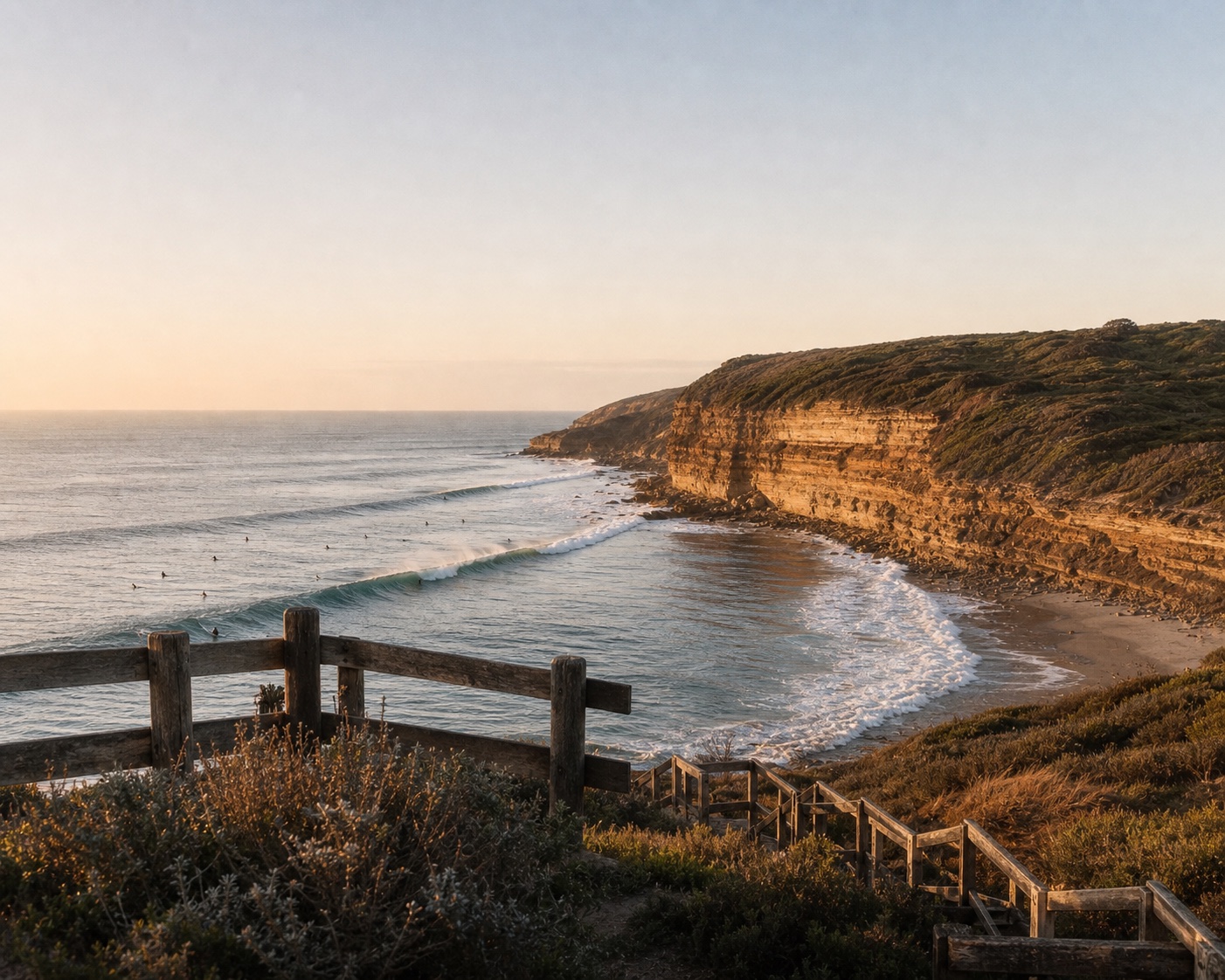
Bells Beach is Australia's most famous wave, a powerful right-hand reef break on Victoria's Surf Coast near Torquay. It has hosted the world's longest-running professional surf competition (the Rip Curl Pro) since the 1960s. The wave breaks over a limestone reef shelf, producing long, powerful walls with barrel sections on bigger swells. The cliff amphitheatre above creates a natural stadium. Cold water, powerful waves, world-class quality.
Needs solid south-westerly groundswell from the Southern Ocean. A northerly wind is offshore. Best at mid to high tide. The 4-8ft range produces its famous walls. Works primarily in autumn and winter (March through September) when the biggest Southern Ocean storms track through. Summer can produce smaller rideable waves.
The main take-off is at the top of the point (the Bowl). The wave then runs right along the reef through the Rincon section and down to the inside. The Bowl is most powerful; Rincon is more workable. Choose based on your ability.
Powerful waves over limestone reef. Cold water (wetsuits year-round in Victoria). Strong currents sweep along the reef. The Bowl section is heavy and fast. Rocks throughout. Sea urchins. This is a serious wave on bigger days.
Large car park at the cliff top. Steps lead down to the beach (5-10 minutes). National surfing museum nearby. The Great Ocean Road runs past.
Crowded on good days. Bells Beach is iconic and attracts surfers from across Victoria and beyond. The Bowl section is competitive. 20-40 people on a solid swell. The local Torquay crew are skilled and experienced. Dawn patrol helps.
Bells is best on a solid SW groundswell with light offshores. The Rincon section offers slightly easier access to quality waves than the heavy Bowl. The competition window (Easter) draws the world's best. Torquay (10 minutes) has excellent surf shops and cafes. The Great Ocean Road drive is one of Australia's best.
No recent check-ins. Be the first to report.
Record your session, conditions and gear.
Based on historical weekly averages
Combining historical conditions with school holiday crowd pressure to find the sweet spot.
How busy each week is based on school holiday overlap from feeder markets.
The timing score combines two signals: historical conditions quality (how good the skiing or surfing typically is in a given week, based on 5 years of weather data) and crowd pressure (how many of this destination's feeder markets have school holidays that week).
Crowd pressure is weighted by each feeder country's share of visitors. If 40% of a resort's visitors come from France and France is on holiday, that contributes 0.40 to the crowd pressure score. Crowds can reduce the timing score by up to 35%, ensuring conditions still matter most.
Scores: 5 = great conditions with low crowds (the sweet spot). 4 = great conditions with moderate crowds, or good conditions with low crowds. 3 = average. 2 = below average conditions or very crowded. 1 = poor conditions or peak holiday chaos.
Last 28 days of logged conditions.
Sign up to save favourite spots and get surf alerts
Create free accountCreate a free profile and let employers in Bells Beach find you.
Create Profile βCurrent conditions refresh every 3 hours when the cron runs. Hourly data updates every 30 minutes. The 7-day forecast, luck factor, and packing notes are all pre-computed at the same time.
We compare the 7-day forecast to the last 5 years of marine data for the same week at Bells Beach. The delta tells you whether conditions are shaping up better, worse, or about the same as a typical mid-June.
We score each day of the 7-day forecast using the same algorithm as the leaderboard, and highlight the highest scorer.
Open-Meteo's Marine API (swell height, period, water temperature) and Weather API (wind and conditions).
Honestly, no. Every break has tide windows, swell directions and reef contours that a global model cannot see. Treat the score as a starting point, then check a local cam.
The best week for surf at Bells Beach is the week of 2 November (score 3/5) with low crowds.
Next to nothing in the water. Check back tomorrow. Mid-period swell giving the waves decent shape and push. Heavy offshore making for difficult paddle-outs but textbook faces. Conditions improving through the afternoon. Not enough swell to get this spot firing properly.
Heads up: rocks exposed at low tide, and cold-shock risk.
Indicators derived from forecast data, not official warnings. Always check local lifeguard or official advice.
Good water clarity: ~10m visibility
Daily scores over the last 12 months at Bells Beach