Open ledger · AOD.CHX.V00 · ILLUSTRATIONClose ledger · AOD.CHX.V00
Ledger AOD.CHX.V00
The valley before the archive
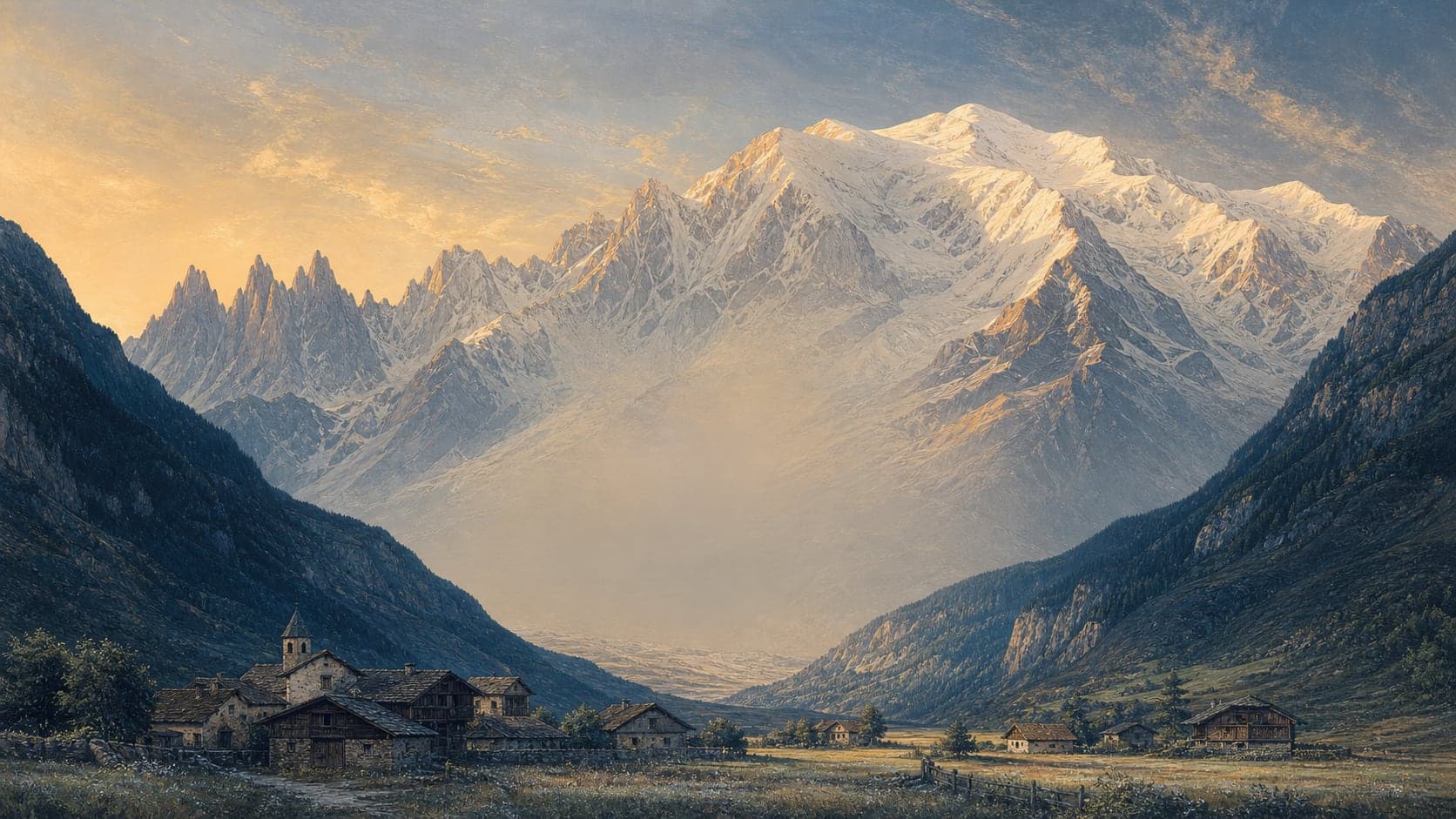
An original interpretive view of Chamonix beneath the Mont Blanc massif. It establishes the valley's geography without pretending to reconstruct an undocumented day.
- Visual description
- An original painted illustration of a small Alpine village beneath the snow-covered Mont Blanc massif at dawn.
- Nature
- illustration
- Made
- Created for The Archive of Days in 2026
- Medium
- AI-assisted digital painting, art-directed by PeakWave
- Source
- PeakWave original illustration · PeakWave original artworkInterpretive illustration, not historical evidence. Awaiting final visual review.
BEFORE SURVIVING RECORDS
Chamonix
A valley becomes the world’s high-mountain capital.
Scroll to follow the rope through time
A valley existed here long before anyone wrote its name.
Ice opened the passage. Water found the floor. People arrived before the surviving written record did. The honest beginning is not an empty valley, but a silence in the archive.
Sources for this chapter
Open ledger · AOD.CHX.V01 · ORIGINALClose ledger · AOD.CHX.V01
Ledger AOD.CHX.V01
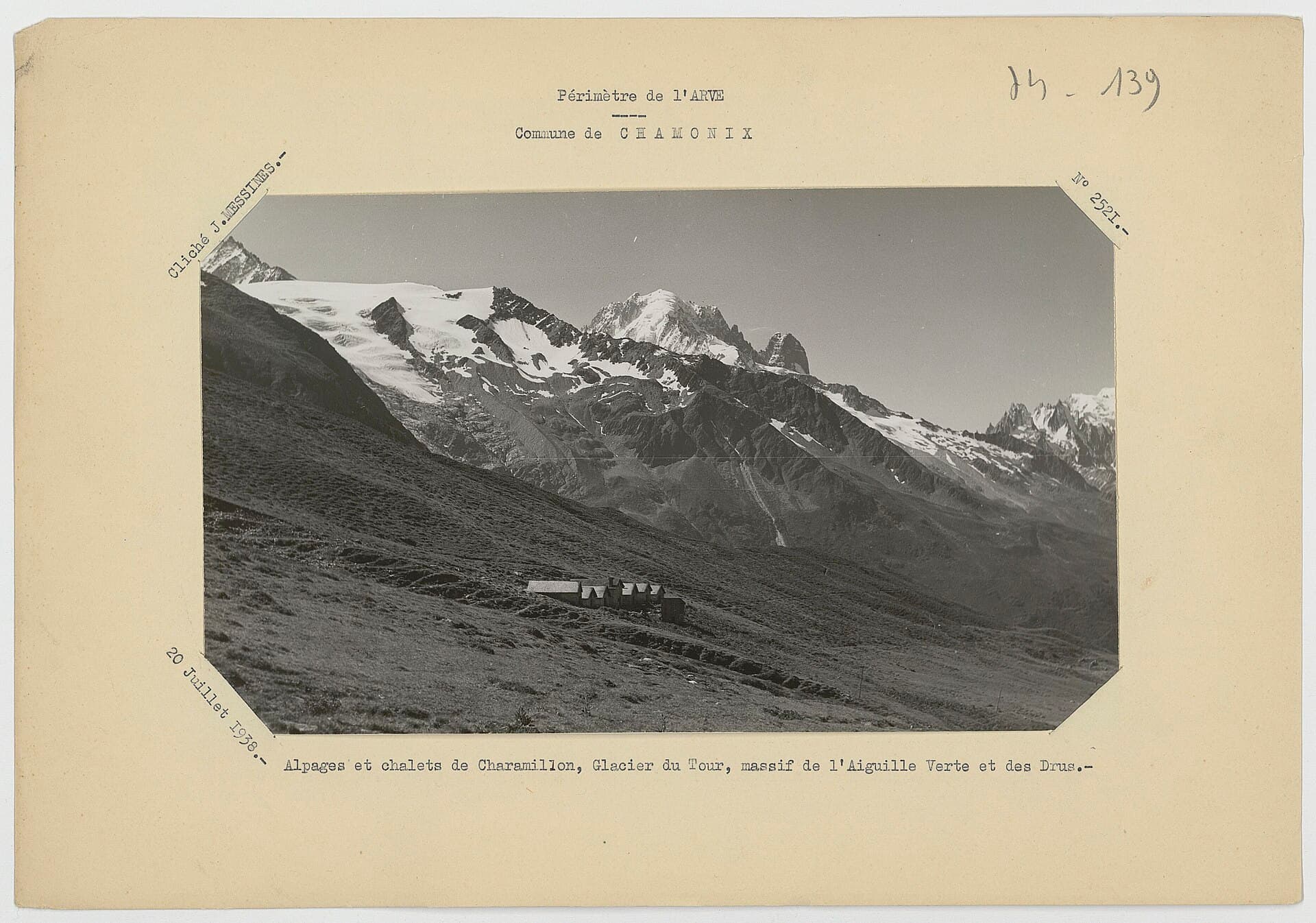
The high pasture at Charamillon, 1938
A later photograph of the valley's working landscape. The chalets, grazing ground and mountain wall preserve the pattern of life that followed the first written record.
- Visual description
- A 1938 catalogue photograph of chalets and grazing land beneath the glaciers and peaks above Charamillon.
- Nature
- original
- Made
- Photographed in 1938
- Medium
- Black-and-white photograph on a catalogue mount
- Source
- Bibliothèque nationale de France · Public domain, per the Wikimedia Commons file pageOpen licence checked on Wikimedia Commons. Awaiting final visual and rights review.
1091
The valley enters the record
In 1091, the valley appears on parchment.
Count Aymon I of Geneva gave the valley to the Benedictine abbey of Saint-Michel-de-la-Cluse. Monks later established a priory, a mill at Les Praz and a farm at Le Mollard. Around them was not a resort, but a chain of working hamlets.
The document uses a Latin name often read as Campum Munitum, an enclosed or fortified field. Historians have proposed several origins for Chamonix, including the possibility that the Latin was itself an attempt to explain an older local name. The name is real. Its first meaning remains contested.
- 1 to 5
- cows kept by many families
- Nov to May
- the long winter indoors
- Every cut
- of hay mattered
Open ledger · AOD.CHX.V02 · ILLUSTRATIONClose ledger · AOD.CHX.V02
Ledger AOD.CHX.V02
Beneath the cursed mountains
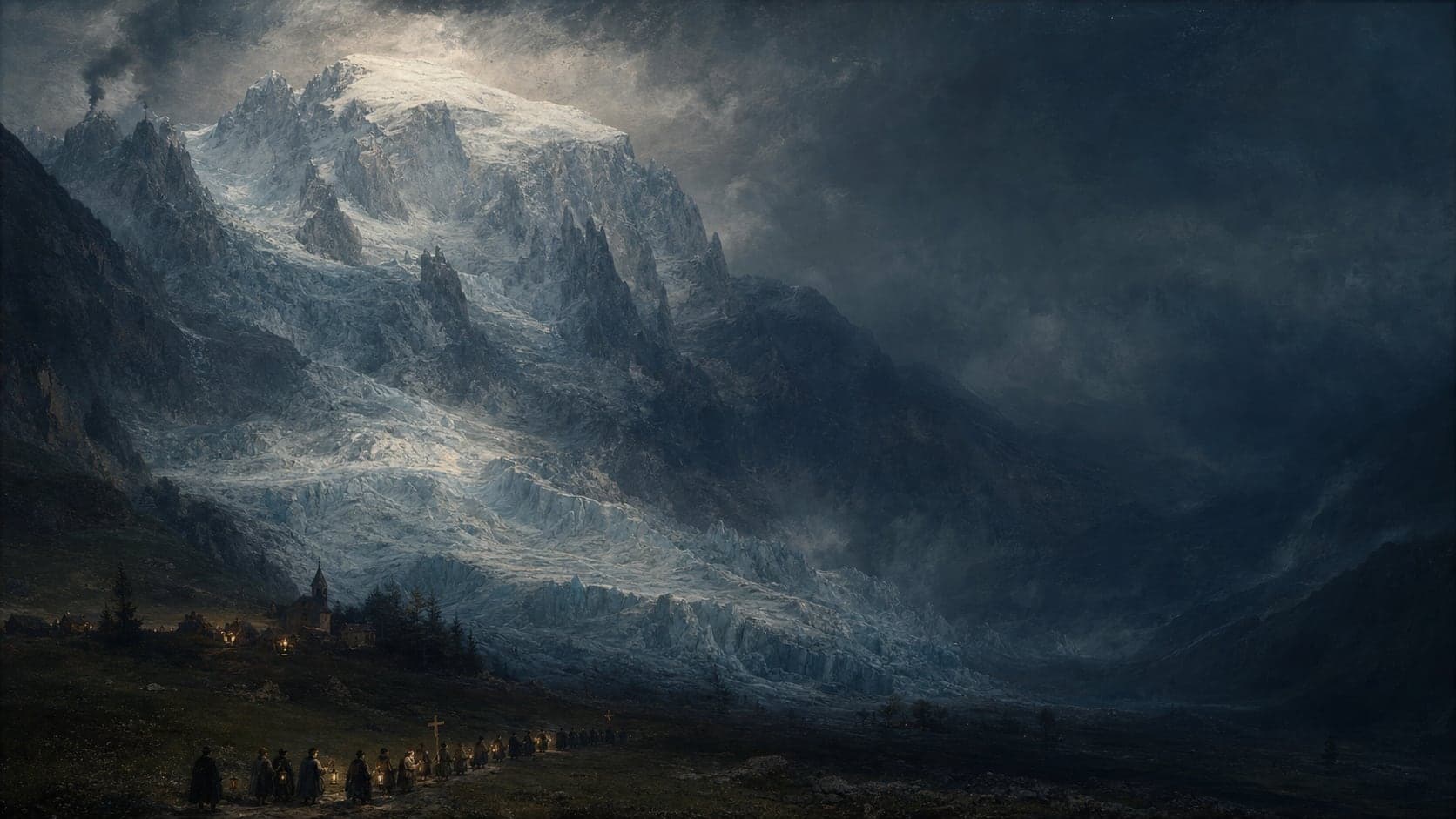
An original interpretation of the feared high valley, with a blessing procession placed in the landscape as cultural memory rather than documentary reconstruction.
- Visual description
- An original dark painted illustration of villagers carrying lanterns towards a glacier beneath the Mont Blanc massif.
- Nature
- illustration
- Made
- Created for The Archive of Days in 2026
- Medium
- AI-assisted digital painting, art-directed by PeakWave
- Source
- PeakWave original illustration · PeakWave original artworkInterpretive illustration, not historical evidence. Awaiting final visual review.
CENTURIES BEFORE TOURISM
Living beneath the cursed mountains
The summits were not invitations. They were warnings.
Families worked the safe ground below, cutting hay, raising livestock and watching ice advance towards fields and houses. Above them stood the Montagnes Maudites, the cursed mountains: dangerous, sterile and beyond ordinary human life. When the ice threatened the valley during the Little Ice Age, records describe residents walking towards the glaciers in blessing processions in 1644.
Sources for this chapter
Open ledger · AOD.CHX.V03 · ORIGINALClose ledger · AOD.CHX.V03
Ledger AOD.CHX.V03
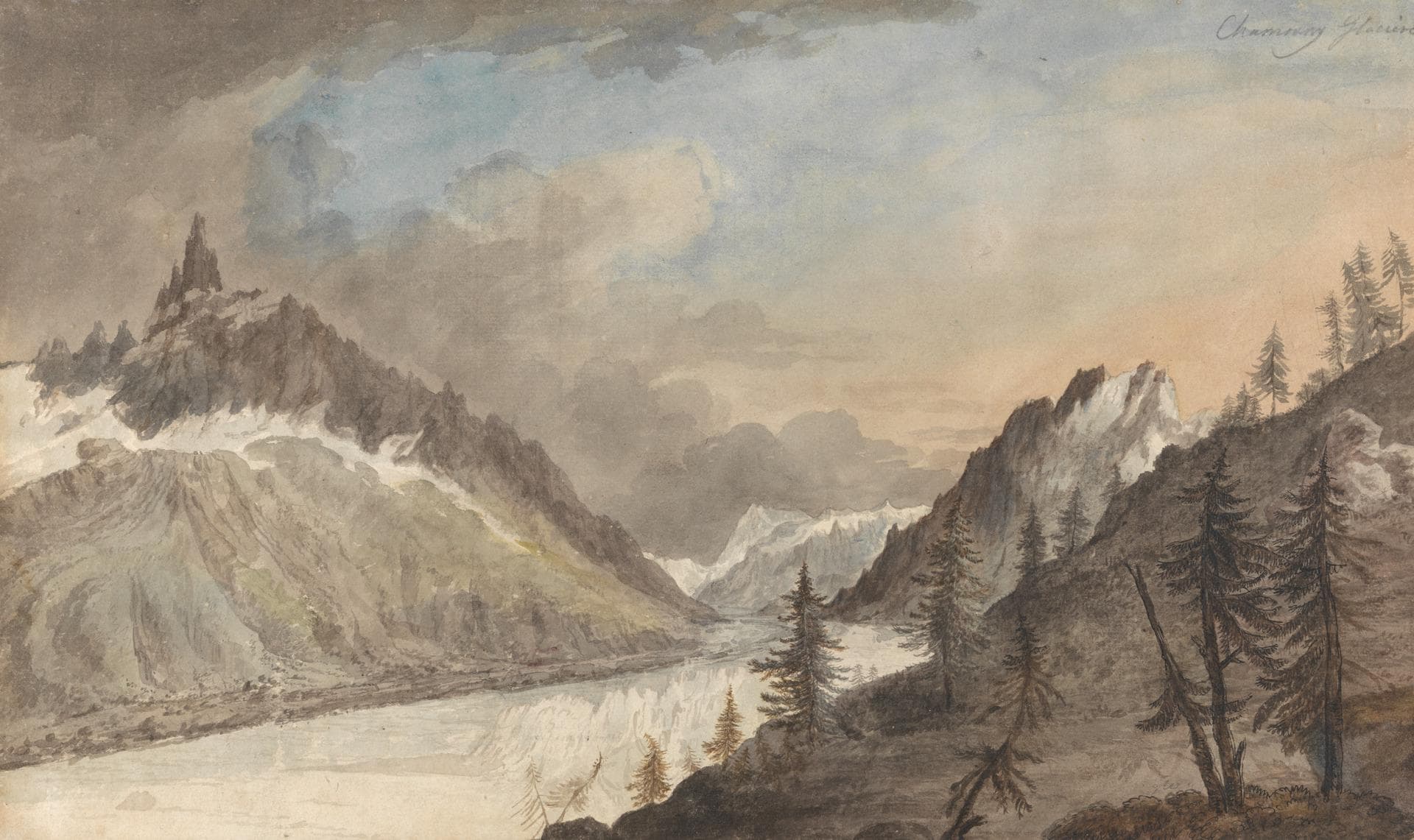
The Mer de Glace through an outsider's eyes
Charles Gore painted the glacier in 1778 or 1779, after travel writing had begun to turn Chamouny into a European spectacle.
- Visual description
- Charles Gore's late eighteenth-century watercolour of the Mer de Glace, framed by steep peaks and trees.
- Nature
- original
- Made
- Painted in 1778 or 1779
- Medium
- Watercolour, graphite and grey ink
- Source
- Yale Center for British Art · CC0, per the Wikimedia Commons file pageOpen licence checked on Wikimedia Commons. Awaiting final visual and rights review.
1741
Europe comes looking
In 1741, outsiders arrived and called it discovery.
William Windham and Richard Pococke travelled into the valley and helped turn the glaciers into a European sensation. Their accounts made Chamouny fashionable. They did not discover an empty valley. They discovered that the outside world wanted to visit it.
Sources for this chapter
Open ledger · AOD.CHX.V04 · ORIGINALClose ledger · AOD.CHX.V04
Ledger AOD.CHX.V04
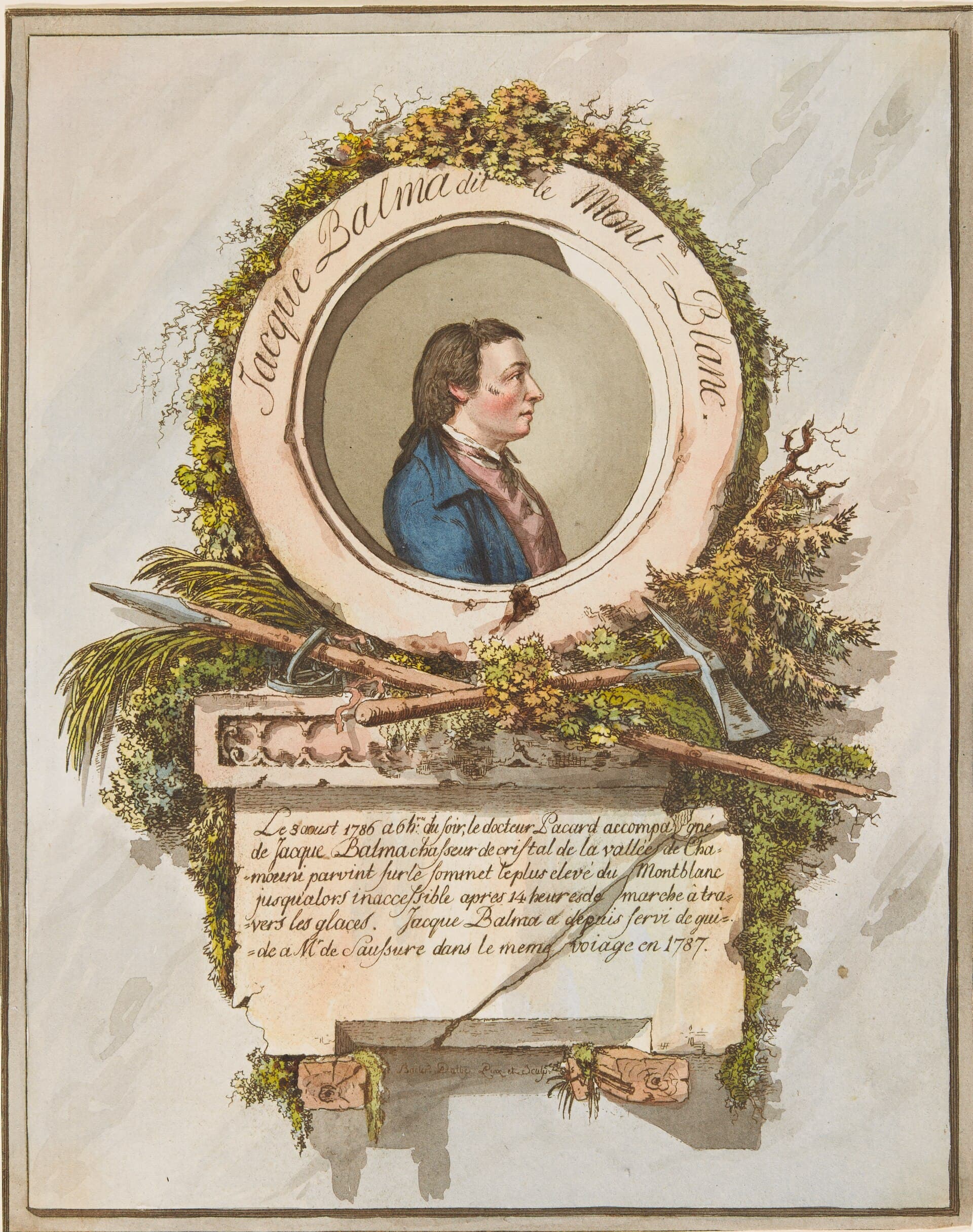
Jacques Balmat enters the legend
This 1789 portrait helped make Balmat the face of the first ascent. The cleaner heroic image should not conceal Michel Paccard's equal place on the summit.
- Visual description
- A coloured 1789 commemorative print of Jacques Balmat, shown in a portrait medallion above mountaineering tools.
- Nature
- original
- Made
- Published in 1789
- Medium
- Coloured print
- Source
- Swiss National Library, Prints and Drawings Department · Public domain, per the Wikimedia Commons file pageOpen licence checked on Wikimedia Commons. Awaiting final visual and rights review.
1760 TO 1821
The mountain becomes possible
A feared summit became a question: could anyone stand on it?
In 1760, Horace-Bénédict de Saussure offered a reward for a route to the top of Mont Blanc. Attempts accumulated for twenty-six years. Then, on 8 August 1786, Dr Michel-Gabriel Paccard and Jacques Balmat reached the summit. After a fatal accident in 1820, the valley organised its guiding profession. The Compagnie des Guides de Chamonix was founded in 1821.
THE HEROIC VERSION
Balmat alone drives the story
legendLater retellings elevated the crystal hunter into a solitary hero and allowed Paccard’s contribution to recede.
THE RECORD REOPENED
Paccard returns to the ascent
contestedHistorians returned to witnesses and instruments, restoring the doctor’s role without reducing Balmat’s.
The ascent matters. So does the way a valley decides who gets remembered.
Sources for this chapter
Open ledger · AOD.CHX.V05 · ORIGINALClose ledger · AOD.CHX.V05
Ledger AOD.CHX.V05
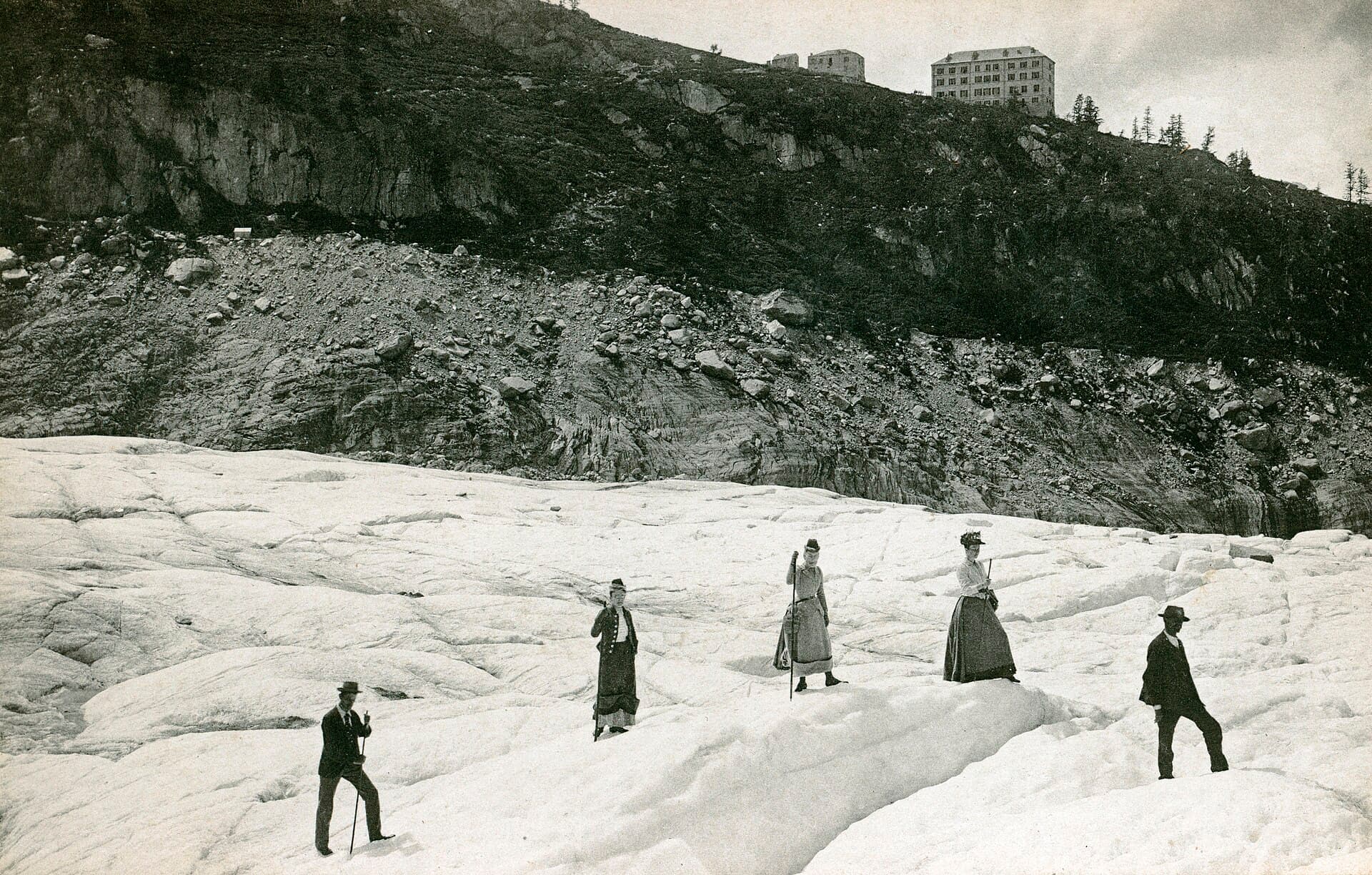
Visitors on the Mer de Glace, around 1900
The ice once described as cursed had become a promenade before the Montenvers railway reached it.
- Visual description
- Visitors in period dress standing and walking on the Mer de Glace around 1900.
- Nature
- original
- Made
- Photographed around 1900
- Medium
- Black-and-white photograph
- Source
- Wikimedia Commons · Public domain, per the Wikimedia Commons file pageOpen licence checked on Wikimedia Commons. Awaiting final visual and rights review.
1792 TO 1909
Borders move, visitors multiply
The mountains stayed. The country around them changed.
The valley passed into revolutionary France in 1792, returned to the Kingdom of Sardinia after 1815 and became definitively French with Savoy in 1860. Each change brought new administration, new visitors and new ways of selling the view.
The railway reached Chamonix in 1901. The Montenvers rack railway climbed towards the Mer de Glace by 1909. Some residents opposed it, fearing that easy access would alter the valley and take work from guides and muleteers. Progress arrived as an argument before it became a postcard.
Sources for this chapter
Open ledger · AOD.CHX.V06 · ORIGINALClose ledger · AOD.CHX.V06
Ledger AOD.CHX.V06
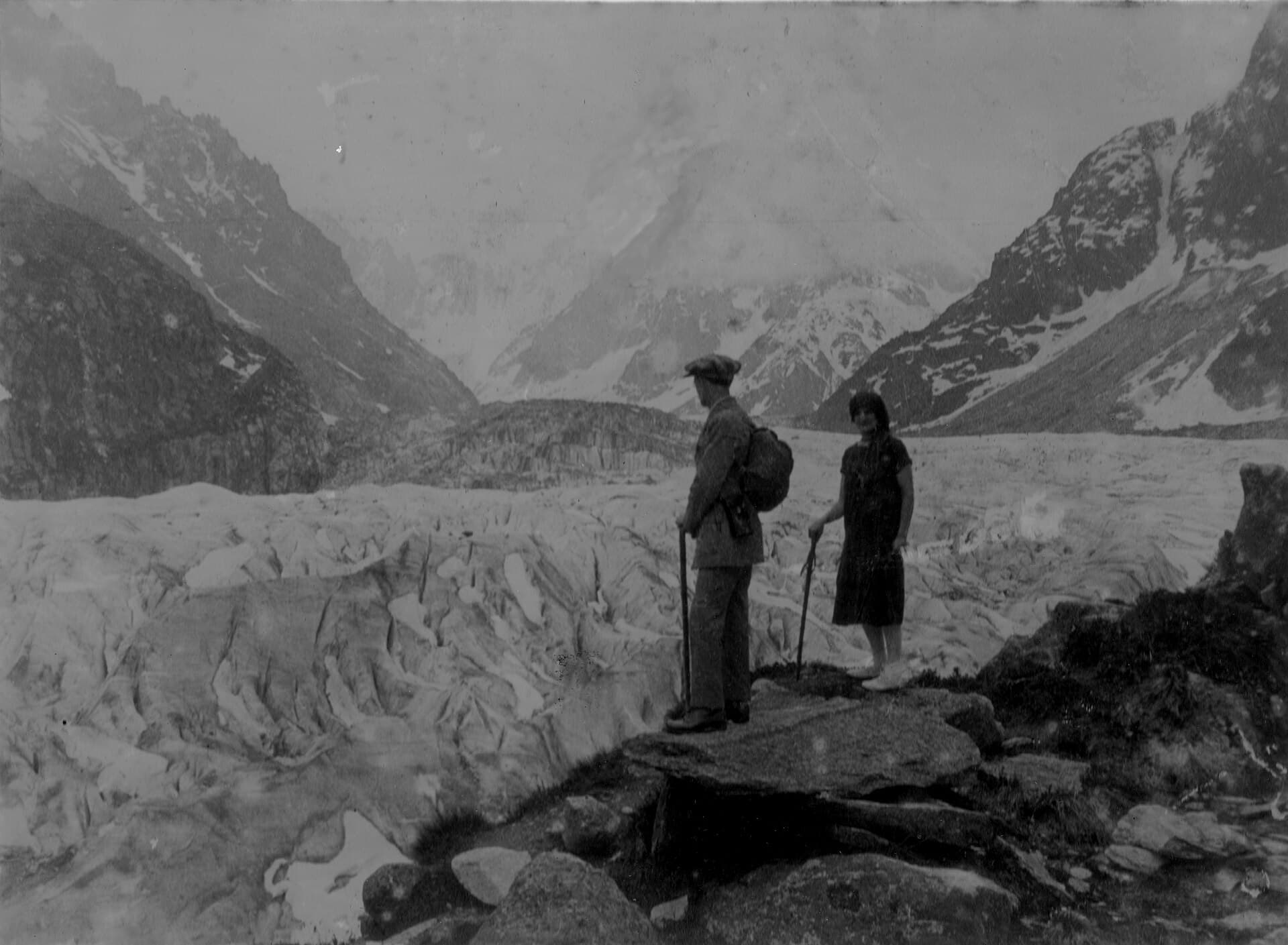
Chamonix-Mont-Blanc, June 1926
Visitors face the glacier less than five years after the commune formally added Mont-Blanc to its name.
- Visual description
- Two visitors look across the Mer de Glace towards steep mountain walls in June 1926.
- Nature
- original
- Made
- Photographed in June 1926
- Medium
- Black-and-white photograph
- Source
- Wikimedia Commons, scan contributed by Pierre Bachelot · Public domain, per the Wikimedia Commons file pageOpen licence checked on Wikimedia Commons. Awaiting final visual and rights review.
1921
The name becomes a destination
Mont-Blanc was added to the name on purpose.
Confusion in the postal service with places such as Chamoux was causing practical problems. Foreign correspondence sometimes arrived marked Chamonix Suisse. The council also understood the power of joining the town permanently to the mountain already known around the world.
On 25 November 1921, Chamonix officially became Chamonix-Mont-Blanc. A geographical relationship became an international identity.
Sources for this chapter
Open ledger · AOD.CHX.V07 · ORIGINALClose ledger · AOD.CHX.V07
Ledger AOD.CHX.V07
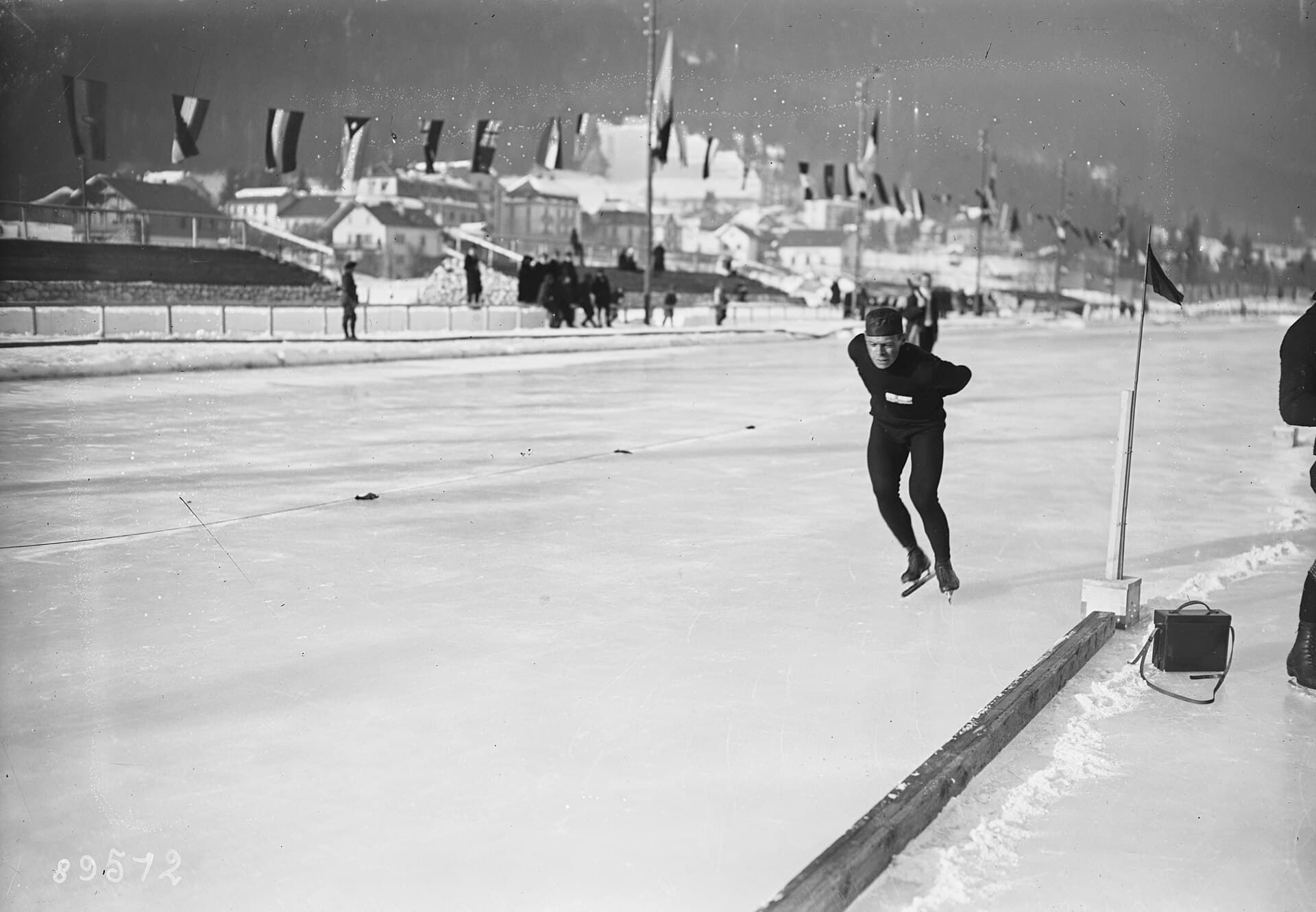
Clas Thunberg on the ice, 1924
The Finnish speed skater won three gold medals as Chamonix staged the first Olympic Winter Games.
- Visual description
- Speed skater Clas Thunberg races on the outdoor ice at Chamonix during the 1924 winter games.
- Nature
- original
- Made
- Photographed in 1924
- Medium
- Agence Rol press photograph
- Source
- Bibliothèque nationale de France, Agence Rol collection · Public domain, per the Wikimedia Commons file pageOpen licence checked on Wikimedia Commons. Awaiting final visual and rights review.
1924
Winter enters the world stage
For eleven days, winter became an international spectacle.
Chamonix hosted the International Winter Sports Week in 1924. It was recognised retrospectively as the first Olympic Winter Games in 1926. Athletes, journalists and spectators turned the valley into a prototype for modern winter sport.
Open ledger · AOD.CHX.030 · ILLUSTRATIONClose ledger · AOD.CHX.030
Ledger AOD.CHX.030
Opening day, staged from the record
An illustrated winter sky for 25 January 1924. Reanalysis data does not reach this date.
- Visual description
- A pale winter sky staged over the Chamonix valley for the opening day in 1924.
- Nature
- illustration
- Source
- Pending: Period weather reports remain under source verification.
Sources for this chapter
Open ledger · AOD.CHX.V08 · ORIGINALClose ledger · AOD.CHX.V08
Ledger AOD.CHX.V08
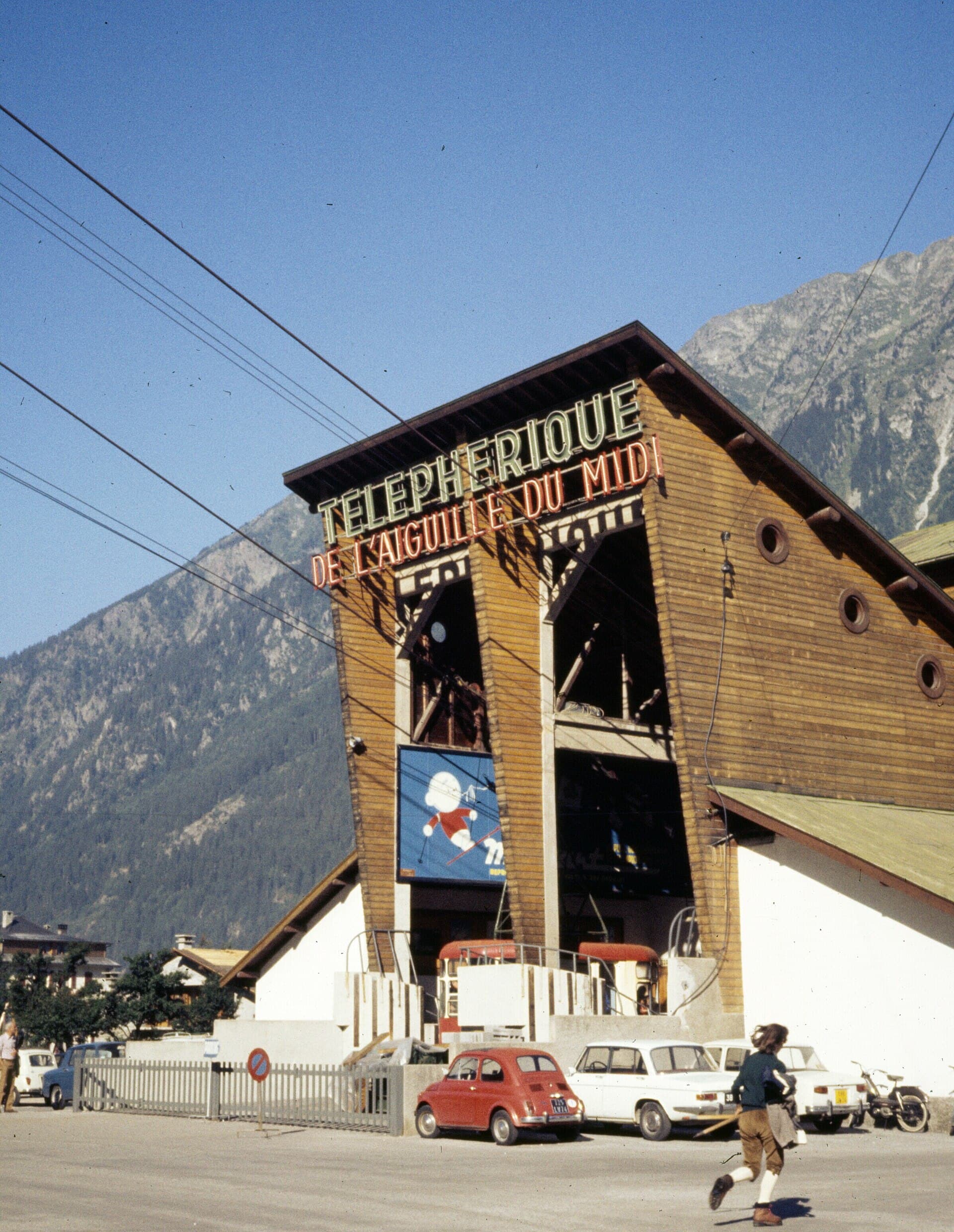
The Aiguille du Midi cable car, 1972
Engineering carried visitors into the high mountain at speed. The painted cabin and timber station belong to an earlier version of the same vertical promise.
- Visual description
- The timber cable-car station and a painted cabin at the Aiguille du Midi terminus in 1972.
- Nature
- original
- Made
- Photographed in 1972
- Medium
- Colour photograph
- Source
- Wikimedia Commons · CC BY-SA 3.0, A. T. Service, per the Wikimedia Commons file pageOpen licence checked on Wikimedia Commons. Awaiting final visual and rights review.
1955 TO 1999
The vertical century
The twentieth century taught the valley to move vertically.
The Aiguille du Midi cable car reached 3,842 metres in 1955. The Mont Blanc road tunnel opened in 1965. Skiing, climbing, science and engineering began to share the same improbable skyline.
Access created freedom and exposure at once. On 24 March 1999, a fire in the road tunnel killed 39 people. The valley’s history of movement also contains the days when movement stopped.
Sources for this chapter
Open ledger · AOD.CHX.V09 · ORIGINALClose ledger · AOD.CHX.V09
Ledger AOD.CHX.V09
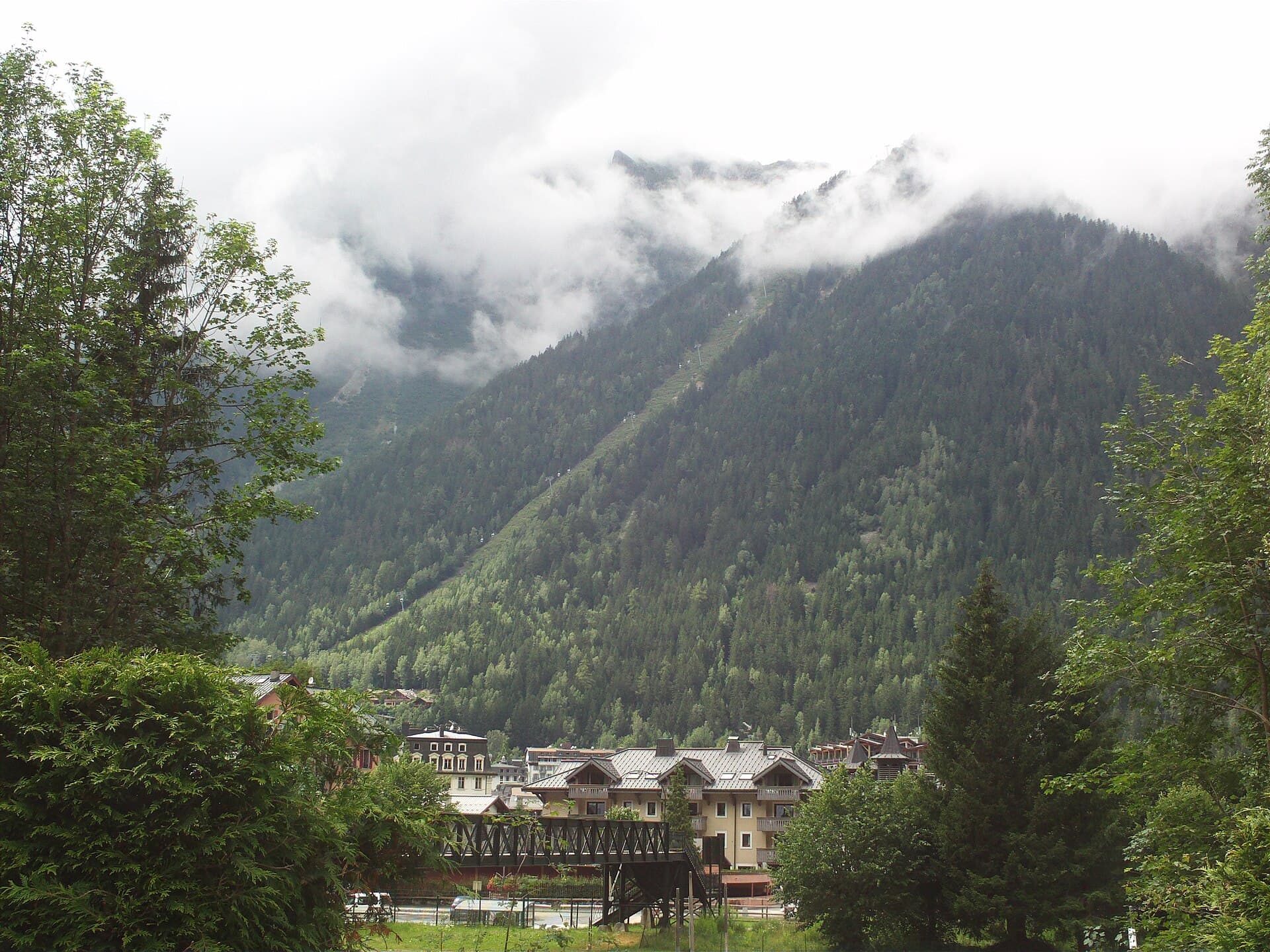
The capital in its valley, 2014
Chamonix is still a town beneath immense terrain, even after its name became shorthand for high-mountain sport around the world.
- Visual description
- Chamonix's roofs and trees sit below cloud-covered mountain walls in a 2014 view from the Montenvers railway.
- Nature
- original
- Made
- Photographed in 2014
- Medium
- Colour photograph
- Source
- Wikimedia Commons · CC0, Ypsilon from Finland, per the Wikimedia Commons file pageOpen licence checked on Wikimedia Commons. Awaiting final visual and rights review.
CHAMONIX TODAY
Capital of the high mountains
Today, Chamonix is less one resort than a world centre for moving through mountains.
Mountaineers, skiers, climbers, trail runners, scientists, rescuers and visitors arrive with different versions of the same question: what can be done here? The old rural village is now a top-tier international mountain destination, but the geography still refuses to become simple. Its ski sectors remain scattered along the valley. The mountain still dictates the plan.
- 110 km
- of pistes on Chamonix LePass
- 86 pistes
- 15 green, 30 blue, 27 red, 14 black
- 1,000 to 2,765 m
- piste altitude range
The principal ski sectors are not all interconnected. Brévent and Flégère are the linked exception.
Sources for this chapter
Open ledger · AOD.CHX.V10 · ORIGINALClose ledger · AOD.CHX.V10
Ledger AOD.CHX.V10
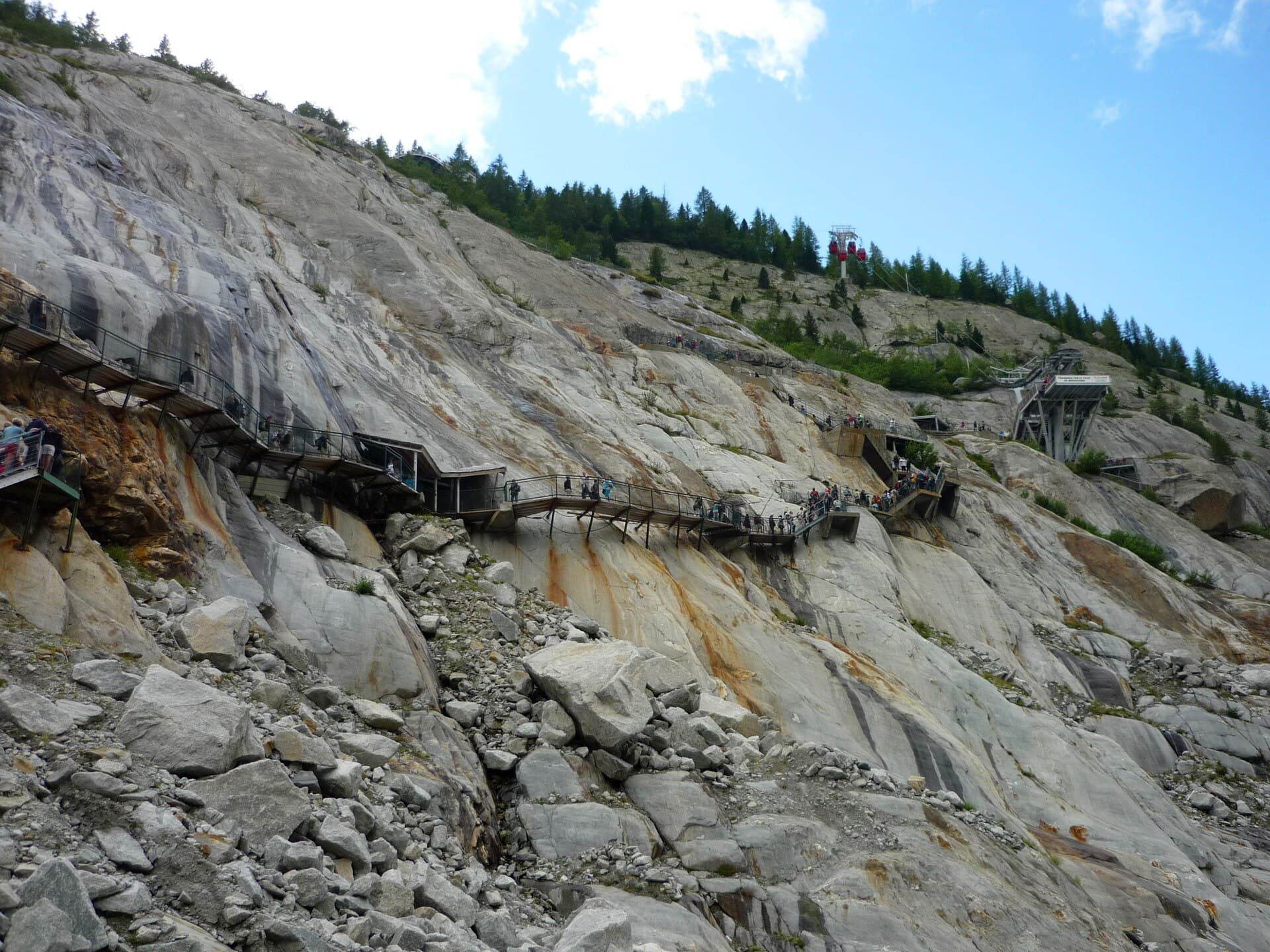
The staircase towards the Mer de Glace, 2010
The long descent from Montenvers makes a changing glacier physical. Access infrastructure has had to follow the ice down the rock.
- Visual description
- Metal staircases zigzag down bare rock towards the Mer de Glace in 2010.
- Nature
- original
- Made
- Photographed on 6 August 2010
- Medium
- Colour photograph
- Source
- Wikimedia Commons · CC BY-SA 3.0, Rémih, per the Wikimedia Commons file pageOpen licence checked on Wikimedia Commons. Awaiting final visual and rights review.
NOW
The price of becoming legendary
The same fame that sustains the valley can make it harder to remain a town.
The Mer de Glace retreats above Montenvers. Below it, Chamonix is confronting pressure on permanent homes, land and the services needed by year-round residents. The municipality’s planning work now explicitly seeks to protect permanent housing from further speculation.
This is not a verdict on tourism. It is the living question inside the postcard: how does a place welcome the world without becoming scenery for it?
Sources for this chapter
Open ledger · AOD.CHX.V11 · ORIGINALClose ledger · AOD.CHX.V11
Ledger AOD.CHX.V11
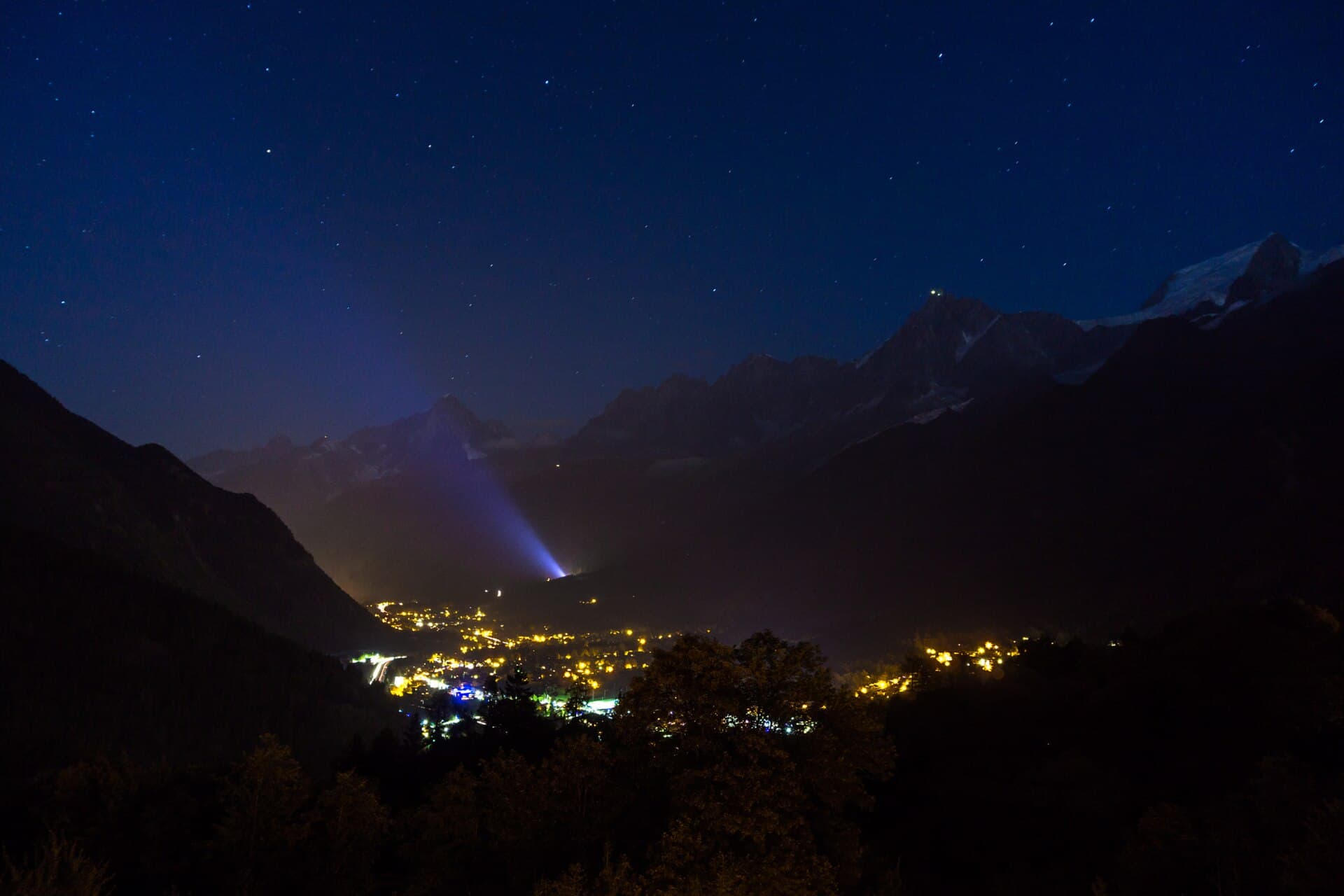
Chamonix at night, 2016
The illuminated town gathers at the foot of a mountain skyline that remains larger than every story told about it.
- Visual description
- The lights of Chamonix glow beneath a dark, starry mountain skyline at night in 2016.
- Nature
- original
- Made
- Photographed on 24 July 2016
- Medium
- Colour photograph
- Source
- Wikimedia Commons · CC BY-SA 3.0, Solarturtle, per the Wikimedia Commons file pageOpen licence checked on Wikimedia Commons. Awaiting final visual and rights review.
TONIGHT
The valley tonight
Live observation over the valley
ClearEvery seasonaire arrives inside somebody else’s history.
Tonight, farmers, guides, lift teams, hotel workers, rescuers, families, athletes and new arrivals share the same narrow floor beneath the summits.
Chamonix is not the story of a mountain conquered. It is the story of a valley that kept changing what the mountain meant.
Sources for this chapter
THE LEDGER
Sources and credits
History is made from surviving traces. Every chapter source and artefact record follows below, including the places where verification or image rights remain open.
Artefacts in order of appearance
The valley before the archive
AOD.CHX.V00 · illustration · PeakWave original illustration · PeakWave original artwork
The high pasture at Charamillon, 1938
AOD.CHX.V01 · original · Bibliothèque nationale de France · Public domain, per the Wikimedia Commons file page
Beneath the cursed mountains
AOD.CHX.V02 · illustration · PeakWave original illustration · PeakWave original artwork
The Mer de Glace through an outsider's eyes
AOD.CHX.V03 · original · Yale Center for British Art · CC0, per the Wikimedia Commons file page
Jacques Balmat enters the legend
AOD.CHX.V04 · original · Swiss National Library, Prints and Drawings Department · Public domain, per the Wikimedia Commons file page
Visitors on the Mer de Glace, around 1900
AOD.CHX.V05 · original · Wikimedia Commons · Public domain, per the Wikimedia Commons file page
Chamonix-Mont-Blanc, June 1926
AOD.CHX.V06 · original · Wikimedia Commons, scan contributed by Pierre Bachelot · Public domain, per the Wikimedia Commons file page
Clas Thunberg on the ice, 1924
AOD.CHX.V07 · original · Bibliothèque nationale de France, Agence Rol collection · Public domain, per the Wikimedia Commons file page
Opening day, staged from the record
AOD.CHX.030 · illustration · source pending
Period weather report
AOD.CHX.031 · facsimile · source pending
The Aiguille du Midi cable car, 1972
AOD.CHX.V08 · original · Wikimedia Commons · CC BY-SA 3.0, A. T. Service, per the Wikimedia Commons file page
The capital in its valley, 2014
AOD.CHX.V09 · original · Wikimedia Commons · CC0, Ypsilon from Finland, per the Wikimedia Commons file page
The staircase towards the Mer de Glace, 2010
AOD.CHX.V10 · original · Wikimedia Commons · CC BY-SA 3.0, Rémih, per the Wikimedia Commons file page
Chamonix at night, 2016
AOD.CHX.V11 · original · Wikimedia Commons · CC BY-SA 3.0, Solarturtle, per the Wikimedia Commons file page
Editorial record
Beta exhibition. Historical anchors are linked to municipal, museum, tourism and operator sources. Candidate artefact scans remain subject to human rights and provenance review before publication status changes.