Costa Rica · Central America
Not enough data yet. Log a session to help build the accuracy score.
This guide was generated from conditions data. Know this spot? Submit your own tips below.
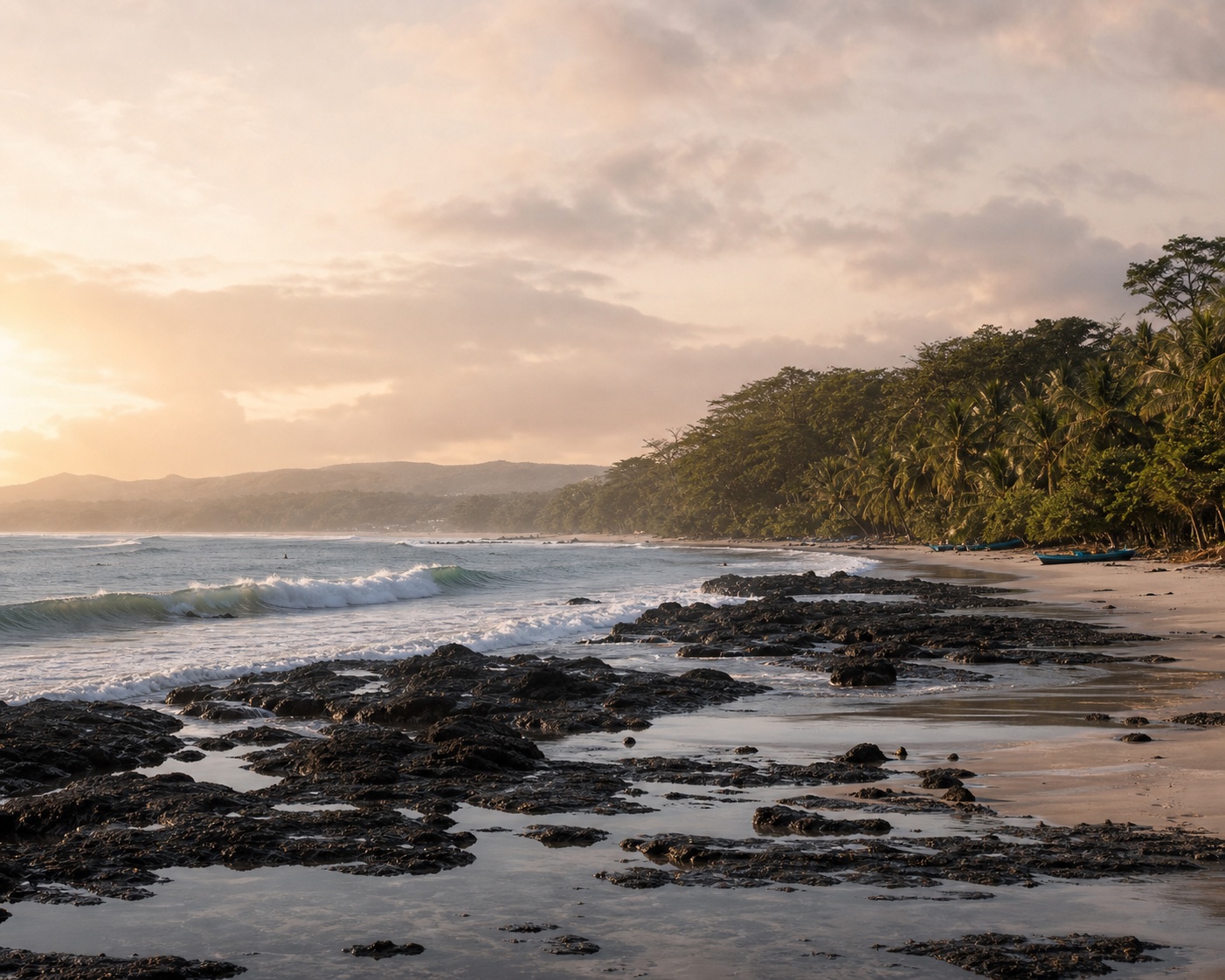
Santa Teresa is a powerful, consistent beach break on Costa Rica's Nicoya Peninsula, producing fast, punchy A-frames over mobile sandbars interspersed with rock outcroppings. The coastline faces directly south-west into the Pacific, capturing long-period groundswells with remarkable efficiency. The town has evolved into a vibrant surf community blending Costa Rican pura vida culture with international surf travellers. The waves here have genuine punch and regularly barrel on lower tides.
South-westerly Pacific groundswells arrive consistently from April through October, with the largest pulses in June and July. The wave works on 3-8ft swells. Easterly offshore winds provide clean conditions, most reliable at dawn. The dry season (December-April) has smaller but cleaner swells. Lower tides produce hollower, more powerful peaks while higher tides fatten the wave.
Multiple peaks stretch along several kilometres of coastline. The main beach in front of the town centre offers consistent A-frames. Playa Hermosa to the south produces heavier waves. Look for the sandbars that form between the scattered rock outcroppings; these create the most defined peaks. Position yourself on the outer bar where the sets first break.
The wave produces powerful, hollow peaks that break in shallow water on lower tides. Strong rip currents develop between the sandbars. Submerged rocks create fall hazards at certain points along the beach. The crowd is significant during peak season. Board collisions occur in the congested take-off zones.
Informal parking along the beachfront roads. The beach is immediately accessible from the town. Accommodation ranges from budget hostels to luxury villas. Surf schools and board rental are abundant. Full facilities line the main street.
Santa Teresa is one of Costa Rica's most popular surf destinations and crowds are significant during peak season (June-September and December-January). The main beach can hold 30-50 surfers on a good day. Walking north or south along the coast reveals quieter peaks. Dawn patrol offers the best window.
The wave changes character dramatically with tide. Low tide produces hollow, critical peaks suited to advanced surfers. High tide makes the wave fat and mushy. The sweet spot is a dropping mid-tide when the banks are defined but there is still adequate water depth. A standard performance shortboard handles most conditions. Check multiple spots along the coast; conditions vary between the scattered peaks. A motorbike is essential for mobility.
No recent check-ins. Be the first to report.
Record your session, conditions and gear.
Based on historical weekly averages
Combining historical conditions with school holiday crowd pressure to find the sweet spot.
How busy each week is based on school holiday overlap from feeder markets.
The timing score combines two signals: historical conditions quality (how good the skiing or surfing typically is in a given week, based on 5 years of weather data) and crowd pressure (how many of this destination's feeder markets have school holidays that week).
Crowd pressure is weighted by each feeder country's share of visitors. If 40% of a resort's visitors come from France and France is on holiday, that contributes 0.40 to the crowd pressure score. Crowds can reduce the timing score by up to 35%, ensuring conditions still matter most.
Scores: 5 = great conditions with low crowds (the sweet spot). 4 = great conditions with moderate crowds, or good conditions with low crowds. 3 = average. 2 = below average conditions or very crowded. 1 = poor conditions or peak holiday chaos.
Last 29 days of logged conditions.
Sign up to save favourite spots and get surf alerts
Create free accountCreate a free profile and let employers in Santa Teresa find you.
Create Profile →Current conditions refresh every 3 hours when the cron runs. Hourly data updates every 30 minutes. The 7-day forecast, luck factor, and packing notes are all pre-computed at the same time.
We compare the 7-day forecast to the last 5 years of marine data for the same week at Santa Teresa. The delta tells you whether conditions are shaping up better, worse, or about the same as a typical mid-June.
We score each day of the 7-day forecast using the same algorithm as the leaderboard, and highlight the highest scorer.
Open-Meteo's Marine API (swell height, period, water temperature) and Weather API (wind and conditions).
Honestly, no. Every break has tide windows, swell directions and reef contours that a global model cannot see. Treat the score as a starting point, then check a local cam.
The best week for surf at Santa Teresa is the week of 30 November (score 3/5) with low crowds.
Rideable waves with moderate energy. Reasonable period putting some grunt behind each wave. Light offshore grooming the faces nicely.
Heads up: thunderstorms forecast, and jellyfish: peak season.
Indicators derived from forecast data, not official warnings. Always check local lifeguard or official advice.
Crystal clear water: ~17m visibility
Daily scores over the last 12 months at Santa Teresa