Create a free profile and let employers in Varkala find you.
Create Profile →Current conditions refresh every 3 hours when the cron runs. Hourly data updates every 30 minutes. The 7-day forecast, luck factor, and packing notes are all pre-computed at the same time.
We compare the 7-day forecast to the last 5 years of marine data for the same week at Varkala. The delta tells you whether conditions are shaping up better, worse, or about the same as a typical early July.
We score each day of the 7-day forecast using the same algorithm as the leaderboard, and highlight the highest scorer.
Open-Meteo's Marine API (swell height, period, water temperature) and Weather API (wind and conditions).
Honestly, no. Every break has tide windows, swell directions and reef contours that a global model cannot see. Treat the score as a starting point, then check a local cam.
The best week for surf at Varkala is the week of 30 November (score 3/5) with low crowds.
Moderate swell providing fun waves for a session. Short-period wind swell: expect weak, crumbly faces. Moderate wind adding texture to the faces. Best conditions early morning before the sea breeze arrives.
Heads up: thunderstorms forecast, and jellyfish: peak season.
Indicators derived from forecast data, not official warnings. Always check local lifeguard or official advice.
The air here is 60% cleaner than the average comparison city right now.
Noticeably cleaner air than a typical city. Good conditions for prolonged outdoor activity.
Not a pollutant. Ozone is naturally higher at altitude and near the coast, and lower in cities where traffic exhaust breaks it down. High readings here typically indicate clean air. Can cause short-term airway irritation during intense exercise but is not linked to the long-term health risks of particulate pollution.
Additive health score: each pollutant contributes points relative to its WHO 2021 guideline and long-term health impact (PM2.5 9, NO₂ 5, O₃ 3, PM10 2, SO₂ 1 at WHO limits). Data via Open-Meteo. City markers show live readings. Red line marks the WHO guideline. Updated 03:00
Moderate water clarity: ~7m visibility
This guide was generated from conditions data. Know this spot? Submit your own tips below.
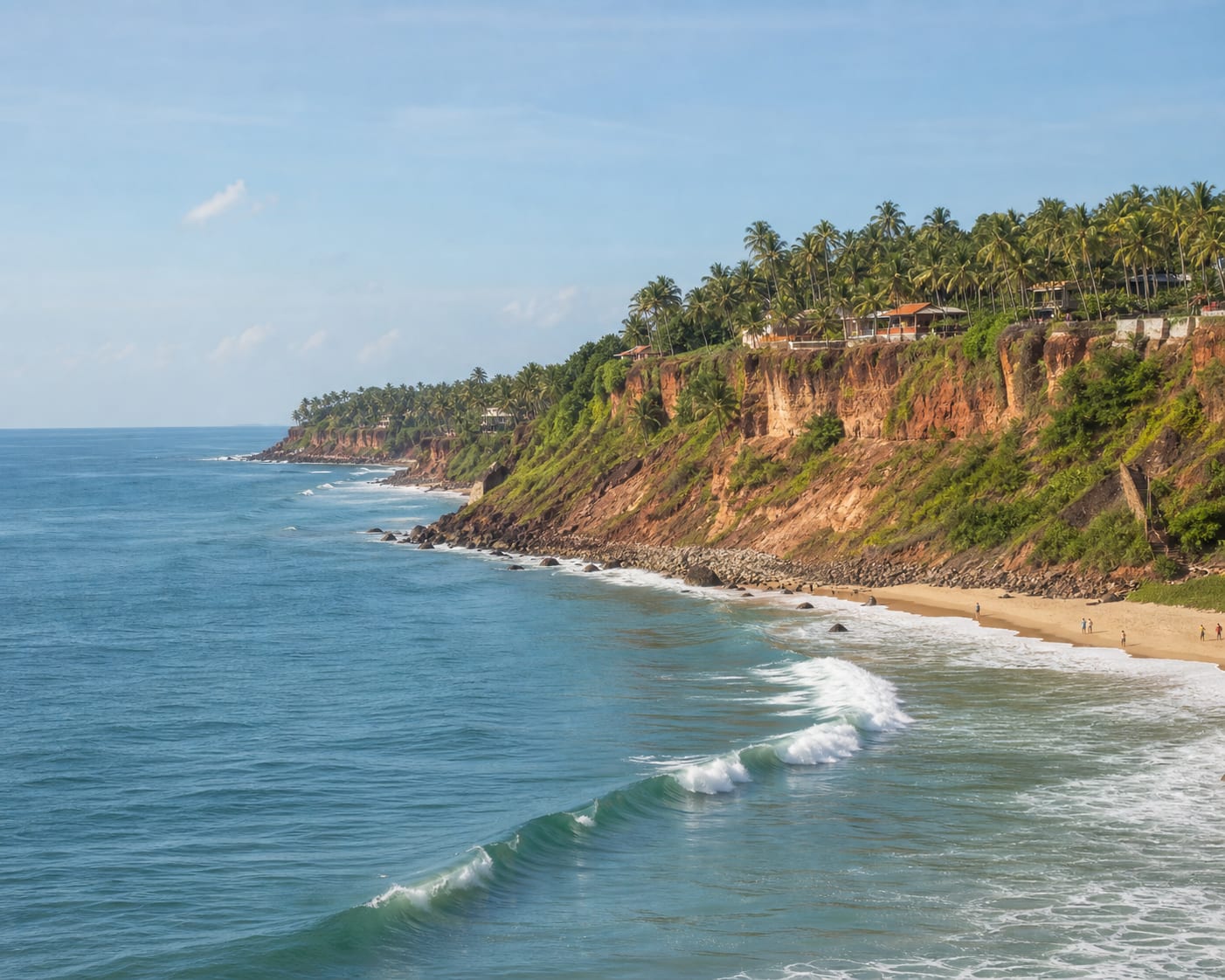
Varkala is an accessible beach break beneath dramatic red laterite cliffs in Kerala, southern India. The wave breaks over a gently sloping expanse of dark sand, producing soft, rolling waves that are ideal for beginners. The cliff-top setting with its cafes and shops overlooking the ocean provides a scenic backdrop. India's surf culture is young and growing, and Varkala offers one of the country's most consistent and accessible entry points.
South-westerly swells from the Indian Ocean arrive most consistently from May through September during the monsoon season. The wave works on 2-4ft of south-west swell. North-easterly winds during the winter season (October-February) provide offshore conditions on a different, calmer sea state. The winter months offer cleaner conditions with occasional small south swells.
The main beach below the cliff offers multiple peaks along its length. The centre of the beach typically has the most consistent banks. Beginners should stay in the whitewater. The inside reform section provides gentle, manageable waves for learning. The peaks are spread widely, offering space for everyone.
Minimal hazards. The sandy bottom is flat and forgiving. The monsoon season brings strong currents and larger, less predictable surf. The cliffs above are unstable in sections (do not walk near the edge after rain). Jellyfish appear seasonally. Basic water safety awareness is important.
Access via steep pathways from the cliff-top down to the beach. The cliff-top has accommodation, restaurants, and shops. No formal parking structures; informal roadside options. Board rental available from a few beach operators.
Varkala's surf community is small but growing. Most days see 5-10 surfers in the water. The atmosphere is friendly and encouraging. International visitors mix with a growing number of Indian surfers. The lack of established surf infrastructure means genuine frontier-surf vibes.
The water is warm (27-29C) year-round; board shorts and a rash vest suffice. A foam board or longboard maximises wave count on the gentle faces. The monsoon season provides the biggest waves but also the most dangerous conditions for beginners; the post-monsoon months (October-December) offer the best combination of clean conditions and manageable size. Support the growing Indian surf community by engaging with local operators.
Surf at Varkala
Your score
Forecast feel
Score this window against what you actually found.
No scored surf reviews in the last 24 hours.
No recent check-ins. Be the first to report.
Record your session, conditions and gear.
Daily scores over the last 12 months at Varkala
Based on historical weekly averages
See timing scores, school holiday busyness, and lift pass pricing to find the best time to book.
View Best Time to Go →Combining historical conditions with school holiday crowd pressure to find the sweet spot.
The timing score combines two signals: historical conditions quality (how good the skiing or surfing typically is in a given week, based on 5 years of weather data) and crowd pressure (how many of this destination's feeder markets have school holidays that week).
Crowd pressure is weighted by each feeder country's share of visitors. If 40% of a resort's visitors come from France and France is on holiday, that contributes 0.40 to the crowd pressure score. Crowds can reduce the timing score by up to 35%, ensuring conditions still matter most.
Scores: 5 = great conditions with low crowds (the sweet spot). 4 = great conditions with moderate crowds, or good conditions with low crowds. 3 = average. 2 = below average conditions or very crowded. 1 = poor conditions or peak holiday chaos.
Last 31 days of logged conditions.
Not enough data yet. Log a session to help build the accuracy score.