United States Β· North America
Not enough data yet. Log a session to help build the accuracy score.
This guide was generated from conditions data. Know this spot? Submit your own tips below.
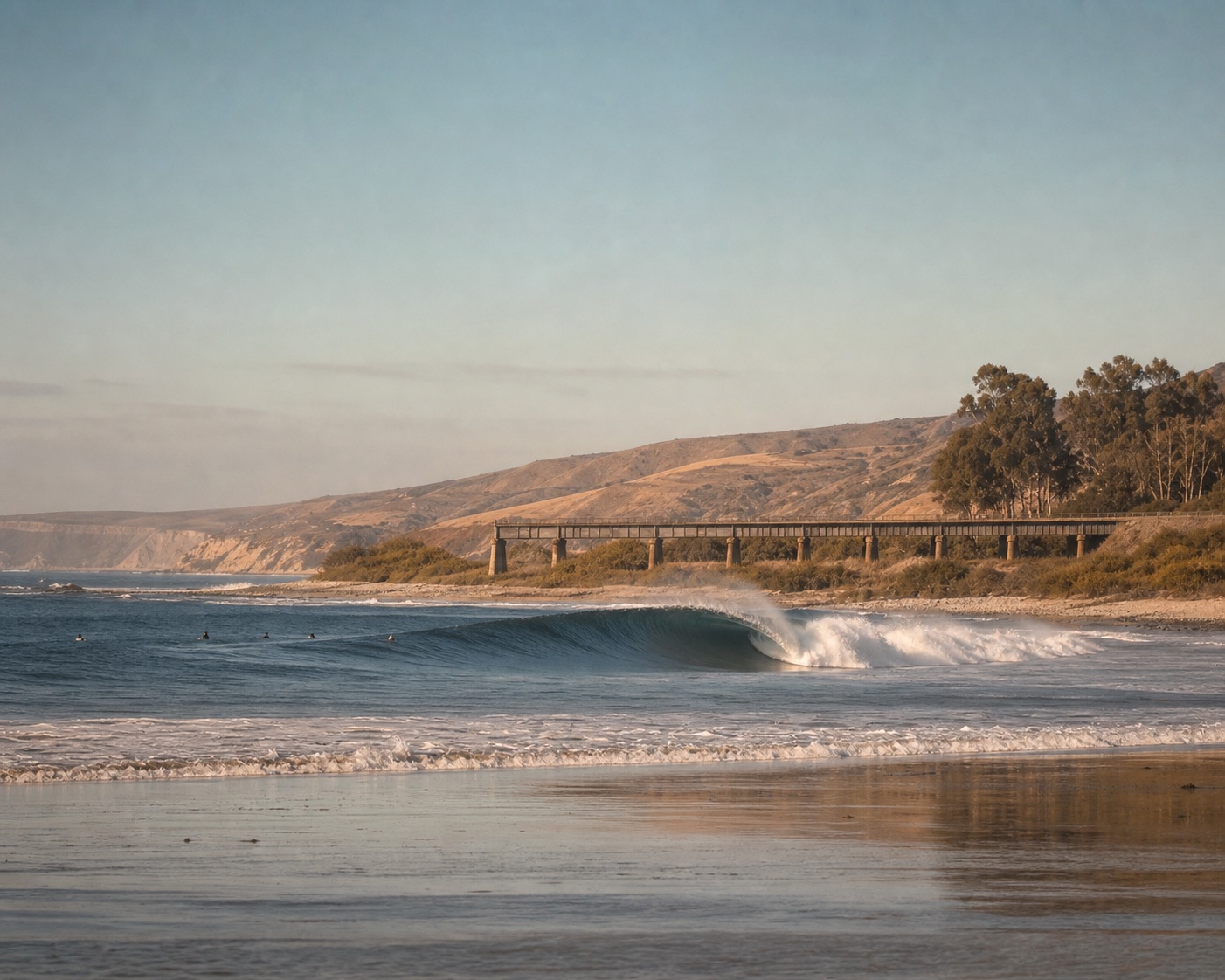
Lower Trestles is one of the world's most celebrated high-performance waves, a symmetrical cobblestone point break in San Clemente that has hosted countless professional competitions. The wave breaks over a uniform delta of smooth river cobblestones deposited by San Mateo Creek, producing near-perfect A-frame peaks that offer both a racing right and a punchy left. The wave is a canvas for progressive surfing, rewarding technical rail work and aerial manoeuvres equally.
Trestles picks up swell from virtually every direction. South swells from April through October produce the classic right-hander, while north-west winter swells from November through March activate the left and the outside sections. The sweet spot is a 3-6ft south to south-west swell with a light east or north-east offshore wind. The wave works across the tide range but tends to be best on a mid-tide when the cobblestones provide maximum shape without too much backwash.
The main peak at Lowers is well-defined, sitting where the creek deposits meet the deeper water. The right peels for 100-150 metres along the cobblestone bank, offering multiple turn sections. The left is shorter but punchier. Uppers, a few hundred metres to the north, catches north-west swells better and is less crowded. Church, to the south, offers a mellower alternative. At Lowers, sit just outside the boil where the cobblestones create a visible disruption in the water surface.
The cobblestone entry is painful on bare feet and treacherous when wet. Wear reef boots for the walk in and out. Rip currents can develop along the creek mouth after rain. The main hazard is honestly the crowd and the aggressive competition for waves. Stingrays inhabit the shallows during late summer. The creek outflow after heavy rain carries bacteria and should be avoided.
The walk in is the price of admission. Park at the San Onofre State Beach lot or the Carl's Jr lot on the inland side of the I-5, then walk approximately one mile down the dirt trail to the beach. The trail is flat but exposed to sun. No facilities exist at the beach itself. Carry water and sun protection.
Lowers is one of the most crowded waves in the world. On any rideable day, expect 50-100 surfers in the water. Professional surfers train here daily and the standard is exceptionally high. The competition for waves is intense and patience is mandatory. Dawn patrol before 7am offers the best window for catching waves without a fight. Mid-week is marginally better than weekends.
The right improves as the tide drops from high to mid. Time your session accordingly rather than battling the crowd at peak high tide when the wave is fat. Bring a board with extra volume for paddling power in the congested line-up. The walk in means you commit to at least a two-hour session, so fuel up beforehand. Watch the local pros for line selection; they read the A-frame peaks before anyone else and their positioning reveals where the next set will break.
No recent check-ins. Be the first to report.
Record your session, conditions and gear.
Based on historical weekly averages
Combining historical conditions with school holiday crowd pressure to find the sweet spot.
How busy each week is based on school holiday overlap from feeder markets.
The timing score combines two signals: historical conditions quality (how good the skiing or surfing typically is in a given week, based on 5 years of weather data) and crowd pressure (how many of this destination's feeder markets have school holidays that week).
Crowd pressure is weighted by each feeder country's share of visitors. If 40% of a resort's visitors come from France and France is on holiday, that contributes 0.40 to the crowd pressure score. Crowds can reduce the timing score by up to 35%, ensuring conditions still matter most.
Scores: 5 = great conditions with low crowds (the sweet spot). 4 = great conditions with moderate crowds, or good conditions with low crowds. 3 = average. 2 = below average conditions or very crowded. 1 = poor conditions or peak holiday chaos.
Last 28 days of logged conditions.
Sign up to save favourite spots and get surf alerts
Create free accountCreate a free profile and let employers in Trestles find you.
Create Profile βCurrent conditions refresh every 3 hours when the cron runs. Hourly data updates every 30 minutes. The 7-day forecast, luck factor, and packing notes are all pre-computed at the same time.
We compare the 7-day forecast to the last 5 years of marine data for the same week at Trestles. The delta tells you whether conditions are shaping up better, worse, or about the same as a typical mid-June.
We score each day of the 7-day forecast using the same algorithm as the leaderboard, and highlight the highest scorer.
Open-Meteo's Marine API (swell height, period, water temperature) and Weather API (wind and conditions).
Honestly, no. Every break has tide windows, swell directions and reef contours that a global model cannot see. Treat the score as a starting point, then check a local cam.
The best week for surf at Trestles is the week of 30 November (score 3/5) with low crowds.
Quality groundswell hitting the coast. Long-period energy means powerful, well-spaced sets. Gentle onshore putting some texture on the faces. Best conditions early morning before the sea breeze arrives.
Heads up: rip risk elevated, and rocks exposed at low tide.
Indicators derived from forecast data, not official warnings. Always check local lifeguard or official advice.
Good water clarity: ~13m visibility
Daily scores over the last 12 months at Trestles
See timing scores, school holiday busyness, and lift pass pricing to find the best time to book.
View Best Time to Go β