United States Β· North America
Not enough data yet. Log a session to help build the accuracy score.
This guide was generated from conditions data. Know this spot? Submit your own tips below.
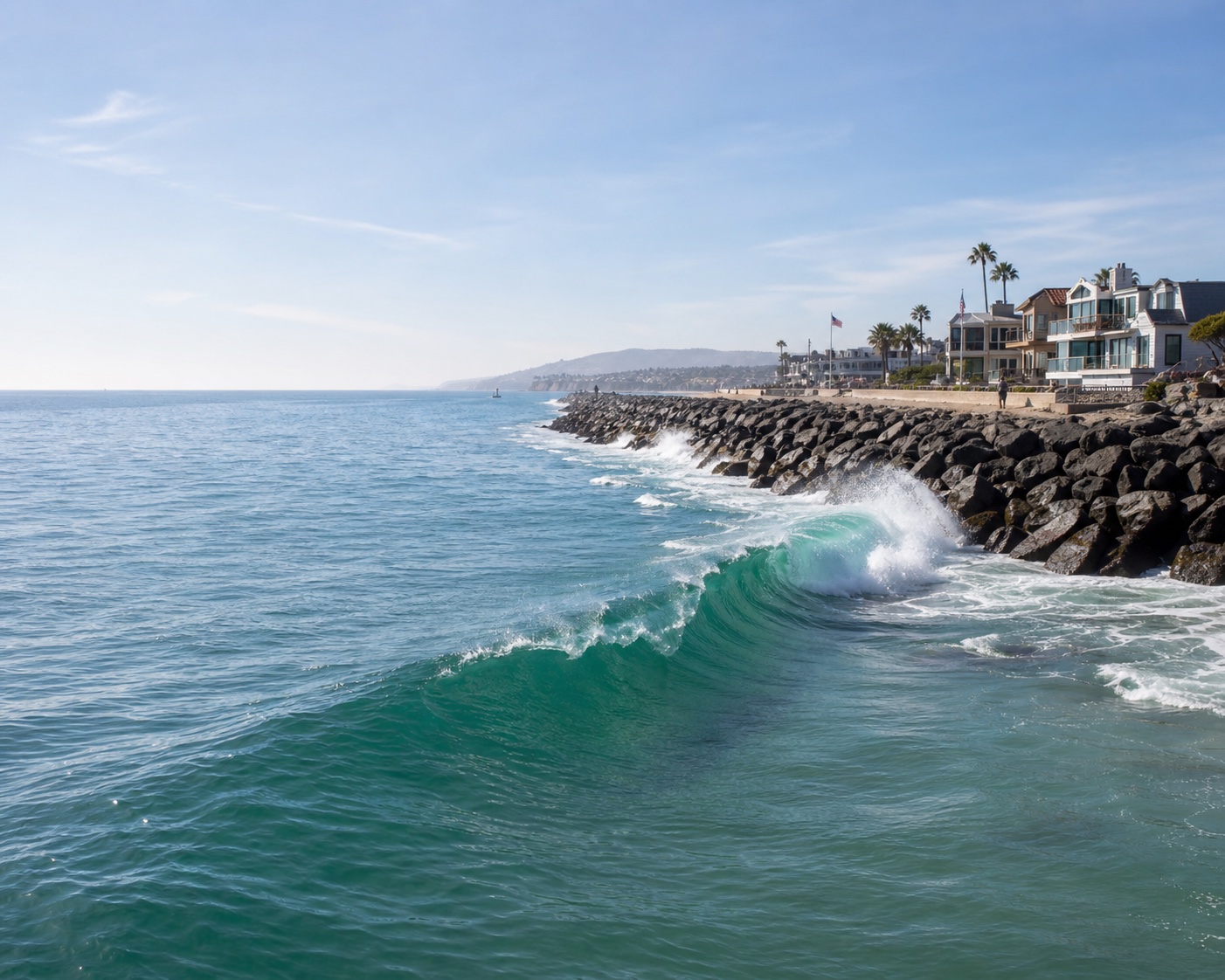
The Wedge is one of the most dangerous shorebreaks on the planet, a brutally powerful wave at the end of the Balboa Peninsula in Newport Beach, California. A man-made rock jetty reflects incoming south swells back onto a steep sandbar, creating a wedging effect that amplifies wave height and produces a near-vertical, violently plunging lip that detonates in inches of water. This is not a conventional surfing wave; it is a raw, explosive force of nature that attracts bodyboarders, bodysurfers, and a handful of certifiably brave stand-up surfers.
Southerly and south-westerly groundswells from April through October produce the most dramatic conditions. Long-period south swells that reflect cleanly off the jetty create the most pronounced wedge effect. The wave needs at least 4ft of swell to start wedging, and on solid 8-10ft days it produces waves that dwarf the original swell height. North-east offshore winds hold the faces up, most reliable at dawn.
The peak forms at the exact point where the reflected wave intersects with the primary incoming swell. This position shifts slightly with swell direction but is always within 50 metres of the jetty. Bodysurfers and bodyboarders position themselves at the peak. Stand-up surfers, when attempting it, take off further outside. The wave offers no rideable shoulder; it is a straight-up-and-down drop into an explosion of whitewater.
The wave breaks in extremely shallow water directly onto steeply graded sand. Spinal injuries, broken necks, and severe concussions have all occurred here. The hydraulic force is immense and unpredictable due to the intersecting wave energy. Being caught in the impact zone means being driven into the sand with tremendous force. The rock jetty is an additional hard surface to avoid. This is genuinely one of the most dangerous places to enter the ocean in California.
Street parking and metered lots are available on the Balboa Peninsula. The beach is immediately accessible and flat. Lifeguards monitor The Wedge and will close it to bodysurfing and bodyboarding when conditions become too dangerous. Pay attention to all posted warnings and lifeguard instructions.
The Wedge attracts a devoted community of bodysurfers and bodyboarders who have spent years learning its rhythms. Stand-up surfing is rare and only attempted by experienced big-wave surfers. Spectators line the beach in large numbers on big days. The crowd in the water is small due to the extreme consequences, but those present are highly experienced.
Do not approach The Wedge as a surfer unless you have extensive big-wave and heavy-water experience. This is primarily a bodysurfing and bodyboarding wave. Watch from the beach on a big day before ever entering the water. The reflected wave arrives from an unexpected angle and can catch even experienced watermen off guard. Swim fins and a solid pair of swim trunks are the standard equipment. The wave is more powerful than it looks from shore; the wedge effect concentrates energy in ways that are not visually obvious until you are in the water.
No recent check-ins. Be the first to report.
Record your session, conditions and gear.
Based on historical weekly averages
Combining historical conditions with school holiday crowd pressure to find the sweet spot.
How busy each week is based on school holiday overlap from feeder markets.
The timing score combines two signals: historical conditions quality (how good the skiing or surfing typically is in a given week, based on 5 years of weather data) and crowd pressure (how many of this destination's feeder markets have school holidays that week).
Crowd pressure is weighted by each feeder country's share of visitors. If 40% of a resort's visitors come from France and France is on holiday, that contributes 0.40 to the crowd pressure score. Crowds can reduce the timing score by up to 35%, ensuring conditions still matter most.
Scores: 5 = great conditions with low crowds (the sweet spot). 4 = great conditions with moderate crowds, or good conditions with low crowds. 3 = average. 2 = below average conditions or very crowded. 1 = poor conditions or peak holiday chaos.
Last 28 days of logged conditions.
Sign up to save favourite spots and get surf alerts
Create free accountCreate a free profile and let employers in The Wedge find you.
Create Profile βCurrent conditions refresh every 3 hours when the cron runs. Hourly data updates every 30 minutes. The 7-day forecast, luck factor, and packing notes are all pre-computed at the same time.
We compare the 7-day forecast to the last 5 years of marine data for the same week at The Wedge. The delta tells you whether conditions are shaping up better, worse, or about the same as a typical mid-June.
We score each day of the 7-day forecast using the same algorithm as the leaderboard, and highlight the highest scorer.
Open-Meteo's Marine API (swell height, period, water temperature) and Weather API (wind and conditions).
Honestly, no. Every break has tide windows, swell directions and reef contours that a global model cannot see. Treat the score as a starting point, then check a local cam.
The best week for surf at The Wedge is the week of 30 November (score 3/5) with low crowds.
Moderate swell providing fun waves for a session. Long-period groundswell delivering clean, organised lines. Light onshore crumble taking the edge off.
Heads up: rip risk elevated, and rocks exposed at low tide.
Indicators derived from forecast data, not official warnings. Always check local lifeguard or official advice.
Good water clarity: ~10m visibility
Daily scores over the last 12 months at The Wedge