Create a free profile and let employers in Tenerife find you.
Create Profile →Current conditions refresh every 3 hours when the cron runs. Hourly data updates every 30 minutes. The 7-day forecast, luck factor, and packing notes are all pre-computed at the same time.
We compare the 7-day forecast to the last 5 years of marine data for the same week at Tenerife. The delta tells you whether conditions are shaping up better, worse, or about the same as a typical early July.
We score each day of the 7-day forecast using the same algorithm as the leaderboard, and highlight the highest scorer.
Open-Meteo's Marine API (swell height, period, water temperature) and Weather API (wind and conditions).
Honestly, no. Every break has tide windows, swell directions and reef contours that a global model cannot see. Treat the score as a starting point, then check a local cam.
The best week for surf at Tenerife is the week of 23 November (score 3/5) with low crowds.
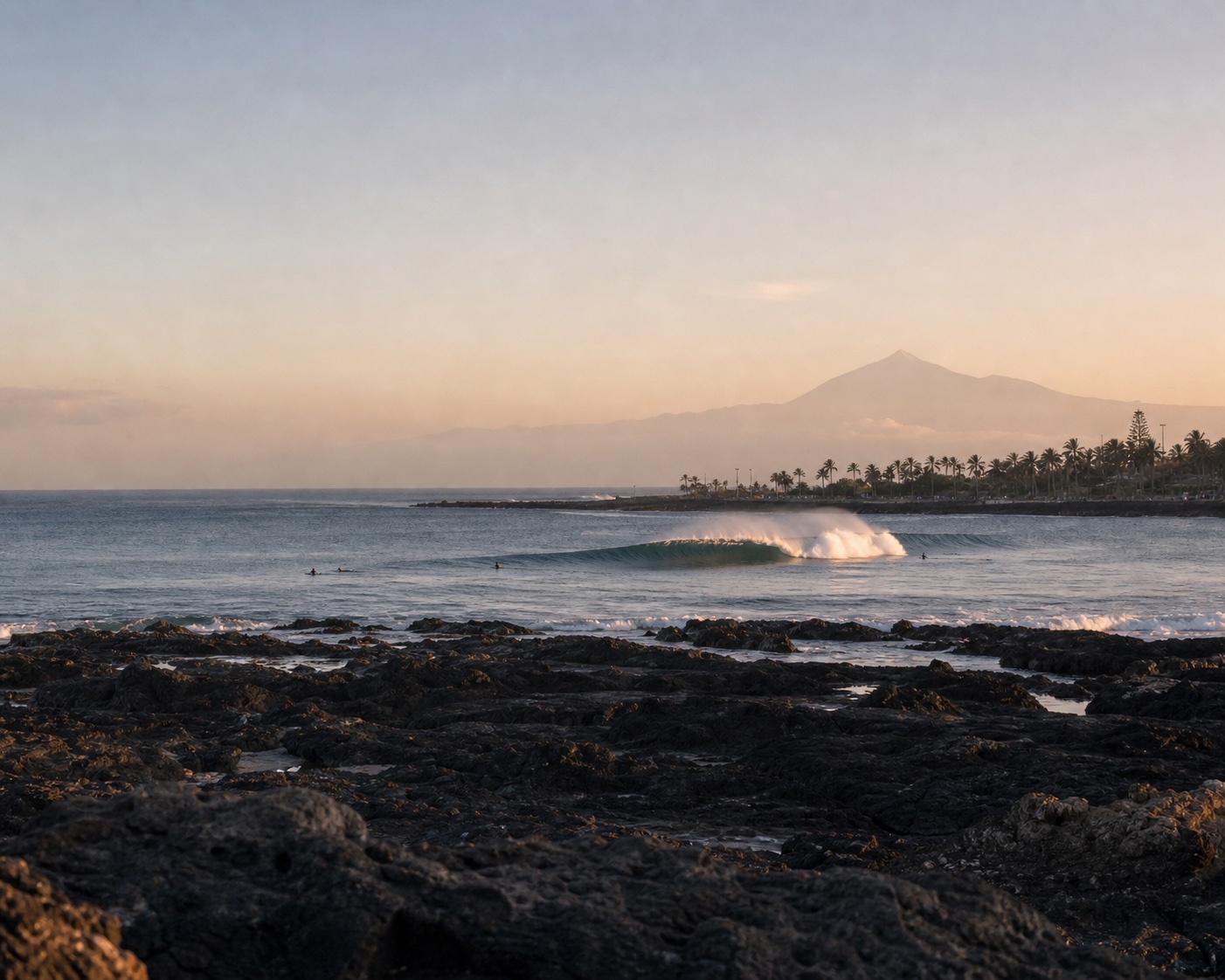
Moderate swell providing fun waves for a session. Light offshore holding the lip up. Clean rides on offer. Not enough swell to get this spot firing properly.
Heads up: jellyfish: peak season, and rocks exposed at low tide.
Indicators derived from forecast data, not official warnings. Always check local lifeguard or official advice.
The air here is 56% cleaner than the average comparison city right now.
Noticeably cleaner air than a typical city. Good conditions for prolonged outdoor activity.
Not a pollutant. Ozone is naturally higher at altitude and near the coast, and lower in cities where traffic exhaust breaks it down. High readings here typically indicate clean air. Can cause short-term airway irritation during intense exercise but is not linked to the long-term health risks of particulate pollution.
Additive health score: each pollutant contributes points relative to its WHO 2021 guideline and long-term health impact (PM2.5 9, NO₂ 5, O₃ 3, PM10 2, SO₂ 1 at WHO limits). Data via Open-Meteo. City markers show live readings. Red line marks the WHO guideline. Updated 03:00
Crystal clear water: ~26m visibility
This guide was generated from conditions data. Know this spot? Submit your own tips below.
Tenerife's northern coast offers powerful reef breaks over volcanic rock, with the area around Puerto de la Cruz and Bajamar being most popular. The island's north shore faces the full Atlantic and receives consistent swell. Multiple reefs produce quality waves ranging from intermediate-friendly to genuinely heavy. Las Americas on the south coast offers gentler options. The volcanic landscape and year-round warmth make it a popular European surf destination.
The north coast picks up north and north-westerly Atlantic swell. Trade winds (north-easterly) are cross-shore. Best at mid to high tide for most reef breaks. Consistent October through March. The 3-8ft range suits most spots. The south coast (Las Americas) works on south swells and is more sheltered.
Multiple breaks along the north coast. El Socorro (beach), Martianes (reef), and Bajamar pools all offer different experiences. Choose based on swell size and your ability. The reefs are for experienced surfers; beach breaks suit all levels.
Volcanic reef is sharp and shallow. Strong currents along the north coast. Powerful waves on bigger swells. The reefs demand respect and experience. Urchins are common. The south coast is much safer.
Various parking options at each spot. The north coast involves cliff access at some reefs. Las Americas (south) has easy beach access. Well-developed tourist infrastructure throughout.
Busy at the popular spots, particularly the south coast breaks which are accessible to all levels. The north coast reefs have smaller, more dedicated crowds. Surf schools are plentiful. Winter brings European surf tourists.
Tenerife offers genuine variety: heavy north coast reefs for experienced surfers and mellow south coast beach breaks for learners. Plan your spot based on the swell direction and your ability. The island is large, so driving between coasts takes 60-90 minutes. The local food (papas arrugadas, mojo sauce) is a highlight. Water temperature is comfortable year-round with a 3/2 or shortie.
Surf at Tenerife
Your score
Forecast feel
Score this window against what you actually found.
No scored surf reviews in the last 24 hours.
No recent check-ins. Be the first to report.
Record your session, conditions and gear.
Daily scores over the last 12 months at Tenerife
Based on historical weekly averages
Conditions at Tenerife tend to be best between 08:00 to 11:00 in July.
Average score during this window: 29/100
See timing scores, school holiday busyness, and lift pass pricing to find the best time to book.
View Best Time to Go →Combining historical conditions with school holiday crowd pressure to find the sweet spot.
The timing score combines two signals: historical conditions quality (how good the skiing or surfing typically is in a given week, based on 5 years of weather data) and crowd pressure (how many of this destination's feeder markets have school holidays that week).
Crowd pressure is weighted by each feeder country's share of visitors. If 40% of a resort's visitors come from France and France is on holiday, that contributes 0.40 to the crowd pressure score. Crowds can reduce the timing score by up to 35%, ensuring conditions still matter most.
Scores: 5 = great conditions with low crowds (the sweet spot). 4 = great conditions with moderate crowds, or good conditions with low crowds. 3 = average. 2 = below average conditions or very crowded. 1 = poor conditions or peak holiday chaos.
Last 31 days of logged conditions.
Not enough data yet. Log a session to help build the accuracy score.