Philippines · Indo-Pacific
Not enough data yet. Log a session to help build the accuracy score.
This guide was generated from conditions data. Know this spot? Submit your own tips below.
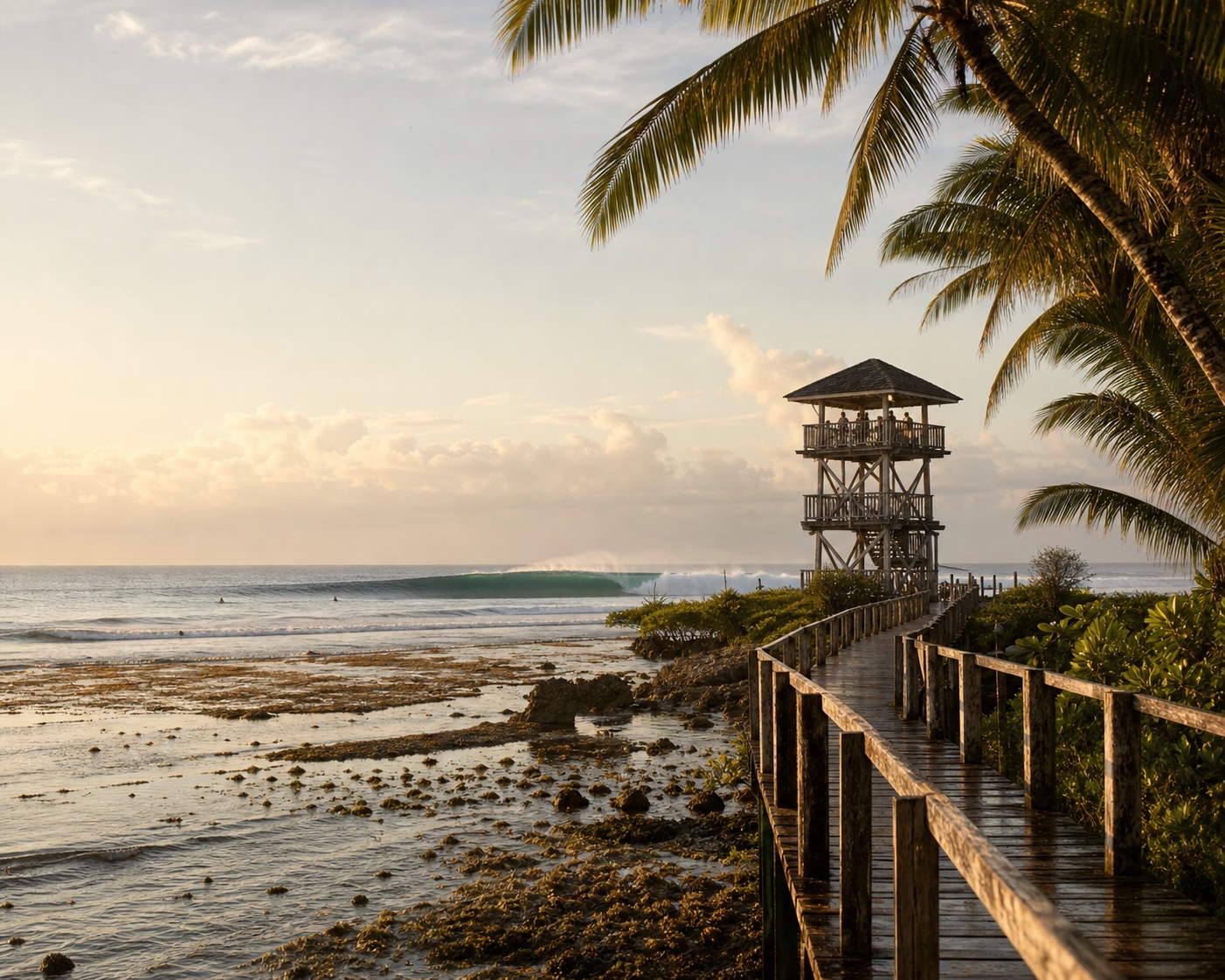
Cloud 9 is the Philippines' most famous wave, a shallow right-hand reef break on Siargao Island that produces thick, powerful barrels over a dangerously shallow coral shelf. The wave pitches top-to-bottom immediately from the take-off, offering virtually no shoulder for preliminary turns. You are either in the barrel or you are on the reef. The boardwalk extending over the reef provides a spectacular viewing platform, and the island's remote tropical beauty has made it a pilgrimage destination for travelling surfers.
The primary season runs from August through November when Pacific typhoon systems generate easterly groundswells that push directly into the reef. September and October typically see the largest, most consistent swells. The wave needs at least 4ft of east swell to properly activate. Westerly offshore winds are most reliable in the mornings before the trade winds establish. The dry season (March-May) can also produce rideable conditions on south-east swells.
The take-off zone is extremely concentrated over the shallowest section of the reef. The peak breaks in the same spot every time. Sit just beyond the boil where the water is slightly deeper, and stroke into position as the set approaches. The drop is steep and immediate, requiring you to bottom turn directly into the barrel without hesitation. The deep-water channel to the south provides entry and exit.
The coral reef is centimetres below the surface and razor-sharp. Any wipeout means direct impact with the reef. The wave breaks with severe hydraulic force, driving you down and across the coral. Hold-downs are disorienting and the shallow water amplifies the violence. Strong currents sweep across the reef during tidal changes. Medical facilities on Siargao are limited. Infected coral cuts are near-guaranteed without immediate treatment.
Motorbike parking is available at the Cloud 9 boardwalk. A small entrance fee provides access to the viewing platform. The paddle-out from the beach via the channel takes 10 minutes. Several surf resorts and hostels operate within walking distance of the break. Siargao is accessed by plane from Manila or Cebu to Sayak airport.
Cloud 9 is Siargao's primary attraction and draws a constant stream of international surf tourists. Expect 15-25 surfers on good days, which is significant given the concentrated peak. The Filipino local crew is skilled and commands respect. Competition for the deepest position is intense. Dawn patrol offers the best window before the crowd builds.
Do not paddle out at Cloud 9 unless you are genuinely comfortable pulling into fast, shallow, heavy barrels. The wave is not forgiving to hesitation or poor positioning. Bring reef boots, a helmet, and comprehensive first aid supplies. The barrel is shorter than it looks from the boardwalk but significantly more powerful. Mid-tide provides the safest water depth while maintaining barrel shape. Stimpy's, a softer right-hander nearby, offers a good warm-up and confidence builder before committing to Cloud 9.
No recent check-ins. Be the first to report.
Record your session, conditions and gear.
Based on historical weekly averages
Combining historical conditions with school holiday crowd pressure to find the sweet spot.
How busy each week is based on school holiday overlap from feeder markets.
The timing score combines two signals: historical conditions quality (how good the skiing or surfing typically is in a given week, based on 5 years of weather data) and crowd pressure (how many of this destination's feeder markets have school holidays that week).
Crowd pressure is weighted by each feeder country's share of visitors. If 40% of a resort's visitors come from France and France is on holiday, that contributes 0.40 to the crowd pressure score. Crowds can reduce the timing score by up to 35%, ensuring conditions still matter most.
Scores: 5 = great conditions with low crowds (the sweet spot). 4 = great conditions with moderate crowds, or good conditions with low crowds. 3 = average. 2 = below average conditions or very crowded. 1 = poor conditions or peak holiday chaos.
Last 28 days of logged conditions.
Sign up to save favourite spots and get surf alerts
Create free accountCreate a free profile and let employers in Siargao/Cloud 9 find you.
Create Profile →Current conditions refresh every 3 hours when the cron runs. Hourly data updates every 30 minutes. The 7-day forecast, luck factor, and packing notes are all pre-computed at the same time.
We compare the 7-day forecast to the last 5 years of marine data for the same week at Siargao/Cloud 9. The delta tells you whether conditions are shaping up better, worse, or about the same as a typical mid-June.
We score each day of the 7-day forecast using the same algorithm as the leaderboard, and highlight the highest scorer.
Open-Meteo's Marine API (swell height, period, water temperature) and Weather API (wind and conditions).
Honestly, no. Every break has tide windows, swell directions and reef contours that a global model cannot see. Treat the score as a starting point, then check a local cam.
The best week for surf at Siargao/Cloud 9 is the week of 30 November (score 3/5) with low crowds.
Next to nothing in the water. Check back tomorrow. Light offshore holding the lip up. Clean rides on offer. Conditions improving through the afternoon. Not enough swell to get this spot firing properly.
Heads up: thunderstorms forecast, and jellyfish: peak season.
Indicators derived from forecast data, not official warnings. Always check local lifeguard or official advice.
Crystal clear water: ~36m visibility
Daily scores over the last 12 months at Siargao/Cloud 9