Each location is refreshed once every three hours. The hourly view, 7-day forecast, luck factor and packing notes come from the same stored update.
We compare the 7-day forecast with the version-matched historical observations available for the same time of year at Sayulita. The delta shows whether conditions look better, worse or about the same as a typical late July.
We score each day of the 7-day forecast using the same algorithm as the leaderboard, and highlight the highest scorer.
Open-Meteo's Marine API (swell height, period, water temperature) and Weather API (wind and conditions).
Enough swell for a fun paddle. Nothing heroic, but enjoyable. Light offshore grooming the faces nicely. Conditions improving through the afternoon.
PeakWave scores are planning signals, not safety clearance. Check local authorities, official bulletins and on-site conditions before you go. Read our editorial policy.
Sayulita is a sheltered, right-hand point break situated in a cove along the Riviera Nayarit in Mexico. The bathymetry comprises an uneven mix of cobblestones and sandy patches that extend outward from the southern headland. Because the bay is recessed, it effectively filters raw south-westerly Pacific groundswells, significantly reducing their kinetic energy before they reach the primary surfing zone. An easterly offshore wind is optimal, blowing off the surrounding hills to maintain clean wave faces. The wave mechanics offer a soft, manageable take-off that transitions into a slow-peeling, workable wall, ideal for longboarding and fundamental manoeuvres. The breaking water dissipates gently rather than pitching violently, creating a low-consequence environment. However, the confined take-off zone over the cobblestones can become heavily congested, requiring basic spatial awareness and line-up etiquette. Due to the moderate wave velocity, the forgiving profile of the spilling lip, and the warm water, Sayulita is universally classified as an excellent venue for beginners learning board control and intermediate surfers refining their technique.
Heads up: thunderstorms forecast, and jellyfish: peak season.
Indicators derived from forecast data, not official warnings. Always check local lifeguard or official advice.
The air here is 56% cleaner than the average comparison city right now.
Noticeably cleaner air than a typical city. Good conditions for prolonged outdoor activity.
Not a pollutant. Ozone is naturally higher at altitude and near the coast, and lower in cities where traffic exhaust breaks it down. High readings here typically indicate clean air. Can cause short-term airway irritation during intense exercise but is not linked to the long-term health risks of particulate pollution.
Additive health score: each pollutant contributes points relative to its WHO 2021 guideline and long-term health impact (PM2.5 9, NO₂ 5, O₃ 3, PM10 2, SO₂ 1 at WHO limits). Data via Open-Meteo. City markers show live readings. Red line marks the WHO guideline. Updated 15:24
Good water clarity: ~8m visibility
Daily scores over the last 12 months at Sayulita
Historical quality only. Safety is not reconstructed for this view.
Create a free profile and let employers in Sayulita find you.
Create Profile →Partly. The model uses stored spot geometry, swell ranges and tide preferences where configured. It cannot see changing banks, crowds, access, closures or everything visible on a local cam, so treat it as a starting point.
The best week for surf at Sayulita is the week of 30 November (score 3/5) with low crowds.
This guide was generated from conditions data. Know this spot? Submit your own tips below.
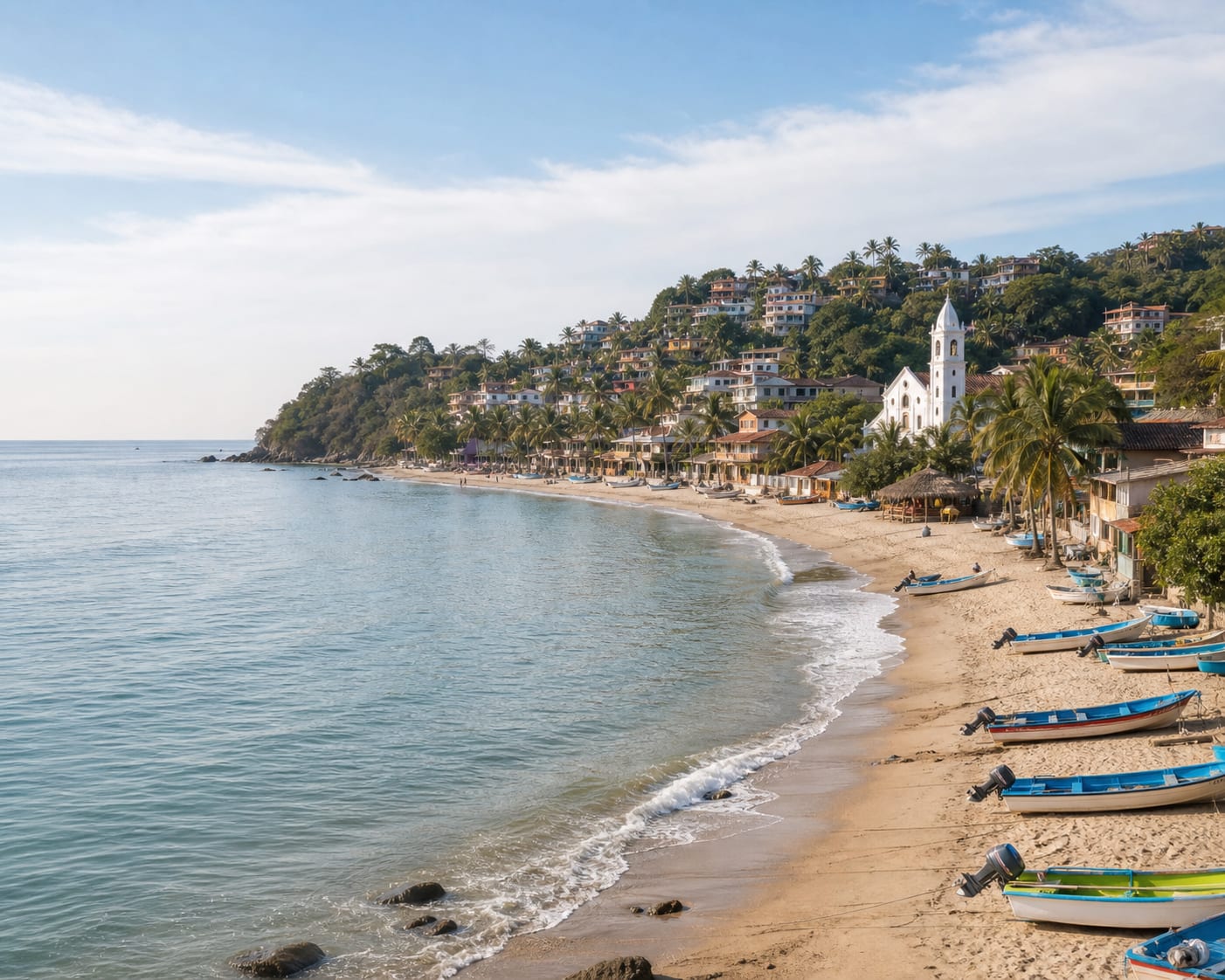
Sayulita is a beginner-friendly right-hand point break in a cove along Mexico's Riviera Nayarit. The wave wraps around a cobblestone headland and peels slowly into the sheltered bay, producing soft, manageable faces that rarely pitch aggressively. The town has transformed from a sleepy fishing village into a bustling surf-and-yoga destination, colourful and chaotic in the best possible way. Warm water, consistent small waves, and an abundance of surf schools make this the go-to spot for first-timers on this stretch of coast.
South-westerly Pacific swells arrive from May through October, producing the most consistent surf. The sheltered bay filters much of the raw energy, so you need 3-5ft of open ocean swell to produce 2-3ft rideable waves inside. Easterly offshore winds blow off the surrounding hills at dawn, providing the cleanest conditions. The wave works year-round but summer delivers the most reliable surf.
The point take-off sits at the southern end of the bay near the cobblestone headland. From here, the wave peels right for 50-80 metres into progressively deeper water. Beginners should sit in the inside section where the broken waves reform. Intermediate riders can take off on the point for longer rides. The paddle-out via the channel alongside the headland is straightforward.
The cobblestone entry is uneven and can be slippery. The take-off zone near the rocks is congested with surf school groups. Board collisions from inexperienced surfers are the primary hazard. The rocks at the headland can be problematic if you fall on the inside. Stingrays inhabit the sandy bottom.
Street parking in the town is limited and competitive. Paid lots operate near the main beach. The beach is a short walk from anywhere in the town centre. The waterfront is flat and fully accessible. Dozens of surf schools and rental shops operate along the beach. Full facilities including restaurants, bars, and shops are steps from the sand.
Sayulita is extremely crowded, particularly in the inside zone where surf schools operate. The water can feel chaotic with beginners on foam boards lacking spatial awareness. The point section is less congested but still busy. For quieter sessions, arrive at dawn before the schools open at 9am. The crowd is friendly but spatially unaware.
Don't fight the inside crowd. Paddle past the school zone to the point where the wave has more shape and fewer bodies. A longboard maximises wave count on this fat, gentle wave. The best conditions occur between 6am and 8am before schools launch. If Sayulita is too flat or too crowded, Punta de Mita to the north and Burros beach to the south offer alternatives. The water is bath-warm year-round.
Thunderstorm
Surf at Sayulita
Your score
Forecast feel
Score this window against what you actually found.
No scored surf reviews in the last 24 hours.
No recent check-ins. Be the first to report.
Log a day
Add Sayulita to your private Companion record without GPS.
Combining historical conditions with school holiday crowd pressure to find the sweet spot.
The timing score combines two signals: historical conditions quality (how good the skiing or surfing typically is in a given week, based on 5 years of weather data) and crowd pressure (how many of this destination's feeder markets have school holidays that week).
Crowd pressure is weighted by each feeder country's share of visitors. If 40% of a resort's visitors come from France and France is on holiday, that contributes 0.40 to the crowd pressure score. Crowds can reduce the timing score by up to 35%, ensuring conditions still matter most.
Scores: 5 = great conditions with low crowds (the sweet spot). 4 = great conditions with moderate crowds, or good conditions with low crowds. 3 = average. 2 = below average conditions or very crowded. 1 = poor conditions or peak holiday chaos.
Last 30 days of logged conditions.
Based on historical weekly averages
Conditions at Sayulita tend to be best between 07:00 to 10:00 in July.
Average score during this window: 44/100
See timing scores, school holiday busyness, and lift pass pricing to find the best time to book.
View Best Time to Go →