United States · North America
Create a free profile and let employers in Outer Banks find you.
Create Profile →Current conditions refresh every 3 hours when the cron runs. Hourly data updates every 30 minutes. The 7-day forecast, luck factor, and packing notes are all pre-computed at the same time.
We compare the 7-day forecast to the last 5 years of marine data for the same week at Outer Banks. The delta tells you whether conditions are shaping up better, worse, or about the same as a typical early July.
We score each day of the 7-day forecast using the same algorithm as the leaderboard, and highlight the highest scorer.
Open-Meteo's Marine API (swell height, period, water temperature) and Weather API (wind and conditions).
Honestly, no. Every break has tide windows, swell directions and reef contours that a global model cannot see. Treat the score as a starting point, then check a local cam.
The best week for surf at Outer Banks is the week of 30 November (score 3/5) with low crowds.
Small waves but still worth a paddle for keen surfers. Short-period wind swell: expect weak, crumbly faces. Moderate wind adding texture to the faces. Not enough swell to get this spot firing properly.
The air here is 58% cleaner than the average comparison city right now.
Noticeably cleaner air than a typical city. Good conditions for prolonged outdoor activity.
Not a pollutant. Ozone is naturally higher at altitude and near the coast, and lower in cities where traffic exhaust breaks it down. High readings here typically indicate clean air. Can cause short-term airway irritation during intense exercise but is not linked to the long-term health risks of particulate pollution.
Additive health score: each pollutant contributes points relative to its WHO 2021 guideline and long-term health impact (PM2.5 9, NO₂ 5, O₃ 3, PM10 2, SO₂ 1 at WHO limits). Data via Open-Meteo. City markers show live readings. Red line marks the WHO guideline. Updated 21:00
Moderate water clarity: ~5m visibility
High sediment levels, possible runoff or storm disturbance
This guide was generated from conditions data. Know this spot? Submit your own tips below.
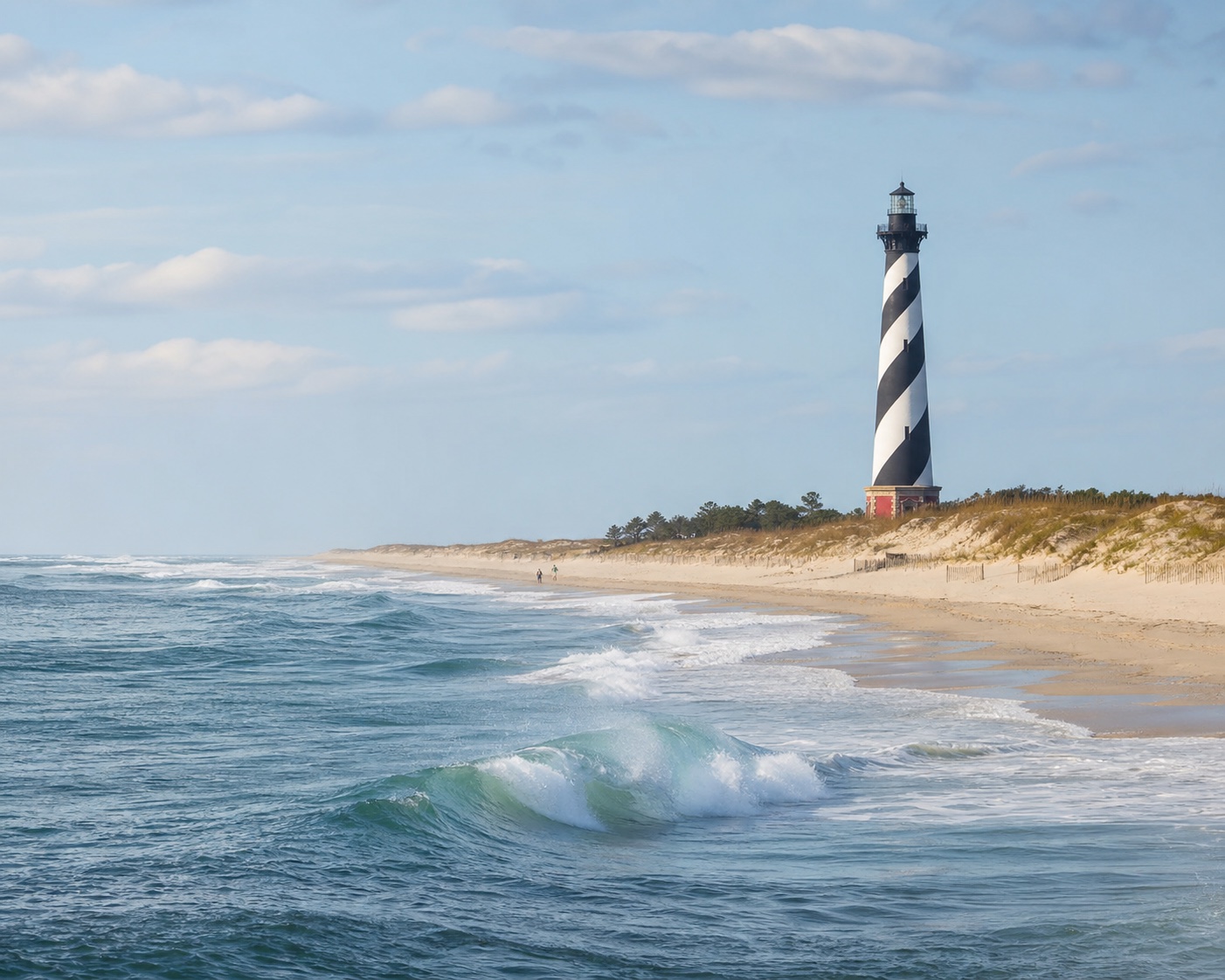
The Outer Banks is a chain of barrier islands off North Carolina that produces some of the East Coast's most powerful beach break waves. The combination of steep sandbars, Atlantic fetch exposure, and warm Gulf Stream-influenced water creates heavy, hollow A-frames that barrel with a ferocity unusual for the eastern seaboard. Hurricane groundswells transform these sandbars into world-class tubes. The remote, windswept island setting has a raw, untamed character.
Hurricane season (August-November) delivers the most powerful groundswells and the best conditions. Winter nor'easters from December through March provide consistent, chunky surf. The breaks work on 3-10ft of east to south-east swell. Westerly offshore winds provide optimal grooming, most common with the passage of cold fronts. The strongest offshore winds coincide with winter fronts.
The breaks shift constantly as the sandbars rearrange with each storm. Classic spots include Rodanthe, Cape Hatteras, and Frisco. The piers at various villages provide reference points and create structured banks. Look for the darker water indicating deeper channels; the peaks form on either side. The steep sandbars produce heavy, hollow A-frames that barrel consistently on the best banks.
The waves break with serious power onto shallow, steep sandbars. Hold-downs can be severe on bigger days. Strong rip currents are ubiquitous and can be extremely powerful during major swell events. The shifting peaks and close-out sets make spatial awareness critical. Sharks (bull, blacktip, and occasional great whites) are present. Lightning from storm systems is a genuine threat.
Beach access points with parking exist at regular intervals along Highway 12 that runs the length of the islands. Four-wheel drive beach access is permitted in certain areas. The beaches are wide and flat with easy access. Towns along the banks have basic facilities. The nearest cities are Norfolk, Virginia (3-4 hours north) or Wilmington (3-4 hours south).
The Outer Banks' remote location keeps crowds manageable compared to East Coast breaks further north. On hurricane swells, visiting surfers arrive in numbers but the long coastline distributes them. The local crew is small but dedicated. Summer tourist crowds don't typically surf. Weekdays and the shoulder seasons offer the emptiest water.
The banks change dramatically after every storm. A spot that was barreling last month might be closeouts now. Drive the length of the banks and check multiple spots before committing. The best barrels form on the steep inner bars during hurricane swells. A performance shortboard with a bit of extra volume handles the punchy waves well. The water is surprisingly warm from June through October due to Gulf Stream influence (24-27C). Winter requires a 4/3mm. Ferry or bridge access to certain islands may be affected by storm events.
Surf at Outer Banks
Your score
Forecast feel
Score this window against what you actually found.
No scored surf reviews in the last 24 hours.
No recent check-ins. Be the first to report.
Record your session, conditions and gear.
Daily scores over the last 12 months at Outer Banks
Based on historical weekly averages
Conditions at Outer Banks tend to be best between 06:00 to 09:00 in July.
Average score during this window: 10/100
See timing scores, school holiday busyness, and lift pass pricing to find the best time to book.
View Best Time to Go →Combining historical conditions with school holiday crowd pressure to find the sweet spot.
The timing score combines two signals: historical conditions quality (how good the skiing or surfing typically is in a given week, based on 5 years of weather data) and crowd pressure (how many of this destination's feeder markets have school holidays that week).
Crowd pressure is weighted by each feeder country's share of visitors. If 40% of a resort's visitors come from France and France is on holiday, that contributes 0.40 to the crowd pressure score. Crowds can reduce the timing score by up to 35%, ensuring conditions still matter most.
Scores: 5 = great conditions with low crowds (the sweet spot). 4 = great conditions with moderate crowds, or good conditions with low crowds. 3 = average. 2 = below average conditions or very crowded. 1 = poor conditions or peak holiday chaos.
Last 31 days of logged conditions.
Not enough data yet. Log a session to help build the accuracy score.