United States Β· North America
Not enough data yet. Log a session to help build the accuracy score.
This guide was generated from conditions data. Know this spot? Submit your own tips below.
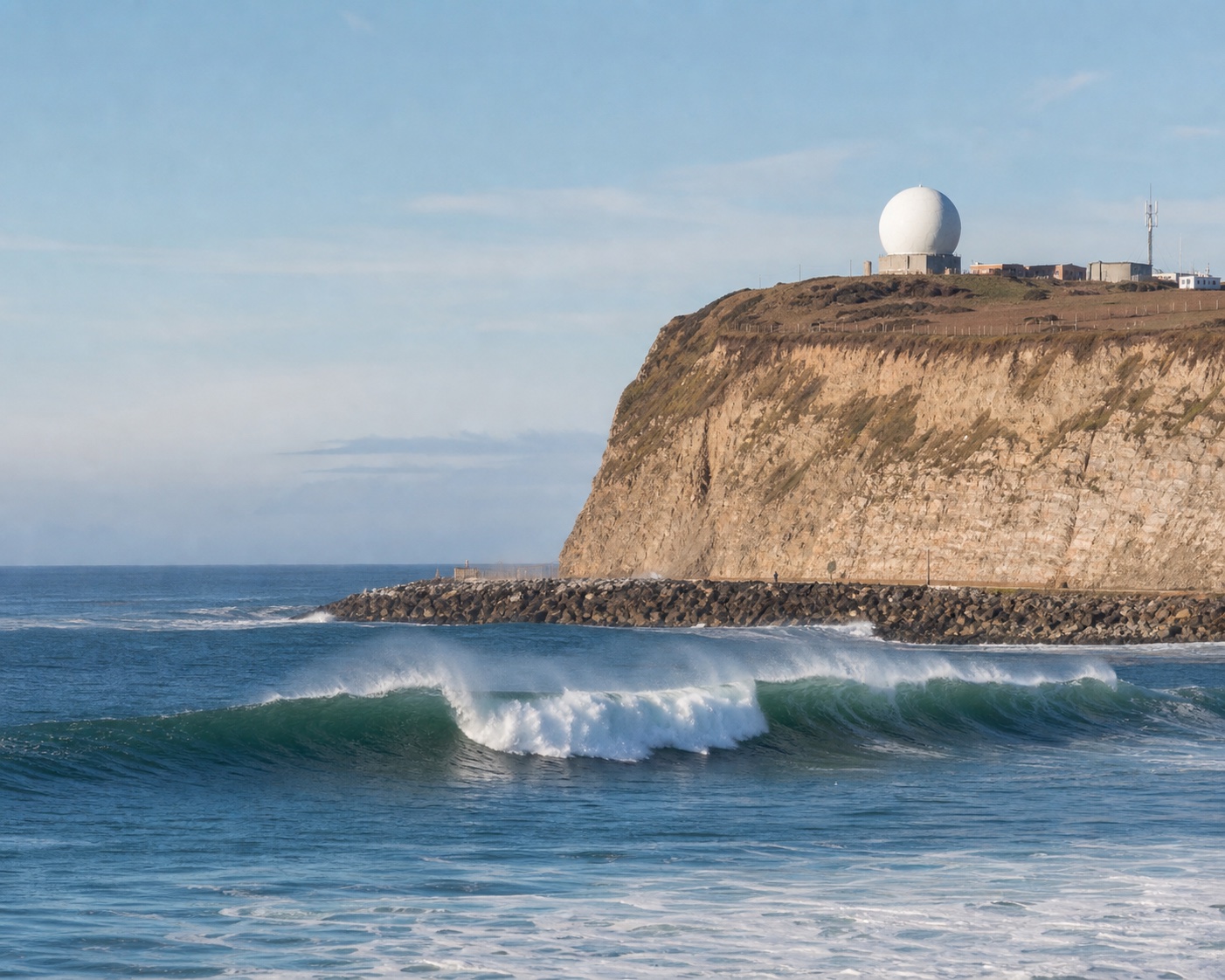
Mavericks is one of the world's most notorious big-wave breaks, an offshore rock ledge half a mile from shore at Half Moon Bay in Northern California. When immense North Pacific winter storms send their energy south, the deep-water reef produces towering, impossibly thick right-hand waves that detonate with catastrophic force. The wave has killed. The combination of giant surf, freezing water, dense kelp, and great white sharks makes Mavericks one of the most hostile surfing environments on the planet.
Massive north-westerly groundswells from November through March, generated by Gulf of Alaska storm systems. The wave needs at least 15ft of open ocean swell to properly activate the deep reef. The biggest days produce 40-60ft faces. Easterly offshore winds are essential to groom the enormous faces. These conditions align perhaps 10-20 times per season.
The take-off zone sits far offshore over the deep reef ledge. The right breaks along the reef for 200+ metres with an inside bowl section that doubles in size. Paddle-in positioning requires being at the exact peak as the wave stands up. Tow-in teams work on the biggest days when paddle-in is impossible. The deep-water channel provides the safety zone.
Everything. The hydraulic force is immense. Hold-downs last 30-60 seconds in violently turbulent, freezing (10-12C) water. Thick kelp forests can entangle surfers during hold-downs. Great white sharks inhabit the area. The rock shelf produces severe turbulence zones. The half-mile paddle from shore in these conditions is exhausting. Medical emergencies require helicopter evacuation. Surfers have died here.
The break is accessed from Pillar Point Harbor. The paddle-out is approximately half a mile through cold, kelp-filled water. Alternatively, jet-ski access from the harbour. The cliff above provides a spectator viewpoint during major events. No beach access. Safety boats are essential support.
Mavericks is surfed by a tight community of 10-30 elite big-wave specialists. These are surfers who have spent years training specifically for this break. The unwritten hierarchy is based on years of commitment and demonstrated ability. Newcomers are scrutinised heavily before being accepted.
Mavericks requires years of specific preparation. Heavy-water training, breath-hold conditioning, big-wave gun shaping (9'0" to 11'0"), inflation vest familiarity, cold-water endurance, and jet-ski rescue coordination are all prerequisites. A 6/5mm wetsuit with hood, boots, and gloves is standard. The paddle-out alone is a fitness test. Study the wave from the cliff for entire seasons before considering paddling out. Know your limits absolutely.
No recent check-ins. Be the first to report.
Record your session, conditions and gear.
Based on historical weekly averages
Combining historical conditions with school holiday crowd pressure to find the sweet spot.
How busy each week is based on school holiday overlap from feeder markets.
The timing score combines two signals: historical conditions quality (how good the skiing or surfing typically is in a given week, based on 5 years of weather data) and crowd pressure (how many of this destination's feeder markets have school holidays that week).
Crowd pressure is weighted by each feeder country's share of visitors. If 40% of a resort's visitors come from France and France is on holiday, that contributes 0.40 to the crowd pressure score. Crowds can reduce the timing score by up to 35%, ensuring conditions still matter most.
Scores: 5 = great conditions with low crowds (the sweet spot). 4 = great conditions with moderate crowds, or good conditions with low crowds. 3 = average. 2 = below average conditions or very crowded. 1 = poor conditions or peak holiday chaos.
Last 28 days of logged conditions.
Sign up to save favourite spots and get surf alerts
Create free accountCreate a free profile and let employers in Mavericks find you.
Create Profile βCurrent conditions refresh every 3 hours when the cron runs. Hourly data updates every 30 minutes. The 7-day forecast, luck factor, and packing notes are all pre-computed at the same time.
We compare the 7-day forecast to the last 5 years of marine data for the same week at Mavericks. The delta tells you whether conditions are shaping up better, worse, or about the same as a typical mid-June.
We score each day of the 7-day forecast using the same algorithm as the leaderboard, and highlight the highest scorer.
Open-Meteo's Marine API (swell height, period, water temperature) and Weather API (wind and conditions).
Honestly, no. Every break has tide windows, swell directions and reef contours that a global model cannot see. Treat the score as a starting point, then check a local cam.
The best week for surf at Mavericks is the week of 30 November (score 3/5) with low crowds.
Flat as a lake. Save your energy for another day. Mid-period swell giving the waves decent shape and push. Heavy offshore making for difficult paddle-outs but textbook faces. Best conditions early morning before the sea breeze arrives. Not enough swell to get this spot firing properly.
Heads up: rocks exposed at low tide.
Indicators derived from forecast data, not official warnings. Always check local lifeguard or official advice.
Moderate water clarity: ~3m visibility
Daily scores over the last 12 months at Mavericks