Not enough data yet. Log a session to help build the accuracy score.
This guide was generated from conditions data. Know this spot? Submit your own tips below.
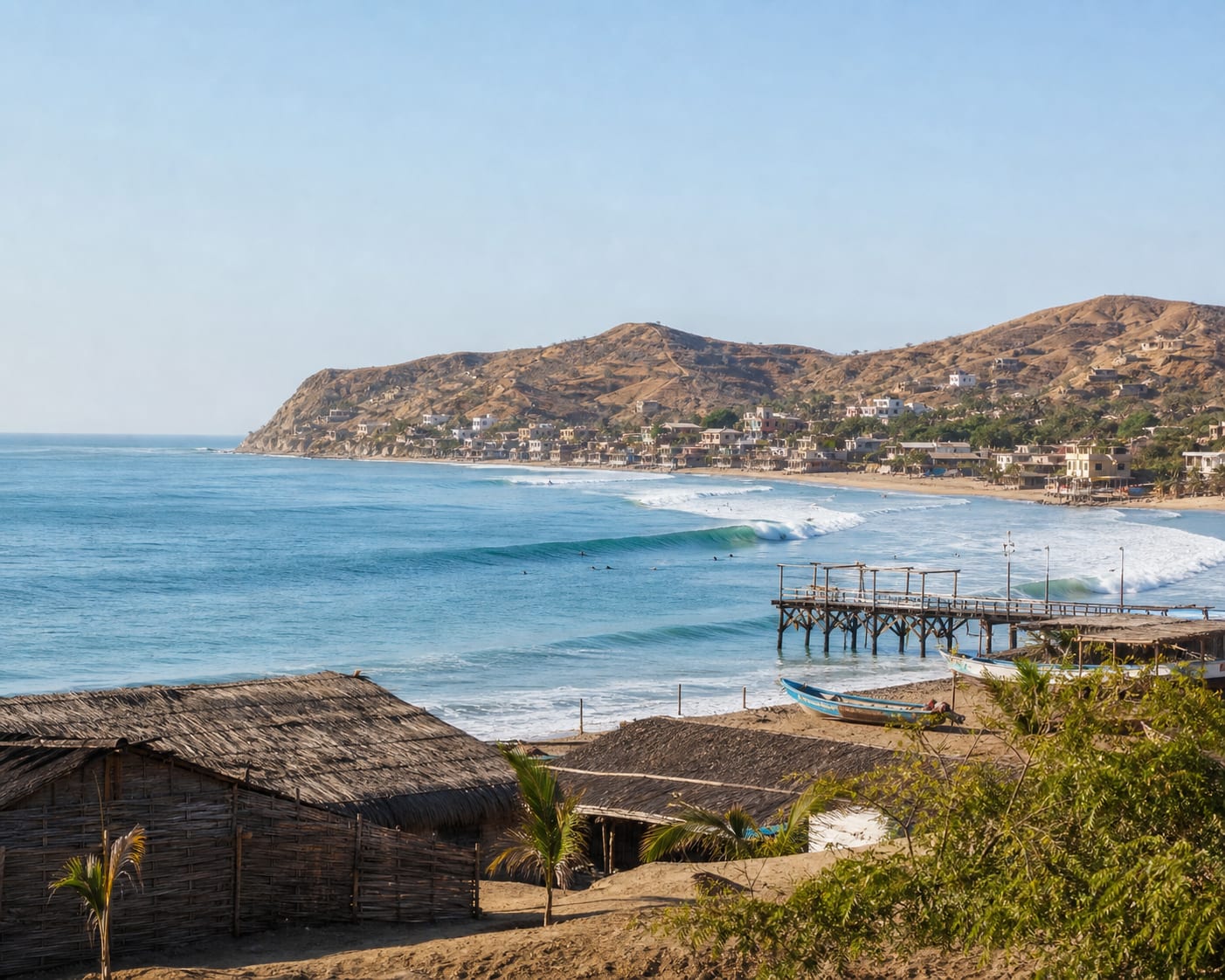
Mancora is northern Peru's most popular surf town, where a consistent left-hand point break peels along a rocky headland into a wide, sandy bay. The wave offers a forgiving, long-peeling wall that rewards smooth, flowing surfing over aggressive shortboarding. The town itself is a bustling resort destination where surfers mix with backpackers and Peruvian holidaymakers, creating a vibrant social atmosphere. Warm water and consistent waves make this an accessible option year-round.
Mancora receives consistent south-westerly Pacific groundswells throughout the year, with the biggest and cleanest conditions arriving from April through October. The wave works on swells as small as 2ft, making it reliable for learners and intermediates. The optimal range is 3-6ft with a south-easterly offshore wind, most consistent in the early mornings. The point handles size well, maintaining its shape up to 8ft before becoming too fast for comfortable intermediate surfing.
The main take-off zone sits at the top of the point where the rocky headland forces the swell to wrap and steepen. From here, the wave peels left for 100-200 metres along the sandy bottom. The initial section near the rocks has the most wall and occasional barrel potential on lower tides. Further down the point, the wave fattens and becomes more suitable for longboarding. Position yourself near the rocks for the steeper take-off, or further down the line for mellower, longer rides.
The rocks at the take-off zone are partially submerged and can catch you if you fall on the inside of the point. Sea urchins inhabit the rocky sections. Currents can be strong on bigger swells, sweeping riders down the beach. Stingrays inhabit the sandy shallows. The biggest hazard is honestly the crowd during peak holiday seasons. Be aware of fishing boats in the morning.
The town sits directly behind the break with numerous accommodation options within walking distance. Street parking is available but security is questionable. The beach is flat and fully accessible with no difficult entry. Board rental and surf schools line the waterfront. Basic facilities including restaurants and showers are abundant.
Mancora is popular. During Peruvian holidays (particularly July and January), the line-up fills with both experienced surfers and learners. The wave's length means there are waves for everyone if you spread along the point. Weekday mornings outside holiday periods offer much quieter sessions. The vibe is generally friendly and non-aggressive.
Unlike the cold water further south, Mancora benefits from the warm equatorial counter-current. Board shorts are sufficient year-round with water temperatures of 22-26C. A longboard or mid-length maximises your wave count on this forgiving, sloping wave. The point works best on a mid to high incoming tide; low tide exposes rocks and the wave becomes sectiony. If the point is too crowded, the beach break peaks to the south offer fun alternatives with far fewer people.
No recent check-ins. Be the first to report.
Record your session, conditions and gear.
Based on historical weekly averages
Combining historical conditions with school holiday crowd pressure to find the sweet spot.
How busy each week is based on school holiday overlap from feeder markets.
The timing score combines two signals: historical conditions quality (how good the skiing or surfing typically is in a given week, based on 5 years of weather data) and crowd pressure (how many of this destination's feeder markets have school holidays that week).
Crowd pressure is weighted by each feeder country's share of visitors. If 40% of a resort's visitors come from France and France is on holiday, that contributes 0.40 to the crowd pressure score. Crowds can reduce the timing score by up to 35%, ensuring conditions still matter most.
Scores: 5 = great conditions with low crowds (the sweet spot). 4 = great conditions with moderate crowds, or good conditions with low crowds. 3 = average. 2 = below average conditions or very crowded. 1 = poor conditions or peak holiday chaos.
Last 29 days of logged conditions.
Sign up to save favourite spots and get surf alerts
Create free accountCreate a free profile and let employers in Máncora find you.
Create Profile →Current conditions refresh every 3 hours when the cron runs. Hourly data updates every 30 minutes. The 7-day forecast, luck factor, and packing notes are all pre-computed at the same time.
We compare the 7-day forecast to the last 5 years of marine data for the same week at Máncora. The delta tells you whether conditions are shaping up better, worse, or about the same as a typical mid-June.
We score each day of the 7-day forecast using the same algorithm as the leaderboard, and highlight the highest scorer.
Open-Meteo's Marine API (swell height, period, water temperature) and Weather API (wind and conditions).
Honestly, no. Every break has tide windows, swell directions and reef contours that a global model cannot see. Treat the score as a starting point, then check a local cam.
The best week for surf at Máncora is the week of 16 November (score 3/5) with low crowds.
Slim pickings. Only worth it if you are gagging for a wave. Reasonable period putting some grunt behind each wave. Strong offshore, clean but tough to paddle into. Best conditions early morning before the sea breeze arrives.
Heads up: jellyfish: peak season, and rocks exposed at low tide.
Indicators derived from forecast data, not official warnings. Always check local lifeguard or official advice.
Moderate water clarity: ~3m visibility
Daily scores over the last 12 months at Máncora