France · Atlantic Europe
Each location is refreshed once every three hours. The hourly view, 7-day forecast, luck factor and packing notes come from the same stored update.
We compare the 7-day forecast with the version-matched historical observations available for the same time of year at La Gravière. The delta shows whether conditions look better, worse or about the same as a typical late July.
We score each day of the 7-day forecast using the same algorithm as the leaderboard, and highlight the highest scorer.
Open-Meteo's Marine API (swell height, period, water temperature) and Weather API (wind and conditions).
Not much swell but keen eyes will find something to ride. Short-period chop. The waves lack any real push. Strong onshore blowing everything out. Give it a miss. Conditions improving through the afternoon. Not enough swell to get this spot firing properly.
PeakWave scores are planning signals, not safety clearance. Check local authorities, official bulletins and on-site conditions before you go. Read our editorial policy.
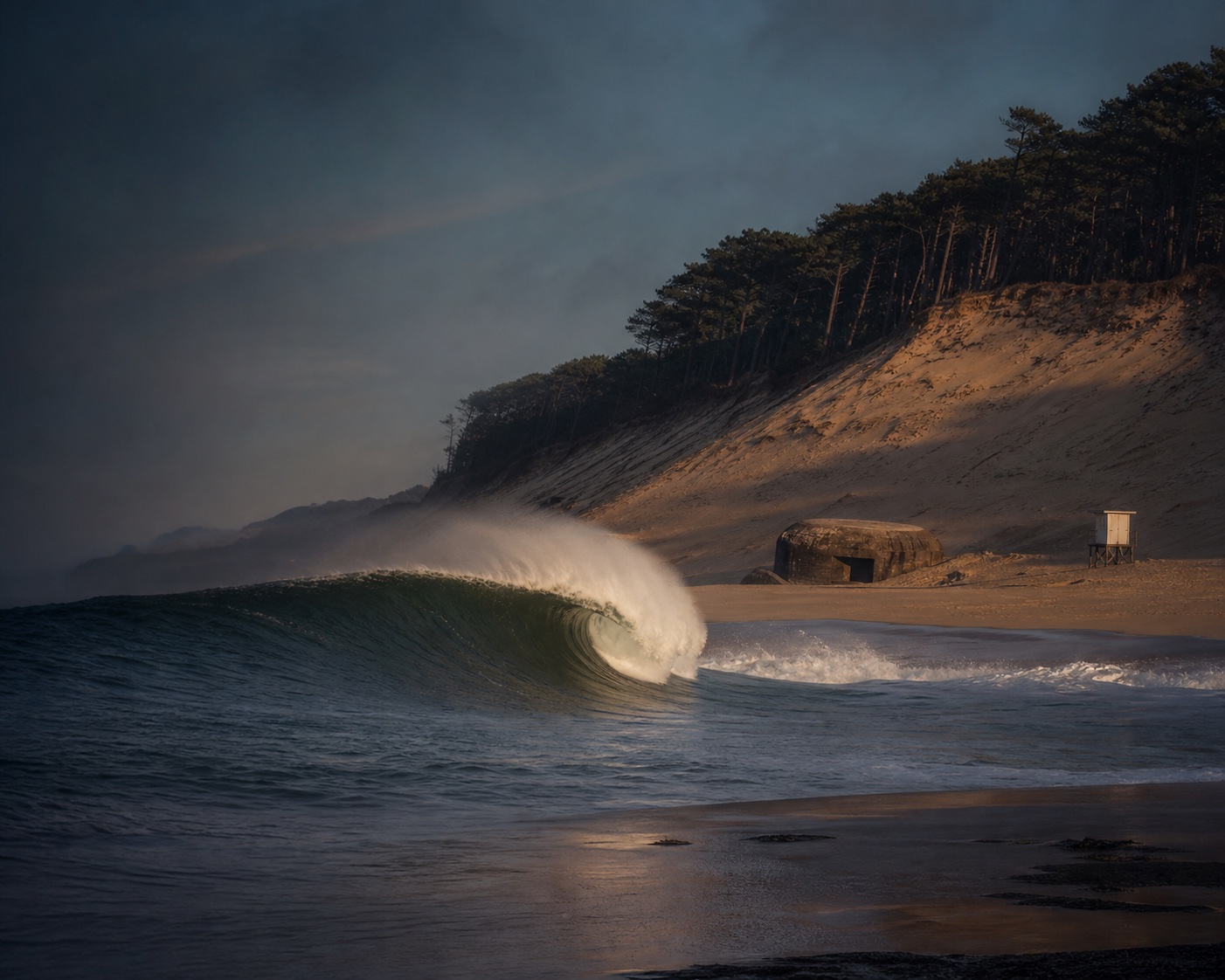
La Gravi-re is an immensely powerful, world-renowned beach break situated in Hossegor on the south-western coast of France. The bathymetry is heavily dictated by the adjacent deep-water Gouf de Capbreton canyon, which allows raw Atlantic swells to march unattenuated toward the shoreline. The seafloor here consists of an extremely steep, compacted sandbank located mere metres from the dry beach. When a solid west-north-westerly groundswell impacts this sudden vertical gradient, the ocean heaves violently, producing an incredibly thick, top-to-bottom plunging barrel. An easterly offshore wind is crucial to hold the heavy lip open. Due to the extreme hydraulic force, the immediate proximity of the break to the shallow sand, and the necessity for rapid, near-vertical take-offs straight into a tube section, La Gravi-re is exclusively the domain of advanced and professional surfers. It is a highly consequential, high-speed tube riding arena known for destroying surfboards and inflicting severe impact injuries.
Heads up: jellyfish: peak season, and rip risk elevated.
Indicators derived from forecast data, not official warnings. Always check local lifeguard or official advice.
The air here is 71% cleaner than the average comparison city right now.
Significantly cleaner air than a typical city. Ideal for outdoor exercise with minimal respiratory strain.
Not a pollutant. Ozone is naturally higher at altitude and near the coast, and lower in cities where traffic exhaust breaks it down. High readings here typically indicate clean air. Can cause short-term airway irritation during intense exercise but is not linked to the long-term health risks of particulate pollution.
Additive health score: each pollutant contributes points relative to its WHO 2021 guideline and long-term health impact (PM2.5 9, NO₂ 5, O₃ 3, PM10 2, SO₂ 1 at WHO limits). Data via Open-Meteo. City markers show live readings. Red line marks the WHO guideline. Updated 15:24
Moderate water clarity: ~4m visibility
Daily scores over the last 12 months at La Gravière
Historical quality only. Safety is not reconstructed for this view.
Create a free profile and let employers in La Gravière find you.
Create Profile →Partly. The model uses stored spot geometry, swell ranges and tide preferences where configured. It cannot see changing banks, crowds, access, closures or everything visible on a local cam, so treat it as a starting point.
The best week for surf at La Gravière is the week of 23 November (score 3/5) with low crowds.
This guide was generated from conditions data. Know this spot? Submit your own tips below.
La Graviere is Hossegor's heaviest section, a brutally powerful beach break that produces some of Europe's thickest, most hollow barrels. The steep sandbanks and canyon-focused swell create waves that pitch violently over shallow sand. It has hosted WSL Championship Tour events and is considered one of the most challenging beach breaks in the world. Short, intense rides with enormous power.
Best at low tide with a solid westerly groundswell (5ft+) and easterly offshore wind. The banks need to be properly formed (usually best in early autumn). The 5-8ft range is where the barrels are most defined. Above that it becomes a genuinely dangerous wave. September and October offer the best bank/swell combination.
The take-off is steep, fast, and specific. Watch from the beach and identify where the sets are throwing. The peak shifts slightly with the banks. Position must be precise; too deep means going over the falls with devastating consequences.
One of Europe's most dangerous waves. The sand is as hard as concrete at the point of impact. Broken boards, neck injuries, and dislocated joints are common. The wave throws with reef-like power over a shallow sandbar. Strong rips. Only experienced surfers comfortable in genuinely heavy waves should paddle out.
Pay parking on the beachfront. Short walk to the sand. The spot is well-known and easy to find. Watch from the beach before committing.
Heavily crowded on good days with experienced surfers and professionals. The peak is fiercely competitive. Drop-ins are dangerous given the power of the wave. If you do not belong here, it will be immediately obvious. The crowd self-selects for advanced surfers.
Be brutally honest about your ability. If you have not surfed heavy hollow waves extensively, La Graviere will punish you. Observe from the beach for at least 20 minutes. The wave looks more manageable from shore than it is. The section just north (Central/La Nord) offers similar style with slightly less intensity. Bring a spare board; breakages are common.
Surf at La Gravière
Your score
Forecast feel
Score this window against what you actually found.
No scored surf reviews in the last 24 hours.
No recent check-ins. Be the first to report.
Log a day
Add La Gravière to your private Companion record without GPS.
Combining historical conditions with school holiday crowd pressure to find the sweet spot.
The timing score combines two signals: historical conditions quality (how good the skiing or surfing typically is in a given week, based on 5 years of weather data) and crowd pressure (how many of this destination's feeder markets have school holidays that week).
Crowd pressure is weighted by each feeder country's share of visitors. If 40% of a resort's visitors come from France and France is on holiday, that contributes 0.40 to the crowd pressure score. Crowds can reduce the timing score by up to 35%, ensuring conditions still matter most.
Scores: 5 = great conditions with low crowds (the sweet spot). 4 = great conditions with moderate crowds, or good conditions with low crowds. 3 = average. 2 = below average conditions or very crowded. 1 = poor conditions or peak holiday chaos.
Last 30 days of logged conditions.
Based on historical weekly averages
Conditions at La Gravière tend to be best between 07:00 to 10:00 in July.
Average score during this window: 39/100
See timing scores, school holiday busyness, and lift pass pricing to find the best time to book.
View Best Time to Go →