Create a free profile and let employers in Le Moule find you.
Create Profile →Current conditions refresh every 3 hours when the cron runs. Hourly data updates every 30 minutes. The 7-day forecast, luck factor, and packing notes are all pre-computed at the same time.
We compare the 7-day forecast to the last 5 years of marine data for the same week at Le Moule. The delta tells you whether conditions are shaping up better, worse, or about the same as a typical early July.
We score each day of the 7-day forecast using the same algorithm as the leaderboard, and highlight the highest scorer.
Open-Meteo's Marine API (swell height, period, water temperature) and Weather API (wind and conditions).
Honestly, no. Every break has tide windows, swell directions and reef contours that a global model cannot see. Treat the score as a starting point, then check a local cam.
The best week for surf at Le Moule is the week of 30 November (score 3/5) with low crowds.
Small waves but still worth a paddle for keen surfers. Short-period wind swell: expect weak, crumbly faces. Full onshore mess. Not worth the paddle unless you are desperate. Conditions improving through the afternoon. Not enough swell to get this spot firing properly.
Heads up: thunderstorms forecast, and jellyfish: peak season.
Indicators derived from forecast data, not official warnings. Always check local lifeguard or official advice.
The air here is 34% cleaner than the average comparison city right now.
Somewhat cleaner than a typical city. Air quality is unlikely to affect most people.
Not a pollutant. Ozone is naturally higher at altitude and near the coast, and lower in cities where traffic exhaust breaks it down. High readings here typically indicate clean air. Can cause short-term airway irritation during intense exercise but is not linked to the long-term health risks of particulate pollution.
Additive health score: each pollutant contributes points relative to its WHO 2021 guideline and long-term health impact (PM2.5 9, NO₂ 5, O₃ 3, PM10 2, SO₂ 1 at WHO limits). Data via Open-Meteo. City markers show live readings. Red line marks the WHO guideline. Updated 21:00
Crystal clear water: ~23m visibility
This guide was generated from conditions data. Know this spot? Submit your own tips below.
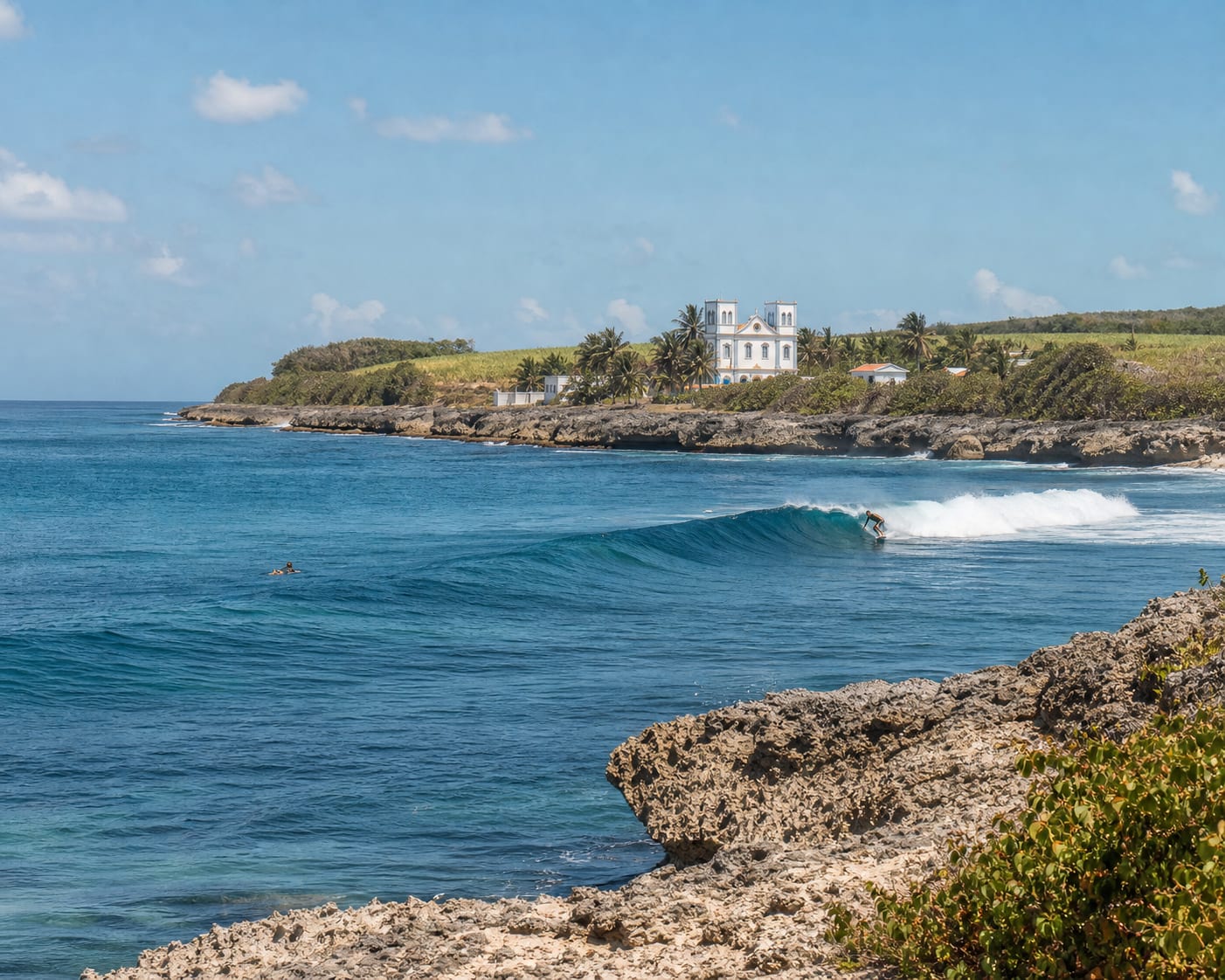
Le Moule is a powerful reef break on the north-eastern coast of Guadeloupe's Grande-Terre island, producing heavy, fast peaks over a shallow coral reef. The wave functions as the premier high-performance break in the French Caribbean, attracting competitive surfers from across the French Antilles. The setting combines tropical beauty with raw Atlantic power, as north-east trade wind swells and winter groundswells hammer the exposed reef with consistent energy.
North-east trade wind swells provide waves year-round, with the strongest from November through April. Long-period North Atlantic groundswells from December through March add power and quality. The wave works on 3-8ft of north-east to north swell. Southerly offshore winds provide the cleanest conditions but are less common than the prevailing trades. Early mornings before the trade winds strengthen offer the best window.
The main peak breaks over the shallowest section of the reef where the A-frame splits. The right is generally hollower and shorter. The left offers a slightly longer wall. Position yourself on the reef edge where the depth transition creates the peak. The deep-water channel provides entry and exit.
The coral reef is shallow and sharp, with severe consequences for wipeouts. The wave breaks with significant force due to the exposure to open Atlantic energy. Strong currents can develop across the reef. The prevailing trade winds create choppy, disorganised conditions on the face. Sea urchins carpet sections of the reef.
Parking near the beach in the town of Le Moule. A short walk reaches the paddle-out point. Facilities in the town include restaurants and basic services. Accommodation is available in the area. Le Moule is a 30-minute drive from Pointe-a-Pitre, Guadeloupe's main city.
Le Moule draws the local Guadeloupean surf community, which is skilled and competitive. Expect 10-20 surfers on good days. International visitors are uncommon. The atmosphere is friendly but the standard is high. The concentrated take-off zone makes even moderate numbers competitive.
The trade winds are relentless on this exposed coast. The cleanest conditions occur in brief windows when the wind drops or shifts. Early morning sessions (before 8am) and rare south wind days offer the best face quality. Reef boots are essential. The Caribbean water is warm (26-28C) year-round, so board shorts suffice. Le Moule is the only genuinely challenging wave in Guadeloupe; the rest of the island offers mellow alternatives. French is the primary language; basic phrases are appreciated.
Surf at Le Moule
Your score
Forecast feel
Score this window against what you actually found.
No scored surf reviews in the last 24 hours.
No recent check-ins. Be the first to report.
Record your session, conditions and gear.
Daily scores over the last 12 months at Le Moule
Based on historical weekly averages
Conditions at Le Moule tend to be best between 16:00 to 19:00 in July.
Average score during this window: 22/100
See timing scores, school holiday busyness, and lift pass pricing to find the best time to book.
View Best Time to Go →Combining historical conditions with school holiday crowd pressure to find the sweet spot.
The timing score combines two signals: historical conditions quality (how good the skiing or surfing typically is in a given week, based on 5 years of weather data) and crowd pressure (how many of this destination's feeder markets have school holidays that week).
Crowd pressure is weighted by each feeder country's share of visitors. If 40% of a resort's visitors come from France and France is on holiday, that contributes 0.40 to the crowd pressure score. Crowds can reduce the timing score by up to 35%, ensuring conditions still matter most.
Scores: 5 = great conditions with low crowds (the sweet spot). 4 = great conditions with moderate crowds, or good conditions with low crowds. 3 = average. 2 = below average conditions or very crowded. 1 = poor conditions or peak holiday chaos.
Last 31 days of logged conditions.
Not enough data yet. Log a session to help build the accuracy score.