Brazil · South America
Create a free profile and let employers in Florianópolis find you.
Create Profile →Current conditions refresh every 3 hours when the cron runs. Hourly data updates every 30 minutes. The 7-day forecast, luck factor, and packing notes are all pre-computed at the same time.
We compare the 7-day forecast to the last 5 years of marine data for the same week at Florianópolis. The delta tells you whether conditions are shaping up better, worse, or about the same as a typical early July.
We score each day of the 7-day forecast using the same algorithm as the leaderboard, and highlight the highest scorer.
Open-Meteo's Marine API (swell height, period, water temperature) and Weather API (wind and conditions).
Honestly, no. Every break has tide windows, swell directions and reef contours that a global model cannot see. Treat the score as a starting point, then check a local cam.
The best week for surf at Florianópolis is the week of 9 November (score 3/5) with low crowds.
Moderate swell providing fun waves for a session. Short-period wind swell: expect weak, crumbly faces. Heavy offshore making for difficult paddle-outs but textbook faces.
Heads up: jellyfish: high.
Indicators derived from forecast data, not official warnings. Always check local lifeguard or official advice.
The air here is 38% cleaner than the average comparison city right now.
Somewhat cleaner than a typical city. Air quality is unlikely to affect most people.
Not a pollutant. Ozone is naturally higher at altitude and near the coast, and lower in cities where traffic exhaust breaks it down. High readings here typically indicate clean air. Can cause short-term airway irritation during intense exercise but is not linked to the long-term health risks of particulate pollution.
Additive health score: each pollutant contributes points relative to its WHO 2021 guideline and long-term health impact (PM2.5 9, NO₂ 5, O₃ 3, PM10 2, SO₂ 1 at WHO limits). Data via Open-Meteo. City markers show live readings. Red line marks the WHO guideline. Updated 21:00
Moderate water clarity: ~5m visibility
This guide was generated from conditions data. Know this spot? Submit your own tips below.
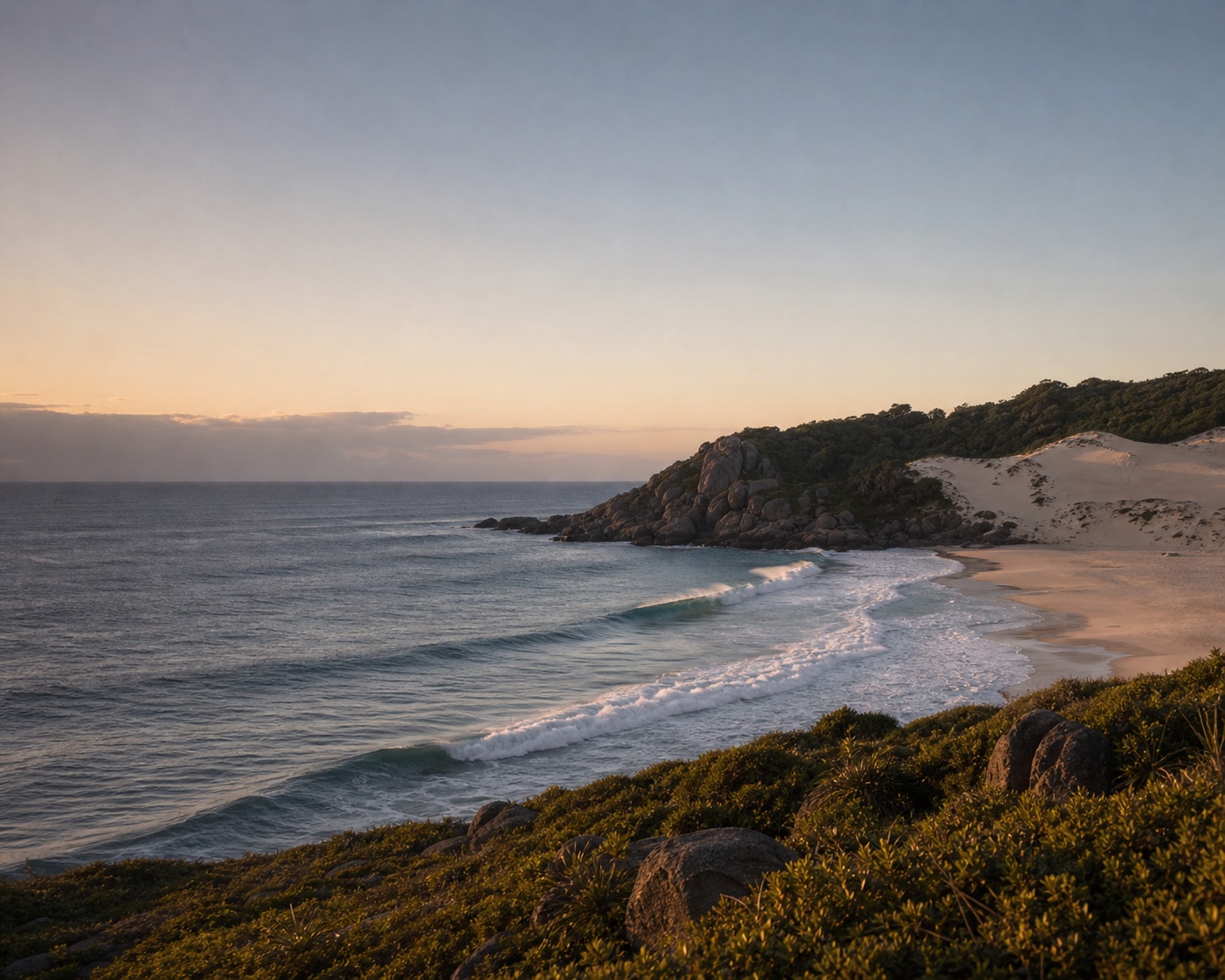
Joaquina is the beating heart of Florianopolis surf culture, a powerful beach and point break on the eastern coast of Santa Catarina Island. A prominent rocky headland anchors the southern end of the beach, creating structured left-hand waves that peel along the rocks when the swell hits right. The sand dunes behind the beach give Joaquina a wild, untamed character, and the Brazilian surf community treats this spot with reverence. It has hosted professional competitions for decades.
The east-facing orientation picks up south-easterly Atlantic groundswells consistently from April through September. The best conditions arrive with solid 4-8ft swells from the south-east combined with a north-westerly offshore wind that blows directly off the land. Cyclone-generated swells in autumn can produce exceptional size and power. Summer brings smaller, more inconsistent surf with occasional east swells providing fun sessions.
The point break adjacent to the rocks at the southern end of the beach produces the highest quality left-hand waves. The take-off zone is concentrated near the rock outcrop where the swell first hits the shallow sandbar. On bigger days, the outside bars across the beach activate and produce powerful A-frames. The northern end of the beach is more exposed and offers hollow peaks when the sand cooperates.
The rocks at the point are sharp and unforgiving. Getting caught inside on a set can push you into the rock zone where injuries are common. Strong rip currents develop along the point and through the centre of the beach on bigger swells. The wave can pack serious punch on larger south-east pulses, producing heavy lips and powerful hold-downs. Bluebottle jellyfish appear seasonally and their stings are painful.
A large car park sits behind the sand dunes at the main beach access. The walk from the car park to the waterline crosses loose sand dunes and takes five minutes. Facilities include showers, toilets, and several beachside restaurants. The point section requires walking south along the beach for another five minutes.
Joaquina is the most popular surf spot on the island, and the crowd reflects this. Weekend swells attract serious numbers, particularly at the point section where the best waves break. The standard is high among the local crew. Weekday mornings offer considerably more space. During summer holidays, the beach fills with non-surfers which can make the entry zone chaotic.
The point left improves dramatically on an incoming mid-tide when the water depth over the rocks provides clean wall without too much backwash. Low tide exposes the rocks dangerously. Watch the sets from the headland path before committing to the point section; the outside sets are significantly larger than what breaks on the inside. Southern Brazil winter brings genuine cold, with water temperatures dropping to 15C, so pack a full wetsuit despite the country's tropical reputation.
Surf at Florianópolis
Your score
Forecast feel
Score this window against what you actually found.
No scored surf reviews in the last 24 hours.
No recent check-ins. Be the first to report.
Record your session, conditions and gear.
Daily scores over the last 12 months at Florianópolis
Based on historical weekly averages
Conditions at Florianópolis tend to be best between 07:00 to 10:00 in July.
Average score during this window: 43/100
See timing scores, school holiday busyness, and lift pass pricing to find the best time to book.
View Best Time to Go →Combining historical conditions with school holiday crowd pressure to find the sweet spot.
The timing score combines two signals: historical conditions quality (how good the skiing or surfing typically is in a given week, based on 5 years of weather data) and crowd pressure (how many of this destination's feeder markets have school holidays that week).
Crowd pressure is weighted by each feeder country's share of visitors. If 40% of a resort's visitors come from France and France is on holiday, that contributes 0.40 to the crowd pressure score. Crowds can reduce the timing score by up to 35%, ensuring conditions still matter most.
Scores: 5 = great conditions with low crowds (the sweet spot). 4 = great conditions with moderate crowds, or good conditions with low crowds. 3 = average. 2 = below average conditions or very crowded. 1 = poor conditions or peak holiday chaos.
Last 31 days of logged conditions.
Not enough data yet. Log a session to help build the accuracy score.