Brazil ¡ South America
Create a free profile and let employers in Fernando de Noronha find you.
Create Profile âCurrent conditions refresh every 3 hours when the cron runs. Hourly data updates every 30 minutes. The 7-day forecast, luck factor, and packing notes are all pre-computed at the same time.
We compare the 7-day forecast to the last 5 years of marine data for the same week at Fernando de Noronha. The delta tells you whether conditions are shaping up better, worse, or about the same as a typical early July.
We score each day of the 7-day forecast using the same algorithm as the leaderboard, and highlight the highest scorer.
Open-Meteo's Marine API (swell height, period, water temperature) and Weather API (wind and conditions).
Honestly, no. Every break has tide windows, swell directions and reef contours that a global model cannot see. Treat the score as a starting point, then check a local cam.
The best week for surf at Fernando de Noronha is the week of 16 November (score 3/5) with low crowds.
Barely any swell. Not much to work with today. Short-period wind swell: expect weak, crumbly faces. Heavy offshore making for difficult paddle-outs but textbook faces. Conditions improving through the afternoon.
Heads up: jellyfish: peak season.
Indicators derived from forecast data, not official warnings. Always check local lifeguard or official advice.
The air here is 45% cleaner than the average comparison city right now.
Noticeably cleaner air than a typical city. Good conditions for prolonged outdoor activity.
Not a pollutant. Ozone is naturally higher at altitude and near the coast, and lower in cities where traffic exhaust breaks it down. High readings here typically indicate clean air. Can cause short-term airway irritation during intense exercise but is not linked to the long-term health risks of particulate pollution.
Additive health score: each pollutant contributes points relative to its WHO 2021 guideline and long-term health impact (PM2.5 9, NOâ 5, Oâ 3, PM10 2, SOâ 1 at WHO limits). Data via Open-Meteo. City markers show live readings. Red line marks the WHO guideline. Updated 03:00
Crystal clear water: ~25m visibility
This guide was generated from conditions data. Know this spot? Submit your own tips below.
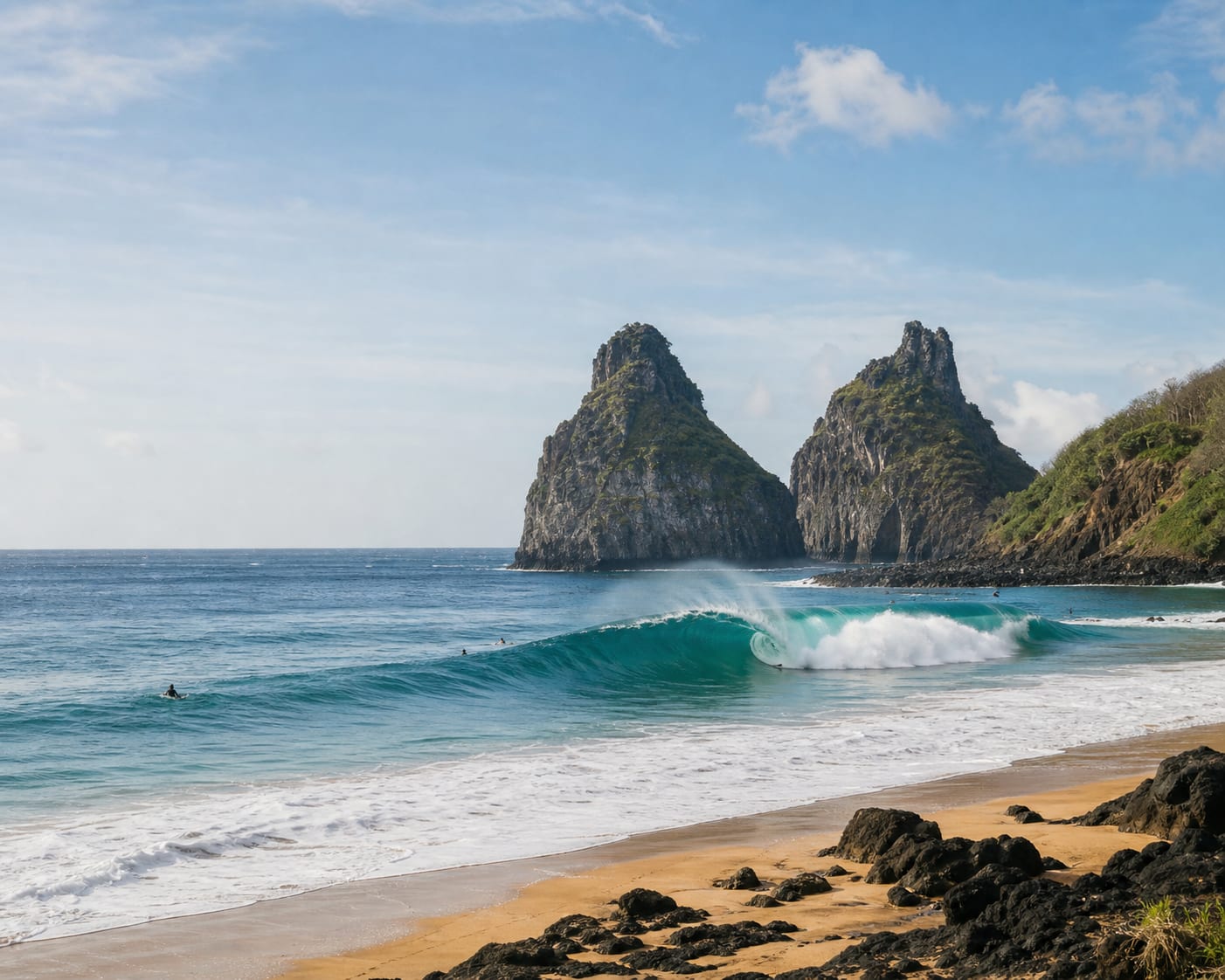
Fernando de Noronha is a volcanic island archipelago 350km off the Brazilian coast, offering some of Brazil's best and most powerful waves. The main breaks face north and receive swells from both north Atlantic storms and hurricane swells. The water is crystal clear, warm, and teeming with marine life. Access is limited and expensive, keeping crowds minimal. A genuine world-class surf destination.
The north-facing breaks need north or north-west swell from Atlantic winter storms. The 4-8ft range produces powerful, hollow waves. November through March is prime season. The island sits in the path of consistent trade wind swell year-round. Different breaks work on different swells.
Cacimba do Padre is the main break: a powerful beach break with barrel sections. Boldro is a quality right. Each break has defined lineups. The volcanic reef creates dramatic underwater topography.
Shark zone (the island is a protected marine area with healthy shark populations). Powerful waves over reef at some spots. The isolation means medical help is limited. Strong currents. Reef at some breaks.
The island limits daily visitors. Fly from Recife or Natal. Environmental tax on entry. Transport around the island by buggy. Limited accommodation (book well in advance).
Very small due to access restrictions and expense. You might share a break with 5-10 people at most. The island's environmental protections keep numbers down. One of the few places where world-class waves meet empty lineups.
Fernando de Noronha requires planning and budget. The environmental restrictions are serious (and appreciated). Bring reef-safe sunscreen. The snorkelling and diving are world-class on flat days. The island is one of the most beautiful places in the Atlantic. Book months in advance during swell season.
Surf at Fernando de Noronha
Your score
Forecast feel
Score this window against what you actually found.
No scored surf reviews in the last 24 hours.
No recent check-ins. Be the first to report.
Record your session, conditions and gear.
Daily scores over the last 12 months at Fernando de Noronha
Based on historical weekly averages
Conditions at Fernando de Noronha tend to be best between 15:00 to 18:00 in July.
Average score during this window: 14/100
See timing scores, school holiday busyness, and lift pass pricing to find the best time to book.
View Best Time to Go âCombining historical conditions with school holiday crowd pressure to find the sweet spot.
The timing score combines two signals: historical conditions quality (how good the skiing or surfing typically is in a given week, based on 5 years of weather data) and crowd pressure (how many of this destination's feeder markets have school holidays that week).
Crowd pressure is weighted by each feeder country's share of visitors. If 40% of a resort's visitors come from France and France is on holiday, that contributes 0.40 to the crowd pressure score. Crowds can reduce the timing score by up to 35%, ensuring conditions still matter most.
Scores: 5 = great conditions with low crowds (the sweet spot). 4 = great conditions with moderate crowds, or good conditions with low crowds. 3 = average. 2 = below average conditions or very crowded. 1 = poor conditions or peak holiday chaos.
Last 31 days of logged conditions.
Not enough data yet. Log a session to help build the accuracy score.