Not enough data yet. Log a session to help build the accuracy score.
This guide was generated from conditions data. Know this spot? Submit your own tips below.
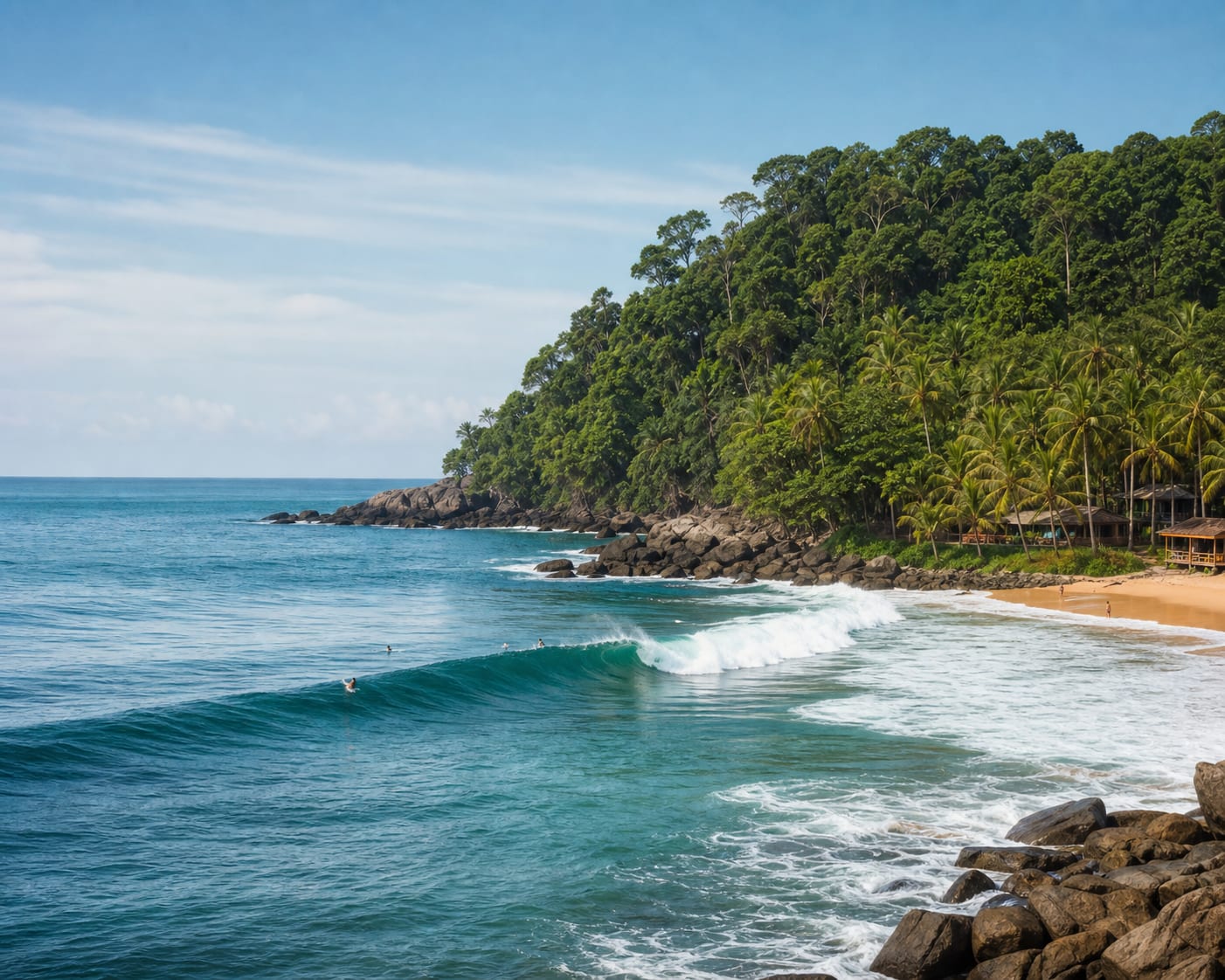
Itacare sits on Bahia's cocoa coast, where Atlantic rainforest tumbles directly onto pristine sandy coves. A succession of horseshoe-shaped bays separated by rocky headlands create multiple breaks, each with its own character. Praia da Tiririca is the most popular, but Prainha, Resende, and Jeribucacu all offer quality waves when conditions align. The town has a vibrant surf culture blended with Bahian warmth and the remnants of the cacao trade.
The coast picks up south-easterly Atlantic groundswells consistently from April through September. The headlands naturally filter and refract the swell, allowing organised waves to enter the bays even when the open ocean is chaotic. A westerly offshore wind blowing down from the coastal mountains provides optimal grooming, most reliable at dawn. Summer brings smaller, inconsistent surf with occasional east swells.
Praia da Tiririca offers the most reliable peaks, with a defined sandbar producing A-frame waves in the centre of the bay. The southern end near the rocks can produce a workable right when the sand cooperates. Prainha to the south handles more swell and produces heavier waves. Position yourself on the central sandbar at Tiririca and watch for the sets that stack up outside the headland before bending into the bay.
Rocky headlands border each bay and getting caught inside on a set can push you towards them. Rip currents develop in the channels between sandbars. The ocean floor at some spots has submerged volcanic rock shelves that activate at lower tides. Stingrays inhabit the sandy shallows. Portuguese man-of-war appear seasonally. The tropical sun is intense and the humidity makes dehydration a risk.
Praia da Tiririca is a five-minute walk from the town centre along a dirt path through coastal vegetation. Prainha requires a 20-minute walk through the forest or a short drive to a trailhead. Car parking in the town is informal. The beaches have no facilities beyond occasional mobile vendors selling coconut water.
Tiririca draws the most surfers, particularly during Brazilian holidays. The vibe is friendly and relaxed. Weekday mornings offer uncrowded sessions. The further south you walk to the more remote beaches, the fewer people you encounter. Jeribucacu, a 40-minute walk through the forest, is often empty.
The various bays handle different swell sizes and directions. When Tiririca is too small, check Prainha which picks up more swell. When Tiririca is too big and closing out, the more sheltered bays further north provide cleaner conditions. Bring insect repellent for the forest walks between beaches. The acai bowls in town are the best post-surf fuel in all of Brazil. A quiver of two boards (standard shortboard plus a fish for smaller days) covers all conditions.
No recent check-ins. Be the first to report.
Record your session, conditions and gear.
Based on historical weekly averages
Combining historical conditions with school holiday crowd pressure to find the sweet spot.
How busy each week is based on school holiday overlap from feeder markets.
The timing score combines two signals: historical conditions quality (how good the skiing or surfing typically is in a given week, based on 5 years of weather data) and crowd pressure (how many of this destination's feeder markets have school holidays that week).
Crowd pressure is weighted by each feeder country's share of visitors. If 40% of a resort's visitors come from France and France is on holiday, that contributes 0.40 to the crowd pressure score. Crowds can reduce the timing score by up to 35%, ensuring conditions still matter most.
Scores: 5 = great conditions with low crowds (the sweet spot). 4 = great conditions with moderate crowds, or good conditions with low crowds. 3 = average. 2 = below average conditions or very crowded. 1 = poor conditions or peak holiday chaos.
Last 29 days of logged conditions.
Sign up to save favourite spots and get surf alerts
Create free accountCreate a free profile and let employers in Itacaré find you.
Create Profile →Current conditions refresh every 3 hours when the cron runs. Hourly data updates every 30 minutes. The 7-day forecast, luck factor, and packing notes are all pre-computed at the same time.
We compare the 7-day forecast to the last 5 years of marine data for the same week at Itacaré. The delta tells you whether conditions are shaping up better, worse, or about the same as a typical mid-June.
We score each day of the 7-day forecast using the same algorithm as the leaderboard, and highlight the highest scorer.
Open-Meteo's Marine API (swell height, period, water temperature) and Weather API (wind and conditions).
Honestly, no. Every break has tide windows, swell directions and reef contours that a global model cannot see. Treat the score as a starting point, then check a local cam.
The best week for surf at Itacaré is the week of 16 November (score 3/5) with low crowds.
Next to nothing in the water. Check back tomorrow. Light onshore crumble taking the edge off. Not enough swell to get this spot firing properly.
Heads up: jellyfish: peak season.
Indicators derived from forecast data, not official warnings. Always check local lifeguard or official advice.
Crystal clear water: ~30m visibility
Daily scores over the last 12 months at Itacaré