Not enough data yet. Log a session to help build the accuracy score.
This guide was generated from conditions data. Know this spot? Submit your own tips below.
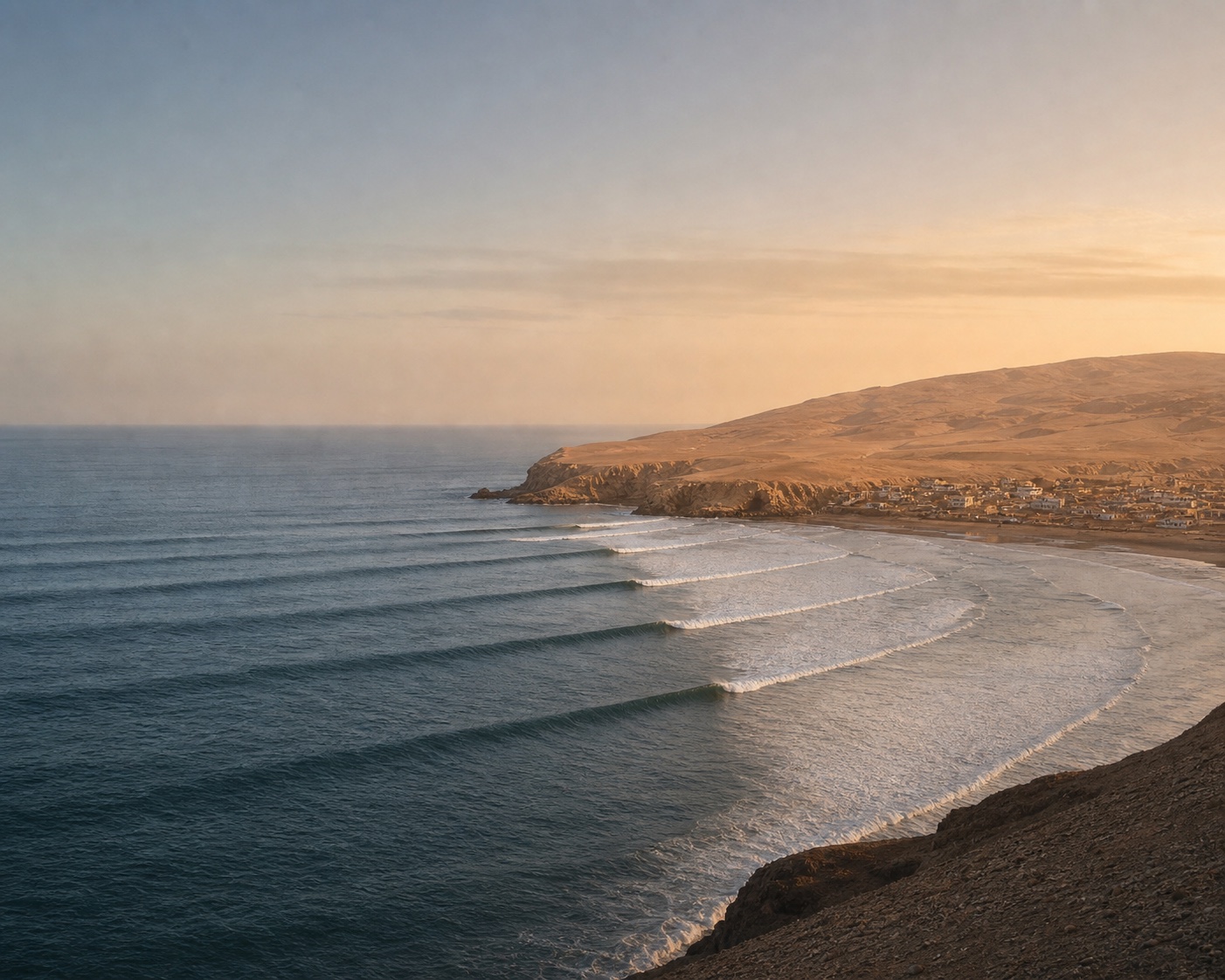
Chicama holds the title of the longest left in the world, a seemingly endless point break on Peru's arid northern coast that can offer rides exceeding a kilometre when the stars align. The wave peels along a uniform sandy bay backed by desert cliffs, with four connecting sections: El Cape, El Point, Keys, and El Hombre. The landscape is stark and beautiful, utterly dry and wind-sculpted, and the wave has an almost meditative quality as it reels endlessly down the line.
The prime season runs from March through October when south-westerly groundswells generated in the Southern Ocean push up the Peruvian coast. April and May often deliver the most consistent large swells before the winter fog sets in. The wave needs at least 4-6ft of swell to connect through all four sections. South-easterly winds blow offshore and are most reliable in the early morning. By midday, the onshore thermal usually compromises conditions.
El Point is the most popular take-off zone, offering the longest connected rides when the swell is adequate. On smaller days, only Keys and El Hombre on the inside work properly. On larger swells, El Cape on the far outside activates and the potential for a ride connecting all the way through becomes real. Position yourself at the top of whichever section is breaking cleanest and commit to riding as far down the line as your legs allow.
The main hazard is exhaustion. Rides can last several minutes, demanding continuous leg work and concentration. The walk back up the point after each wave takes 15-20 minutes over rocky ground. Sea urchins inhabit the rocks near the take-off zones. The current can be strong on bigger days, sweeping riders further down the point than intended. The desert sun is intense and dehydration is a real risk during extended sessions.
The town of Puerto Malabrigo sits at the end of the point. A rough dirt road leads to informal parking areas near the various take-off spots. Access to the water requires scrambling over rocks at most sections. There are no formal facilities at the surf spots themselves. The town has basic accommodation and a handful of restaurants.
Chicama receives far fewer visitors than its reputation might suggest, largely because of its remote location and the physical demands of surfing it. On a good day, expect 10-20 surfers spread across the four sections. The vibe is relaxed and friendly, with a small but welcoming local crew. The length of the point naturally disperses surfers along the line.
Bring a mid-length board or a longboard. The wave does not demand aggressive shortboarding; it rewards smooth, flowing surfing with drawn-out turns. Your legs will burn. Stretch thoroughly and bring glucose supplements. The walk back is the limiting factor in your wave count, so some surfers hire a local tuk-tuk driver to ferry them back up the point between rides. The water is cold year-round due to the Humboldt Current, hovering around 16-18C, so a 3/2mm wetsuit is essential despite the desert heat.
No recent check-ins. Be the first to report.
Record your session, conditions and gear.
Based on historical weekly averages
Combining historical conditions with school holiday crowd pressure to find the sweet spot.
How busy each week is based on school holiday overlap from feeder markets.
The timing score combines two signals: historical conditions quality (how good the skiing or surfing typically is in a given week, based on 5 years of weather data) and crowd pressure (how many of this destination's feeder markets have school holidays that week).
Crowd pressure is weighted by each feeder country's share of visitors. If 40% of a resort's visitors come from France and France is on holiday, that contributes 0.40 to the crowd pressure score. Crowds can reduce the timing score by up to 35%, ensuring conditions still matter most.
Scores: 5 = great conditions with low crowds (the sweet spot). 4 = great conditions with moderate crowds, or good conditions with low crowds. 3 = average. 2 = below average conditions or very crowded. 1 = poor conditions or peak holiday chaos.
Last 28 days of logged conditions.
Sign up to save favourite spots and get surf alerts
Create free accountCreate a free profile and let employers in Chicama find you.
Create Profile →Current conditions refresh every 3 hours when the cron runs. Hourly data updates every 30 minutes. The 7-day forecast, luck factor, and packing notes are all pre-computed at the same time.
We compare the 7-day forecast to the last 5 years of marine data for the same week at Chicama. The delta tells you whether conditions are shaping up better, worse, or about the same as a typical mid-June.
We score each day of the 7-day forecast using the same algorithm as the leaderboard, and highlight the highest scorer.
Open-Meteo's Marine API (swell height, period, water temperature) and Weather API (wind and conditions).
Honestly, no. Every break has tide windows, swell directions and reef contours that a global model cannot see. Treat the score as a starting point, then check a local cam.
The best week for surf at Chicama is the week of 9 November (score 3/5) with low crowds.
Slim pickings. Only worth it if you are gagging for a wave. Mid-period swell giving the waves decent shape and push. Full onshore mess. Not worth the paddle unless you are desperate. Best conditions early morning before the sea breeze arrives.
Heads up: jellyfish: peak season, and rip risk elevated.
Indicators derived from forecast data, not official warnings. Always check local lifeguard or official advice.
Reduced water clarity: ~3m visibility
Elevated phytoplankton detected, possible algal bloom
Daily scores over the last 12 months at Chicama