Australia ยท Australasia
Each location is refreshed once every three hours. The hourly view, 7-day forecast, luck factor and packing notes come from the same stored update.
We compare the 7-day forecast with the version-matched historical observations available for the same time of year at Burleigh Heads. The delta shows whether conditions look better, worse or about the same as a typical late July.
We score each day of the 7-day forecast using the same algorithm as the leaderboard, and highlight the highest scorer.
Open-Meteo's Marine API (swell height, period, water temperature) and Weather API (wind and conditions).
Not much swell but keen eyes will find something to ride. Short-period chop. The waves lack any real push. Light cross-shore texture but very manageable. Not enough swell to get this spot firing properly.
PeakWave scores are planning signals, not safety clearance. Check local authorities, official bulletins and on-site conditions before you go. Read our editorial policy.
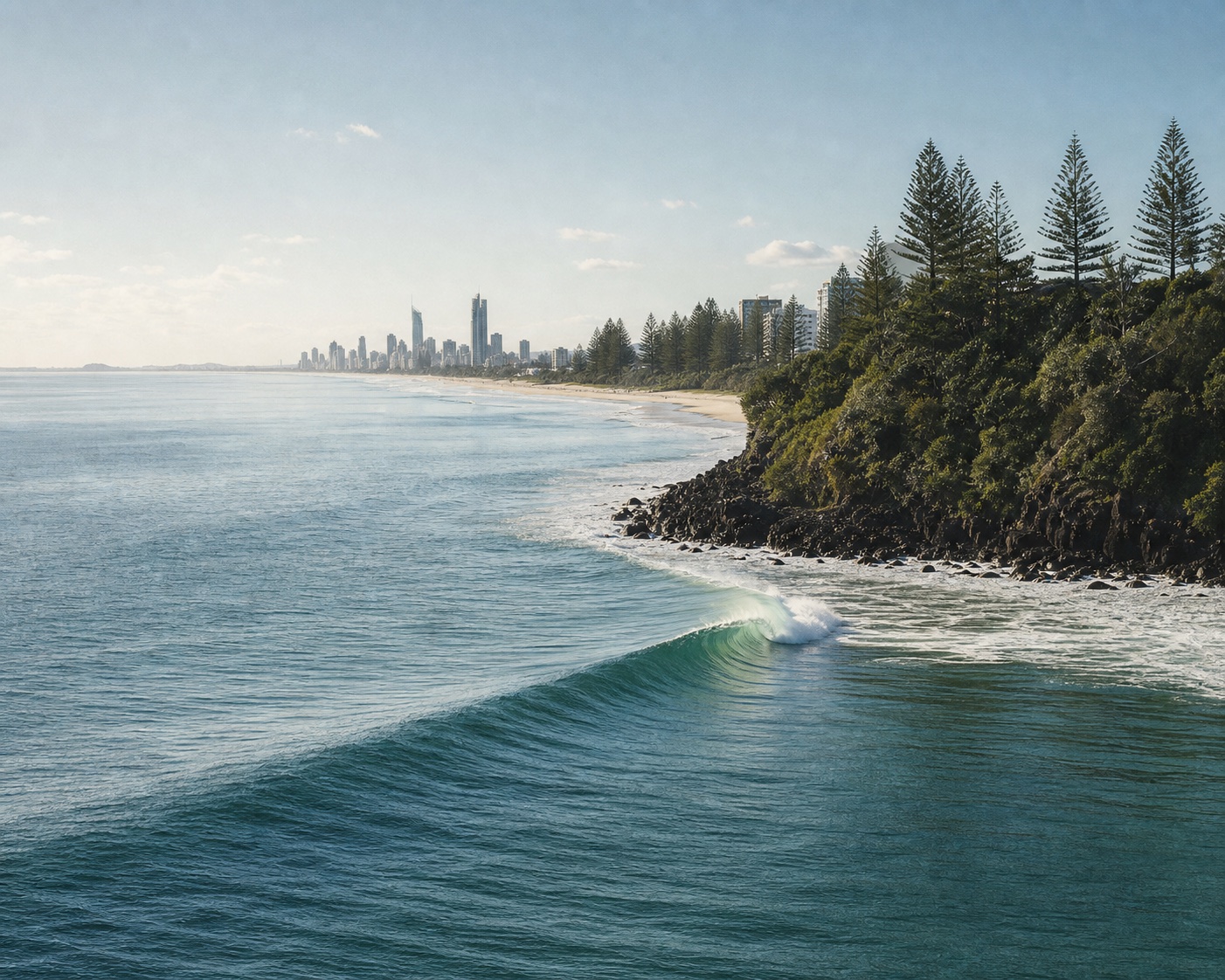
Burleigh Heads is a premier right-hand point break located on the Gold Coast of Queensland, Australia. The geomorphology consists of a prominent basalt rock headland that transitions into a highly compacted, engineered sandbank. When hit by strong south-easterly groundswells, typically generated by passing cyclones or deep low-pressure systems, the wave diffracts around the rocky point and pitches violently over the shallow sand. This bathymetry creates a remarkably heavy, cylindrical barrel immediately upon take-off, followed by a fast, reeling wall. A south-westerly offshore wind is essential to hold up the thick lip and groom the expansive wave face. The take-off zone, situated precariously close to the exposed basalt boulders, is highly congested and demands a steep, critical drop. Consequently, Burleigh Heads is strictly an advanced surfing location. It requires immense paddle fitness, split-second decision-making, and high-level tube-riding mechanics to successfully negotiate the initial hollow section and connect through to the inside cove.
Heads up: rocks exposed at low tide, and cold-shock risk.
Indicators derived from forecast data, not official warnings. Always check local lifeguard or official advice.
The air here is 63% cleaner than the average comparison city right now.
Noticeably cleaner air than a typical city. Good conditions for prolonged outdoor activity.
Not a pollutant. Ozone is naturally higher at altitude and near the coast, and lower in cities where traffic exhaust breaks it down. High readings here typically indicate clean air. Can cause short-term airway irritation during intense exercise but is not linked to the long-term health risks of particulate pollution.
Additive health score: each pollutant contributes points relative to its WHO 2021 guideline and long-term health impact (PM2.5 9, NOโ 5, Oโ 3, PM10 2, SOโ 1 at WHO limits). Data via Open-Meteo. City markers show live readings. Red line marks the WHO guideline. Updated 15:12
Moderate water clarity: ~5m visibility
Daily scores over the last 12 months at Burleigh Heads
Historical quality only. Safety is not reconstructed for this view.
Create a free profile and let employers in Burleigh Heads find you.
Create Profile โPartly. The model uses stored spot geometry, swell ranges and tide preferences where configured. It cannot see changing banks, crowds, access, closures or everything visible on a local cam, so treat it as a starting point.
The best week for surf at Burleigh Heads is the week of 2 November (score 3/5) with low crowds.
This guide was generated from conditions data. Know this spot? Submit your own tips below.
Burleigh Heads is a world-class right-hand point break on the Gold Coast of Queensland. The wave wraps around a basalt headland and barrels along the rocks, producing fast, hollow tubes. When it is on, Burleigh is one of Australia's best waves. The national park headland, warm water, and city backdrop create a unique setting. Short, intense, barrel-heavy rides.
Needs a solid east or south-east cyclone swell. A westerly or south-westerly wind is offshore. Best at mid to high tide. The 4-8ft range produces its famous barrels. Works primarily in cyclone season (January through April) and during autumn groundswells. Needs size to wrap around the headland properly.
The take-off is tight at the top of the point. The wave barrels along the rocks and runs into the beach. Positioning must be precise. Sit in the takeoff zone and commit; hesitation is punished. The inside section is less critical.
Rocky headland with a powerful wave breaking close to the rocks. Getting swept into the boulders is the main danger. Shallow reef sections. Strong currents on bigger swells. The wave is fast and powerful. Experienced surfers only on solid days.
Park at Burleigh Heads village or the national park car park. Walk around the headland to view the wave. Entry from the beach at the bottom of the point. Short paddle to the lineup.
Extremely crowded when it works. Burleigh is in the middle of a major city (Gold Coast) and attracts huge numbers. Good swells see 40-60 people. The take-off zone is tiny, creating intense competition. The local crew are aggressive and skilled. Dawn patrol is essential.
Burleigh only properly works a handful of times per year. When it does, the entire Gold Coast converges. Go at first light or do not bother. The national park walk around the headland is excellent for assessing conditions. Burleigh Village has excellent cafes and restaurants. If it is not working, check Snapper Rocks or Currumbin.
Surf at Burleigh Heads
Your score
Forecast feel
Score this window against what you actually found.
No scored surf reviews in the last 24 hours.
No recent check-ins. Be the first to report.
Log a day
Add Burleigh Heads to your private Companion record without GPS.
Combining historical conditions with school holiday crowd pressure to find the sweet spot.
The timing score combines two signals: historical conditions quality (how good the skiing or surfing typically is in a given week, based on 5 years of weather data) and crowd pressure (how many of this destination's feeder markets have school holidays that week).
Crowd pressure is weighted by each feeder country's share of visitors. If 40% of a resort's visitors come from France and France is on holiday, that contributes 0.40 to the crowd pressure score. Crowds can reduce the timing score by up to 35%, ensuring conditions still matter most.
Scores: 5 = great conditions with low crowds (the sweet spot). 4 = great conditions with moderate crowds, or good conditions with low crowds. 3 = average. 2 = below average conditions or very crowded. 1 = poor conditions or peak holiday chaos.
Last 30 days of logged conditions.
Based on historical weekly averages
Conditions at Burleigh Heads tend to be best between 07:00 to 10:00 in July.
Average score during this window: 41/100
See timing scores, school holiday busyness, and lift pass pricing to find the best time to book.
View Best Time to Go โ