United Kingdom · Atlantic Europe
Create a free profile and let employers in Brimms Ness find you.
Create Profile →Current conditions refresh every 3 hours when the cron runs. Hourly data updates every 30 minutes. The 7-day forecast, luck factor, and packing notes are all pre-computed at the same time.
We compare the 7-day forecast to the last 5 years of marine data for the same week at Brimms Ness. The delta tells you whether conditions are shaping up better, worse, or about the same as a typical early July.
We score each day of the 7-day forecast using the same algorithm as the leaderboard, and highlight the highest scorer.
Open-Meteo's Marine API (swell height, period, water temperature) and Weather API (wind and conditions).
Honestly, no. Every break has tide windows, swell directions and reef contours that a global model cannot see. Treat the score as a starting point, then check a local cam.
The best week for surf at Brimms Ness is the week of 23 November (score 3/5) with low crowds.
Barely any swell. Not much to work with today. Full onshore mess. Not worth the paddle unless you are desperate. Conditions improving through the afternoon. Not enough swell to get this spot firing properly.
Heads up: rocks exposed at low tide, and jellyfish: high.
Indicators derived from forecast data, not official warnings. Always check local lifeguard or official advice.
The air here is 90% cleaner than the average comparison city right now.
Significantly cleaner air than a typical city. Ideal for outdoor exercise with minimal respiratory strain.
Not a pollutant. Ozone is naturally higher at altitude and near the coast, and lower in cities where traffic exhaust breaks it down. High readings here typically indicate clean air. Can cause short-term airway irritation during intense exercise but is not linked to the long-term health risks of particulate pollution.
Additive health score: each pollutant contributes points relative to its WHO 2021 guideline and long-term health impact (PM2.5 9, NO₂ 5, O₃ 3, PM10 2, SO₂ 1 at WHO limits). Data via Open-Meteo. City markers show live readings. Red line marks the WHO guideline. Updated 03:00
Good water clarity: ~13m visibility
Local knowledge and community tips for Brimms Ness
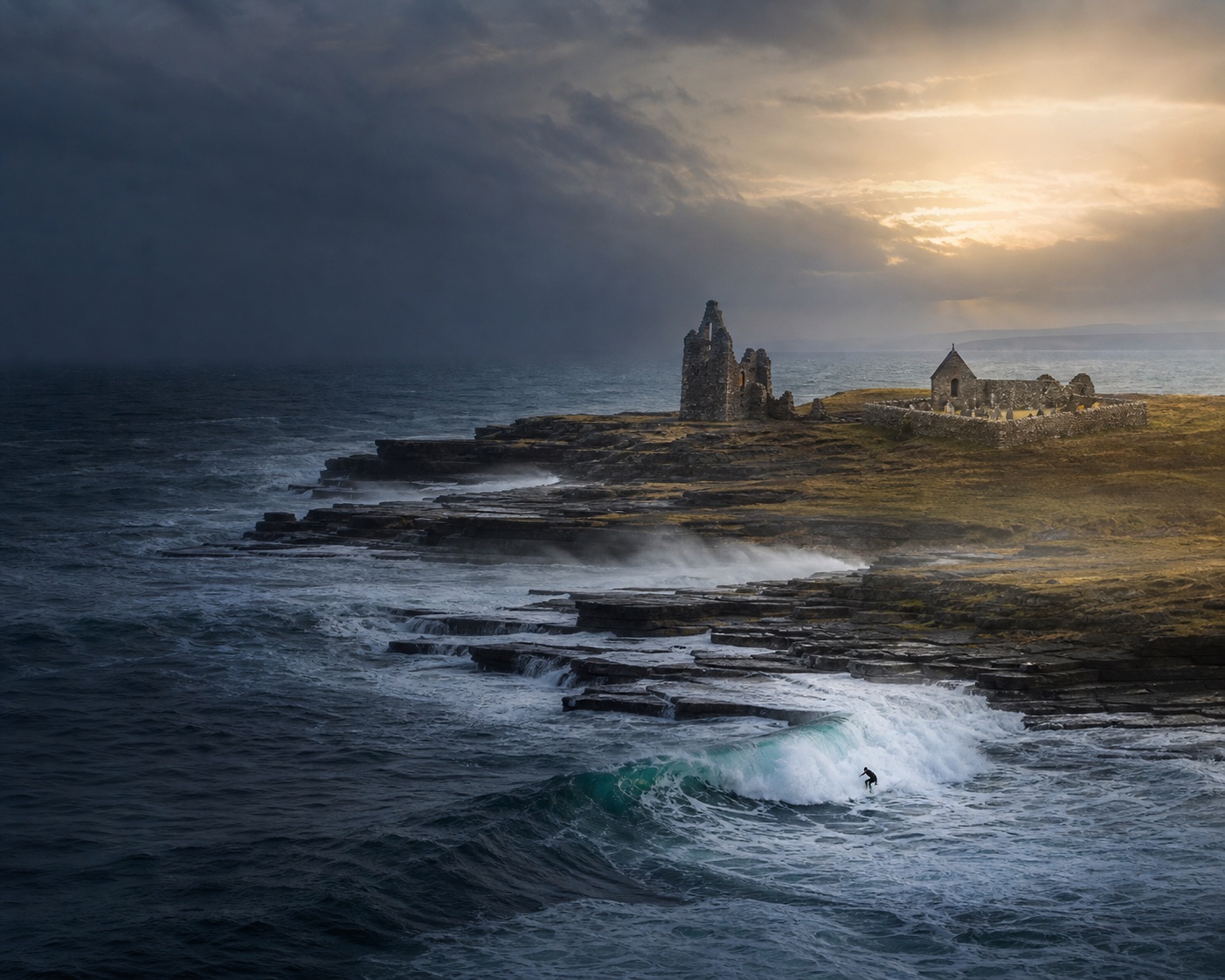
Brimms Ness is a heavy, cold-water reef break on the far north coast of Scotland, near Thurso. Flat flagstone shelves extend out into the North Atlantic, creating thick, powerful waves that barrel over shallow rock. It produces both lefts and rights depending on the swell direction. The setting is utterly remote: cliffs, sheep, and the open ocean. This is serious, high-consequence surfing in one of the UK's most challenging environments.
Needs a substantial north-westerly groundswell from deep Atlantic low-pressure systems. Works from September through April, with the biggest swells arriving in winter. A southerly offshore wind is required to hold up the thick lips. Head-high to double overhead is the sweet spot; beyond that, the consequences become extreme.
The main peak breaks over a defined section of reef. Line up with the cliff features on the shore to find the take-off zone. You need to be precise here because the wave jacks very quickly over the shallow shelf. Sitting too far inside means getting caught by sets that swing wide.
This is a serious wave. Shallow flagstone reef is directly below at all stages of tide. Mid to high tide gives more water over the shelf but the wave still throws over rock. Currents sweep along the coast and can pull you away from the take-off. Water temperatures are extreme, rarely above 8 degrees even in summer. Access involves a cliff scramble with no easy exit if you get into trouble.
Park on the clifftop verge and walk along the headland. The entry point requires climbing down rocks with your board, which is awkward and exposed. Check your exit route before paddling out because the coast here offers very few safe landing spots if you drift.
Almost deserted. You might share it with one or two Thurso locals who know the spot. The difficulty, cold, and remoteness keep numbers minimal. If you encounter another surfer, they will likely be very experienced and worth chatting to about conditions.
Never surf here alone. The isolation and heavy nature of the wave make it essential to have someone watching or in the water with you. Study the reef at low tide before surfing it. The take-off shifts slightly depending on swell size, so what works at 4ft is not the same spot at 8ft. Thurso is 20 minutes away for food, fuel, and warmth.
Surf at Brimms Ness
Your score
Forecast feel
Score this window against what you actually found.
No scored surf reviews in the last 24 hours.
No recent check-ins. Be the first to report.
Record your session, conditions and gear.
Daily scores over the last 12 months at Brimms Ness
Based on historical weekly averages
Conditions at Brimms Ness tend to be best between 05:00 to 08:00 in July.
Average score during this window: 18/100
See timing scores, school holiday busyness, and lift pass pricing to find the best time to book.
View Best Time to Go →Combining historical conditions with school holiday crowd pressure to find the sweet spot.
The timing score combines two signals: historical conditions quality (how good the skiing or surfing typically is in a given week, based on 5 years of weather data) and crowd pressure (how many of this destination's feeder markets have school holidays that week).
Crowd pressure is weighted by each feeder country's share of visitors. If 40% of a resort's visitors come from France and France is on holiday, that contributes 0.40 to the crowd pressure score. Crowds can reduce the timing score by up to 35%, ensuring conditions still matter most.
Scores: 5 = great conditions with low crowds (the sweet spot). 4 = great conditions with moderate crowds, or good conditions with low crowds. 3 = average. 2 = below average conditions or very crowded. 1 = poor conditions or peak holiday chaos.
Last 31 days of logged conditions.
Not enough data yet. Log a session to help build the accuracy score.